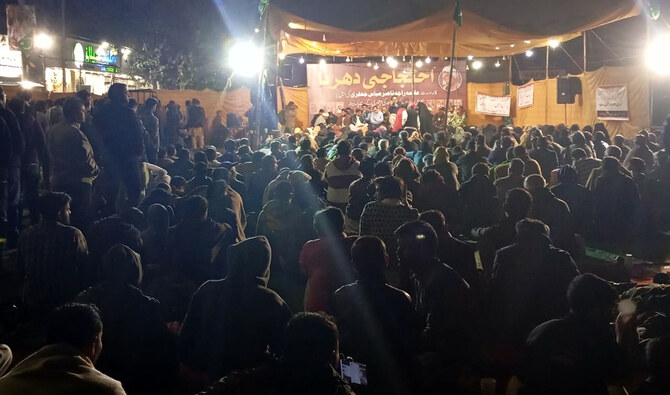
KARACHI: Sit-in protests at various locations across Pakistan’s southern port city of Karachi continued for a third consecutive day today, Sunday, with demonstrators showing solidarity with the people in Kurram district, where violence and a lack of medical access have claimed over 130 lives in recent weeks.
Kurram, a northwestern district of around 600,000 people in Khyber Pakhtunkhwa province, has long been a hotspot for tribal and sectarian violence, with authorities struggling to maintain control.
The area’s situation has necessitated travel in convoys escorted by security personnel, yet it failed to prevent an attack on Nov. 21, when gunmen ambushed a convoy, killing 52 people. The attack sparked further violence and road closures, restricting access to medicine, food and fuel in the region.
A grand jirga, or council of political and tribal elders, has attempted to mediate between rival factions, as protests in Parachinar, the main city in Kurram, spread to Karachi on Friday where demonstrators held sit-in protests at 10 different locations in the city.
“Protest demonstrations due to the Parachinar incident in Karachi city are ongoing,” Karachi Traffic Police said in an advisory, urging citizens to avoid traveling unnecessarily in certain locations across the metropolis.
The protests have been called by the Majlis-e-Wahdatul Muslimeen (MWM), a Shia organization, with demonstrators blocking main thoroughfares, including Shahrah-e-Faisal, which connects the airport to the city’s Red Zone, home to sensitive government installations, and major hotels.
Another area that has been choked is Numaish, a vital junction linking the city’s central district to its commercial hubs.
“Passengers are requested to exercise patience and refrain from going to locations where the demonstrations are taking place,” the traffic police said.
MWM’s Karachi spokesperson, Syed Ahmad Naqvi, told Arab News on Saturday that the protests would continue as long as the Parachinar protests persist.
“Large-scale protests in Karachi highlight the situation in Kurram, where many precious lives have been lost in recent weeks but have received no attention,” he said.
Meanwhile, Karachi Mayor Murtaza Wahab criticized demonstrators for disrupting daily life in the city.
“If the aim of a protest is to inconvenience people, disrupt a city’s system, prevent ambulances and fire brigades from operating, or hinder police and administrative vehicles, then I believe this is inappropriate,” Wahab told Arab News on Saturday.


![]()

Sit-in protests in solidarity with violence-hit Kurram district enter third day in Karachi
Short Url
https://arab.news/m2vxc
Sit-in protests in solidarity with violence-hit Kurram district enter third day in Karachi
- Demonstrators call protests in Karachi vital to draw attention to ‘overlooked’ crisis in Kurram
- Traffic police urges citizens to avoid traveling unnecessarily in protest areas, exercise patience
Latest updates


© 2026 SAUDI RESEARCH & PUBLISHING COMPANY, All Rights Reserved And subject to Terms of Use Agreement.