ISLAMABAD: Bilawal Bhutto-Zardari, chairman of a main party in the ruling coalition, on Friday criticized “foreign interference” in Pakistan’s politics, saying that its real target was the South Asian country’s nuclear program.
Bhutto-Zardari’s statement came days after US President-elect Donald Trump’s special envoy nominee Richard Grenell urged President Joe Biden’s administration to use its last days in power to push for former prime minister Imran Khan’s release from prison so he could run for office in Pakistan.
Grenell has been in the news in Pakistan in recent weeks over social media posts calling for the release of Khan. His comments came more than a week after the US State Department imposed sanctions on four entities related to nuclear-armed Pakistan’s long-range ballistic-missile program, including on the state-owned defense agency that oversees the program.
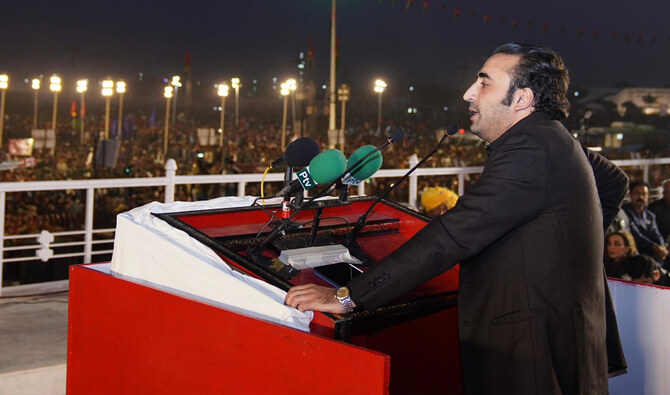
Speaking at his Pakistan Peoples Party rally in Larkana, Bhutto-Zardari said Pakistan was currently facing internal issues, economic crisis and a surge in militancy as well as several difficulties on the external front, which required unity of all political stakeholders.
“No one is worried about Pakistan’s democracy, human rights or about a prisoner in Pakistan,” he said, without naming anyone.
“Imran [Khan] is only an excuse, but the target is Pakistan’s atomic program.”
Bhutto-Zardari said Pakistan’s opponents were looking at the country’s nuclear capability with an “evil eye.”
“They wish that no Muslim country should have such [nuclear] power and they are trying to deprive you of this power some way or the other,” he said.
“As long as the Pakistan Peoples Party is there, we will not let anyone make a compromise on our atomic power.”
Speaking to reporters on Thursday, Pakistan’s Foreign Office Spokesperson Mumtaz Zahra Baloch declined to comment on Grenell’s statement, while Pakistan’s Defense Minister Khawaja Asif this week alleged that Western voices backed by Israel were demanding Khan’s release from prison as part of an “anti-Pakistan campaign.”
Pakistan has been gripped by political unrest and uncertainty since Khan’s ouster from power through a parliamentary no-confidence vote in April 2022. He blames his removal from the PM’s office on his political rivals led by PM Shehbaz Sharif and the all-powerful military. Both reject the charge.
Khan has been in jail since August last year on a slew of cases he says are politically motivated to keep him away from power.

Head of coalition party slams ‘foreign interference’ in Pakistani politics, vows to defend nuclear program
https://arab.news/9tbfy
Head of coalition party slams ‘foreign interference’ in Pakistani politics, vows to defend nuclear program
- Bhutto-Zardari’s statement comes days after the US imposed sanctions on entities related to nuclear-armed Pakistan’s missile program
- It also follows Trump nominee Richard Grenell’s call for the US administration to push for ex-PM Imran Khan’s release from Pakistan jail
Pakistan raises fuel prices by Rs55 per liter as Middle East conflict drives oil surge
- Government says adequate fuel stocks in place despite global energy shock
- Oil prices jump from about $78 to over $106 per barrel amid regional conflict
ISLAMABAD: Pakistan on Friday increased petrol and diesel prices by Rs55 ($0.20) per liter each as escalating conflict in the Middle East sent global oil prices sharply higher and disrupted energy supply routes, officials said.
Global oil markets have been rattled since coordinated strikes by the United States and Israel against Iran began last week, triggering retaliatory attacks across the region, raising fears of disruption to key energy shipping routes and pushing petroleum prices sharply upward.
The price adjustment in Pakistan was announced after a joint press conference by Finance Minister Muhammad Aurangzeb, Deputy Prime Minister and Foreign Minister Ishaq Dar and Petroleum Minister Ali Pervaiz Malik, who said the government was monitoring international energy markets and domestic supply conditions amid the crisis.
“So, the decision we have made by changing the levy a little bit is that we are going ahead with increasing the price of both fuels, petrol and diesel, by Rs55 ($0.20),” Malik told reporters.
“And as soon as this matter settles, we will revise the prices downward with the same speed and take steps on how to increase people’s income and purchasing power.”
He said Pakistan entered the crisis with “comfortable energy reserves” due to earlier planning but rising global prices had forced the government to adjust domestic fuel rates to maintain supply continuity.
He said international petrol prices had climbed from roughly $78 per barrel on March 1 to around $106.8 per barrel, while diesel prices had risen to about $150 per barrel.
Malik added that the government had taken steps to minimize the burden on consumers, noting diesel plays a critical role in agriculture, transportation and public mobility.
Malik also warned that authorities would take strict action against anyone attempting to hoard fuel or manipulate supply for profiteering.
The minister said Pakistan was working with international partners to secure additional energy supplies, including arrangements with Saudi Aramco and the use of Pakistan National Shipping Corporation vessels to transport crude oil imports.
Finance Minister Aurangzeb said a high-level government committee formed by Prime Minister Shehbaz Sharif had been meeting daily to review developments in global petroleum markets and their potential impact on Pakistan’s economy.
“Pakistan currently maintains adequate energy stocks and macroeconomic stability,” Aurangzeb said, adding that the government’s response was based on preparedness rather than panic.
He said the committee, which includes senior ministers, the governor of the State Bank of Pakistan and other officials, was assessing short-, medium- and long-term implications of the crisis for inflation, foreign exchange reserves and broader economic indicators.
Deputy PM Dar said the regional conflict had significantly disrupted global energy markets, with international petroleum prices rising by as much as 50–70 percent in recent days.
The deputy prime minister added that Pakistan was also engaged in diplomatic efforts aimed at de-escalating tensions and restoring stability in the region.
Petroleum prices will now be reviewed more frequently, potentially on a weekly basis, and any reduction in global oil prices would be passed on to consumers.
Pakistan, which relies heavily on imported fuel to meet its energy needs, is particularly vulnerable to global oil price shocks that can quickly feed into inflation and pressure the country’s external accounts.


