Bloodied Ukrainian troops risk losing more hard-won land in Kursk to Russia

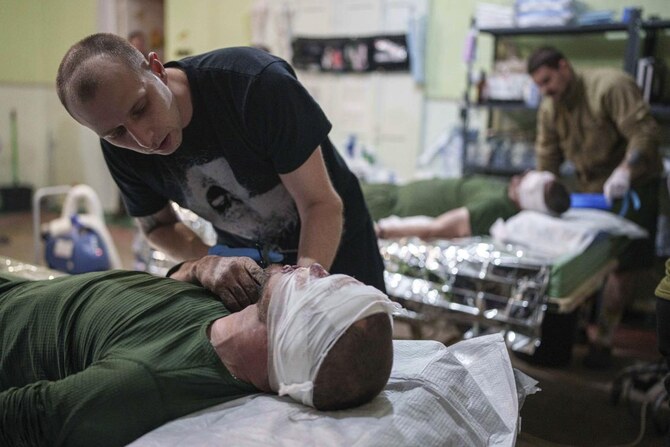
A medic treats an injured Ukrainian serviceman on Pokrovsk direction in Ukraine on Dec. 23, 2024. (AP)
Short Url
Updated 28 December 2024
Follow

Bloodied Ukrainian troops risk losing more hard-won land in Kursk to Russia

  • Battles are so intense that some Ukrainian commanders cannot evacuate the dead
  • Communication lags and poorly timed tactics have cost lives, and troops have little way to counterattack

KYIV: Five months after their shock offensive into Russia, Ukrainian troops are bloodied and demoralized by the rising risk of defeat in Kursk, a region some want to hold at all costs while others question the value of having gone in at all.
Battles are so intense that some Ukrainian commanders can’t evacuate the dead. Communication lags and poorly timed tactics have cost lives, and troops have little way to counterattack, seven front-line soldiers and commanders told The Associated Press on condition of anonymity so they could discuss sensitive operations.
Since being caught unaware by the lightning Ukrainian incursion, Russia has amassed more than 50,000 troops in the region, including some from its ally North Korea. Precise numbers are hard to obtain, but Moscow’s counterattack has killed and wounded thousands and the overstretched Ukrainians have lost more than 40 percent of the 984 square kilometers (380 square miles) of Kursk they seized in August.
Its full-scale invasion three years ago left Russia holding a fifth of Ukraine, and Ukrainian President Volodymyr Zelensky has hinted that he hopes controlling Kursk will help force Moscow to negotiate an end to the war. But five Ukrainian and Western officials in Kyiv who spoke on condition of anonymity to freely discuss sensitive military matters said they fear gambling on Kursk will weaken the whole 1000-kilometer front line, and Ukraine is losing precious ground in the east.
“We have, as they say, hit a hornet’s nest. We have stirred up another hot spot,” said Stepan Lutsiv, a major in the 95th Airborne Assault Brigade.
The border raid that became an occupation
Army chief Oleksandr Syrskyi has said that Ukraine launched the operation because officials thought Russia was about to launch a new attack on northeast Ukraine.
It began on Aug. 5 with an order to leave Ukraine’s Sumy region for what they thought would be a nine-day raid to stun the enemy. It became an occupation that Ukrainians welcomed as their smaller country gained leverage and embarrassed Russian President Vladimir Putin.
Gathering his men, one company commander told them: “We’re making history; the whole world will know about us because this hasn’t been done since World War II.
Privately, he was less certain.
“It seemed crazy,” he said. “I didn’t understand why.”
Shocked by success achieved largely because the Russians were caught by surprise, the Ukrainians were ordered to advance beyond the original mission to the town of Korenevo, 25 kilometers into Russia. That was one of the first places where Russian troops counterattacked.
By early November the Russians began regaining territory rapidly. Once in awe of what they accomplished, troops’ opinions are shifting as they come to terms with losses. The company commander said half of his troops are dead or wounded.
Some front-line commanders said conditions are tough, morale is low and troops are questioning command decisions, even the very purpose of occupying Kursk.
Another commander said that some orders his men have received don’t reflect reality because of delays in communication. Delays occur especially when territory is lost to Russian troops, he said.
“They don’t understand where our side is, where the enemy is, what’s under our control, and what isn’t,” he said. “They don’t understand the operational situation, we so act at our own discretion.”
One platoon commander said higher ups have repeatedly turned down his requests to change his unit’s defensive position because he knows his men can’t hold the line.
“Those people who stand until the end are ending up MIA,” he said. He said he also knows of at least 20 Ukrainian soldiers whose bodies had been abandoned over the last four months because the battles were too intense to evacuate them without more casualties.
No option to retreat as Russia doubles down
Ukrainian soldiers said they were not prepared for the aggressive Russian response in Kursk, and cannot counterattack or pull back.
“There’s no other option. We’ll fight here because if we just pull back to our borders, they won’t stop; they’ll keep advancing,” said one drone unit commander.
The AP requested comment from Ukraine’s General Staff but did not receive a response before publication.
American longer-range weapons have slowed the Russian advance and North Korean soldiers who joined the fighting last month are easy targets for drones and artillery because they lack combat discipline and often move in large groups in the open, Ukrainian troops said.
On Monday, Zelensky said 3,000 North Korean soldiers had been killed and wounded. But they appear to be learning from their mistakes, soldiers added, by becoming more adept at camouflaging near forested lines.
One clash took place last week near Vorontsovo tract, a forested area between the settlements of Kremenne and Vorontsovo.
Until last week, the area was under Ukraine’s control. This week part of it has been lost to Russian forces and Ukrainian troops fear they will reach a crucial logistics route.
Eyeing frontline losses in the eastern region known as the Donbas — where Russia is closing on a crucial supply hub — some soldiers are more vocal about whether Kursk has been worth it.
“All the military can think about now is that Donbas has simply been sold,” the platoon commander said. “At what price?”


US intel did not suggest a preemptive strike from Iran before US-Israeli attacks, AP sources say

Updated 02 March 2026
Follow

US intel did not suggest a preemptive strike from Iran before US-Israeli attacks, AP sources say

  • The official said a variety of factors created a golden opportunity to take out much of Iran’s leadership

WASHINGTON: Trump administration officials told congressional staff in private briefings Sunday that US intelligence did not suggest Iran was preparing to launch a preemptive strike against the US, three people familiar with the briefings said.
The administration officials instead acknowledged there was a more general threat in the region from Iran’s missiles and proxy forces, two of the people said. The third person, however, said the administration emphasized that Iran’s missiles and proxy forces posed an imminent threat to US personnel and allies in the region.
The officials did not provide any clarity about what would happen next in Iran after the joint US-Israeli operation, the two people said. All three people insisted on anonymity to discuss details that have not been made public.
The information conveyed to the congressional staff contrasts with the message from President Donald Trump. “Our objective is to defend the American people by eliminating imminent threats from the Iranian regime. A vicious group of very hard, terrible people,” he said in a video message after launching strikes on Iran.
Senior Trump administration officials, who like others were not authorized to comment publicly and spoke on condition of anonymity, had told reporters Saturday that there were indicators that the Iranians could launch a preemptive attack.
The White House and Pentagon did not immediately reply to requests for comment on Sunday night. Details of the briefing were first reported by Politico.
On Tuesday, Secretary of State Marco Rubio, Defense Secretary Pete Hegseth, CIA Director John Ratcliffe and Gen. Dan Caine, chairman of the Joint Chiefs of Staff, will brief the full membership of Congress on the US military operation against Iran, the White House said Sunday. Rubio also was slated to brief Hill leadership Monday, the same day Hegseth and Caine are planning a press conference about the operation.
Three strikes, three locations, within a single minute
The military operation came after authorities from Israel and the US spent weeks tracking the movements of senior Iranian leaders, including Supreme Leader Ayatollah Ali Khamenei, and shared information that allowed the strikes to be carried out in a surprise daylight attack, according to an Israeli military official and another person familiar with the operation.
The eventual barrage of US-Israeli attacks on Iran came so quickly that they were nearly simultaneous — with three strikes in three locations hitting within a single minute — killing Khamenei and some 40 senior figures, including the head of the paramilitary Revolutionary Guard and the country’s defense minister, the Israeli military official said Sunday.
The official said a variety of factors created a golden opportunity to take out much of Iran’s leadership, like weeks of training and monitoring the movements of senior figures as well as intelligence in real-time before the attack began that key targets were gathered together.
Striking by day also gave an additional element of surprise, said the official, who said so many major, rapid-fire strikes were critical to keep key officials from fleeing after the first strike. The official said Israel closely cooperated with its US counterparts and had used a similar tactic at the beginning of last June’s war — which resulted in the killing of several senior Iranian figures.
The official also noted Khamenei having posted defiant tweets taunting President Donald Trump in the days before the attack.
The details about the strikes came as the conflict entered its second day, with Trump saying in a video message Sunday that he expected it would continue until “all of our objectives are achieved.” He did not spell out what those objectives were.
The Republican president also said the US military and its partners hit hundreds of targets in Iran, including Revolutionary Guard facilities, Iranian air defense systems and nine warships, “all in a matter of literally minutes.”
CIA had long tracked top Iranian leaders
Before the attacks, the CIA had for months tracked the movements of senior Iranian leaders, including Khamenei.
The intelligence was shared with Israeli officials, and the timing of the strikes was adjusted in part because of that information about the Iranian leaders’ location, according to the person familiar with the planning.
The intelligence-sharing between US and Israel reflects the preparation that went into the strikes, which threw the future of the Islamic Republic into uncertainty and raised the risk of escalating regional conflict.
The US regularly shares intelligence with allies including Israel. Those partnerships, and the accuracy of the intelligence they yield, is often critical not only to the success of a military operation but also to the public’s support for it.
Virginia Sen. Mark Warner, the senior Democrat on the committee, told The Associated Press that, historically, “our working relationship with the Mossad and Israel is really strong.” Mossad is the Israeli spy agency.
Warner said he has serious concerns about the justification for the strikes, Trump’s long-term plans for the conflict and the risks that US service members will face. The military announced Sunday that three American troops had been killed in the Iran operation.
“No tears will be shed over their leadership being eliminated, but always the question is: OK, what next?” Warner said.
Iran has signaled it’s open to talks with the US
A senior White House official said Iran’s “new potential leadership” has suggested it is open to talks with the United States. That official, who spoke on condition of anonymity to discuss internal administration deliberations, said Trump has indicated he’s “eventually” willing to talk but that for now the military operation “continues unabated.”
The official did not say who the potential new Iranian leaders are or how they made their alleged willingness to talk known. Separately, Trump told The Atlantic that he planned to speak with Iran’s new leadership.
“They want to talk, and I have agreed to talk, so I will be talking to them,” he said Sunday, declining comment on the timing.