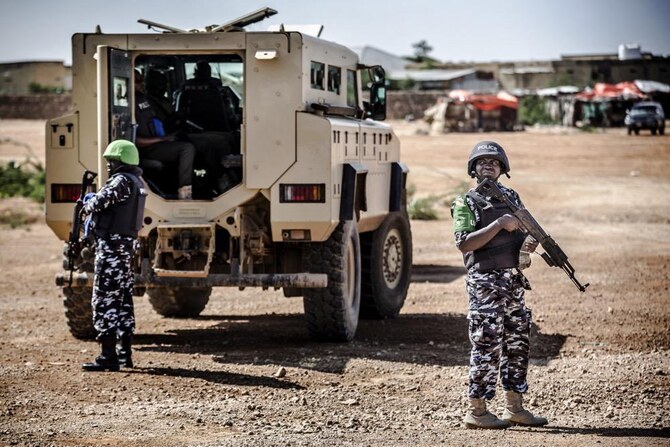
UN: The UN Security Council on Friday gave the green light to a new African Union force in Somalia that is meant to take on the Islamist armed group Al-Shabab, with the soldiers due to deploy in January.
The resolution was adopted by 14 of the Council’s 15 member states, while the United States abstained due to reservations about funding.
It provides for the replacement of the African Union Transition Mission in Somalia (ATMIS), whose mandate ends on December 31, by the African Union Support and Stabilization Mission in Somalia (AUSSOM).
Somalia is one of the world’s poorest countries, enduring decades of civil war, a bloody insurgency by the Al-Qaeda-linked Al-Shabab, and frequent climate disasters.
Representatives from Somalia and its western neighbor Ethiopia were invited to participate in the council’s meeting, although they were not allowed to vote.
“We emphasize that the current AUSSOM troops allocations are completed through bilateral agreements,” said the Somali representative, adding 11,000 troops were currently pledged.
On Monday, Egypt’s foreign minister announced his country would take part in the new force.
Tensions flared in the Horn of Africa after Ethiopia signed a maritime deal in January with the breakaway region of Somaliland, pushing Mogadishu closer to Addis Ababa’s regional rival Cairo.
This month, Turkiye brokered a deal to end the nearly year-long bitter dispute between Somalia and Ethiopia, although Ethiopian troops would not be involved in the new AU force.
Burundi will not be taking part in the new force either, a Burundian military source told AFP on condition of anonymity.
The text adopted by the UN Security Council provides for the possibility of using a mechanism that it created last year, under which an African force deployed with the green light of the UN can be up to 75 percent financed by the UN.
“In our view, the conditions have not been met for immediate transition to application of” that measure, US representative Dorothy Shea said, justifying her country’s abstention.


UN approves new African Union force to take on Al-Shabab in Somalia
https://arab.news/8xz9q
UN approves new African Union force to take on Al-Shabab in Somalia


Flash floods in Nairobi kill 23, disrupt flights at major airport
- Ruto said he had deployed a team of emergency responders, including soldiers, to coordinate rescue efforts
- “I have also ordered that relief food from our national strategic reserves be immediately released”
NAIROBI: Aid workers pulled bodies from floodwaters across Nairobi on Saturday after flash floods that began overnight killed at least 23 people, swept away dozens of cars and disrupted flights at East Africa’s biggest airport, authorities said.
Kenyan President William Ruto said he had deployed a team of emergency responders, including soldiers, to coordinate rescue efforts, while offering condolences to the affected communities.
“I have also ordered that relief food from our national strategic reserves be immediately released and distributed to families affected by the floods,” he said in a statement on social media.
In the industrial neighborhood of Grogan, security guard John Lomayan, 34, looked at the body of an elderly man he recognized — a roadside egg seller — trapped beneath a car that had been washed away when the Nairobi River burst its banks.
“I saw him being carried by the water from up there,” he said, gesturing up the road. “We didn’t know where he had gone. It is only now that we see him under the car.”
Bus driver John Mwai recounted how he turned his bus into a rescue vehicle to move people to higher ground.
Kenya Airways said the rains had disrupted flights to Nairobi and forced some to divert to the coastal city of Mombasa.
Scientists say global warming is worsening floods and droughts across East Africa by concentrating rainfall into shorter, more intense bursts. A 2024 World Weather Attribution study found climate change had made devastating rains in the region twice as likely as before.
A Reuters reporter saw three bodies pulled from underneath cars. Some of the dead had been electrocuted by damaged power lines. National provider Kenya Power separately said the waters had damaged equipment at a substation, listing 14 neighborhoods that had been affected.
“So many cars, so much stuff, I don’t know. Everything was just (washed away). All of the water (came) ... from that river,” shocked resident Cedric Mwanza said, referring to the Nairobi River.