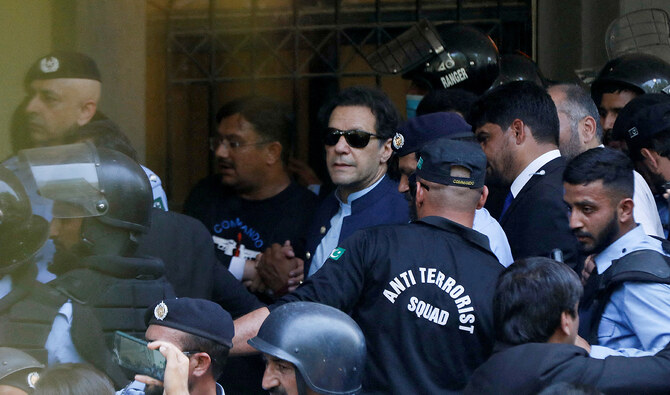
ISLAMABAD: Former Prime Minister Imran Khan, who has been in jail for well over a year, said in a social media post on Friday he rejected a house arrest deal, as he also urged Pakistanis abroad to boycott remittances in protest against the country’s political situation.
Khan’s statement comes only a few days after the government began formal negotiations with his Pakistan Tehreek-e-Insaf (PTI) party to address mutual differences and ease the country’s growing political polarization.
Talks began after Khan threatened civil disobedience, urging overseas Pakistanis to halt remittances unless the government freed PTI political prisoners and formed judicial commissions to probe violent protests on May 9 and Nov. 26, blamed on his supporters.
His latest message hints at a backchannel offering “a deal,” without naming interlocutors.
“The proposal I received for a deal was: ‘Negotiate with us, and we will give your party political space, but you will be placed under house arrest and moved to [your] Bani Gala [residence],’” read a message posted from Khan’s account on X, formerly Twitter.
“My response was that all other political prisoners must first be released. I would rather stay in jail than accept any deal. I will neither go into house arrest nor to any jail in Khyber Pakhtunkhwa,” he added, referring to the province ruled by his party.
Khan doubled down on his call for overseas Pakistanis to boycott remittances, framing it as part of a campaign for “true freedom and the restoration of democracy.” It is not clear how his stance might affect the ongoing negotiations between his party and the government.
“Currently, the government is playing ‘committee after committee’ regarding our demands,” he said, adding that the boycott campaign would be halted if negotiations produced positive results.
Khan also assured his supporters that the coming year would bring better prospects for democracy in the country while pledging to remain steadfast.
Criticizing military trials and recent sentencing of his party supporters arrested in the wake of the May 9 protest last year, Khan said they had violated basic rights of civilians and caused international embarrassment for Pakistan.
“If these trials had been conducted in open courts, the video footage of the events of May 9 would have had to be presented,” he said, adding transparent trials were also guaranteed in Pakistan’s constitution.
Hundreds of people carrying flags of Khan’s party attacked government and military installations last year on May 9 after he was briefly detained on corruption charges.
The government is yet to react to the former premier’s statement.


![]()

Imran Khan says he declined house arrest, urges overseas Pakistani to halt remittances
Short Url
https://arab.news/y52fg
Imran Khan says he declined house arrest, urges overseas Pakistani to halt remittances
- Ex-PM’s social media post hints at a backchannel offering him a ‘deal,’ without naming interlocutors
- Khan criticizes military trials and sentencing of supporters, says the proceedings violated basic rights
Latest updates


© 2026 SAUDI RESEARCH & PUBLISHING COMPANY, All Rights Reserved And subject to Terms of Use Agreement.