

On death anniversary, Pakistani leaders remember Benazir Bhutto, first woman PM in Muslim world

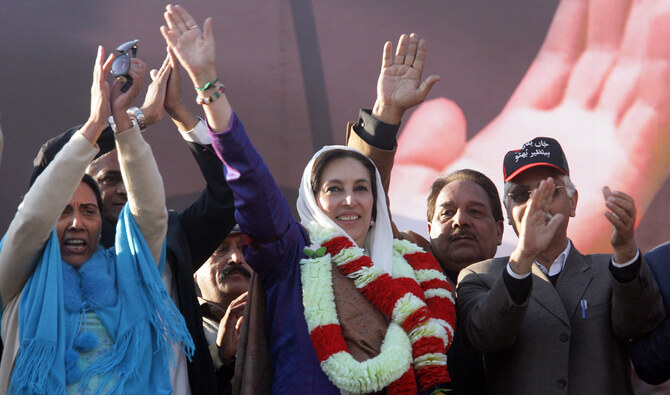
Pakistani former premier Benazir Bhutto (C) waves to her supporters during her last election compaign rally in Rawalpindi, Pakistan, on December 27, 2007. (AFP/File)
Short Url
Updated 27 December 2024
Follow

On death anniversary, Pakistani leaders remember Benazir Bhutto, first woman PM in Muslim world

  • Bhutto was daughter of ex-PM Zulfikar Ali Bhutto who was hanged during reign of former military ruler Gen. Zia-ul-Haq
  • Year before assassination in 2007, Bhutto signed landmark deal with rival Nawaz Sharif to prevent army interventions

ISLAMABAD: Prime Minister Shehbaz Sharif and other Pakistani leaders on Friday paid tribute to Benazir Bhutto, the first woman prime minister in the Muslim world who was assassinated 17 years ago in a gun and bomb attack after a rally in the city of Rawalpindi.
Bhutto, born on Jun. 21, 1953, was elected premier for the first time in 1988 at the age of 35. She was deposed in 1990, re-elected in 1993, and ousted again in 1996 amid charges of corruption and mismanagement, which she denied as being politically motivated.
Bhutto only entered politics after her father was hanged in 1979 during military ruler Gen. Zia-ul-Haq’s reign. Throughout her political career, she had a complex and often adversarial relationship with the now ruling Sharif family, but despite the differences signed a ‘Charter of Democracy’ in 2006 with three-time former PM Nawaz Sharif, with a pledge to strengthen democratic institutions and prevent military interventions in Pakistan in the future. She was assassinated a year and a half later.
“Today, we commemorate the 17th anniversary of the martyrdom of Shaheed Mohtarma Benazir Bhutto,” PM Shehbaz Sharif, who is Nawaz’s younger brother, said in a post on X. “A champion of democracy, and a staunch advocate of the power of dialogue and reconciliation in the political process, Mohtarma Benazir Bhutto remains an icon of courage and resilience.”

President Asif Ali Zardari, Bhutto’s widower, urged the nation to draw inspiration from the late premier and work to realize her “dream of a peaceful, progressive, and democratic Pakistan.”
“On this day, we honor a leader who embodied the very spirit of hope, resilience, and unwavering commitment to the ideals of democracy and justice,” he was quoted as saying by Radio Pakistan.
“Mohtarma Benazir Bhutto was a trailblazer who dreamt of a Pakistan where the rights of all citizens, irrespective of color, class and creed, would be protected.”
Powerful families from the Bhuttos and Sharifs of Pakistan to the Gandhis of India and the Bandaranaike family of Sri Lanka have dominated politics in this diverse region since independence from British colonial rule. But none have escaped tragedy at the hands of rebels, militants or ambitious military leaders.
It was Zulfikar Ali Bhutto who founded the troubled Bhutto dynasty, becoming the country’s first popularly elected prime minister before being toppled by the army in 1977 and later hanged. Both his sons died in mysterious circumstances.
Before her assassination on Dec. 27, 2007, Bhutto survived another suicide attack on her motorcade that killed nearly 150 people as she returned to Pakistan after eight years in exile in October 2007.
Bhutto’s Oxford-educated son Bilawal Bhutto Zardari, 36, is now leading her Pakistan Peoples Party, founded by her father, and was foreign minister in the last administration of Shehbaz Sharif.
Pakistan has been ruled by military regimes for almost half its history since independence from Britain in 1947. Both former premier Imran Khan and the elder Sharif, Nawaz, have alleged that they were ousted by the military after they fell out with the generals. The army says it does not interfere in politics.


Pakistan transporters call off five-day strike after successful talks with Punjab government

Updated 12 December 2025
Follow

Pakistan transporters call off five-day strike after successful talks with Punjab government

  • Transporters went on strike against heavy fines, penalties imposed by Punjab over traffic violations
  • Punjab government sets up committee to resolve transporters issues, confirms provincial minister

ISLAMABAD: Pakistani goods transporters called off their five-day-long nationwide strike on Friday after successful talks with the Punjab government, officials and transporters confirmed, as the business community warned of an impending economic crisis if the dispute stayed unresolved. 

Transporters went on a nationwide strike on Dec. 8 against stringent traffic rules and heavy fines imposed by the Punjab government over traffic violations. These penalties were included in the Motor Vehicle Ordinance 2025 last month. 

The ordinance details hefty fines ranging from Rs2000 [$7] to Rs50,000 [$178] and mentions prison sentences going up to six months for various offenses committed by drivers, such as driving on the wrong side of the road or driving in vehicles with tinted windows. 

“Yes, the strike has been called off after our meeting with Senior Minister of Punjab Marriyum Aurangzeb,” Nabeel Tariq, president of the All Pakistan Goods Transport Association (APGTA), told Arab News. 

Tariq said fines ranging from Rs1000 ($3.6) to Rs1500 ($5.4) for traffic violations have been increased to around Rs20,000 ($71.3) as per the new rules. 

He said the APGTA has agreed to accept a 100 percent or even 200 percent hike in fines. However, he said an increase of 2000 percent was not “logical.”

“Our urgent demands have been accepted and a committee has been formed to review the ordinance and come up with recommendations,” Tariq said. 

Speaking to Arab News, Aurangzeb confirmed the strike had been called off after talks with the Punjab government and that a committee has been formed to resolve the transporters’ issues. 

The committee will be headed by Aurangzeb and will include representatives of goods transporters, a statement issued by her office said. 

“The government wants to protect human lives and make things better for all citizens,” the statement said. “We will resolve the issues (with transporters) amicably.” 

‘UNPRECEDENTED CRISIS’

Pakistan’s business and industrial community, meanwhile, warned of an impending crisis if the disputed was not resolved. 

The All Pakistan Textile Mills Association (APTMA) and the Karachi Chamber of Commerce and Industry (KCCI) have both appealed for immediate government intervention.

Imdad Hussain Naqvi, president of the Grand Transport Alliance Pakistan (GTAP), told Arab News that over 400,000 goods carriers had been stranded across Pakistan due to the strike, affecting supplies to millions of consumers.

Earlier, in a letter to Punjab Chief Minister Maryam Nawaz, APTMA Chairman Kamran Arshad said the strike has “critically impacted import and export operations which are backbone of the country’s economy.”

He said hundreds of cargo vehicles remain stranded across Punjab, creating “abnormal delays” in goods movement and triggering heavy demurrage, detention charges, missed vessels and production shutdowns due to the non-availability of raw materials.

Arshad warned the disruption poses “a serious risk of order cancelation of export orders by international buyers, which would have far-reaching consequences for Pakistan’s foreign exchange earnings.”

Meanwhile in Pakistan’s commercial hub Karachi, KCCI President Rehan Hanif issued an even stronger warning, saying the nationwide strike threatens to paralyze Pakistan’s economic lifeline. 

“The complete suspension of cargo movement is pushing Pakistan toward an unprecedented trade and industrial crisis,” Hanif said in a statement. 

He added that import and export consignments are now stranded at the city’s ports, highways and industrial zones.