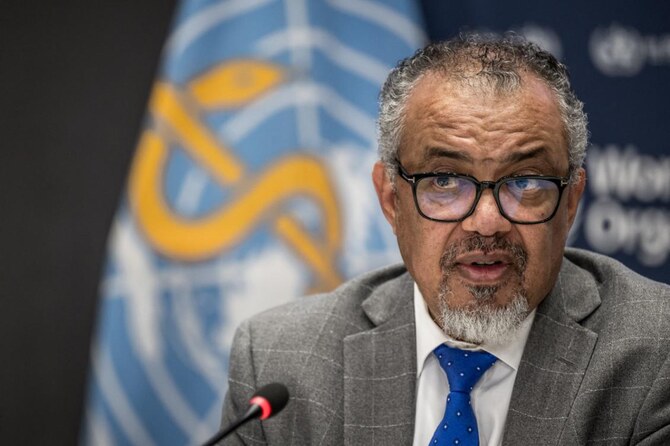
GENEVA: The head of the World Health Organization, who was at the Sanaa airport in Yemen amid an Israeli bombardment on Thursday, said there was damage to infrastructure but he remained safe.
“One of our plane’s crew members was injured. At least two people were reported killed at the airport,” Tedros Adhanom Ghebreyesus posted on X.
Other UN staff were also safe but their departure was delayed until repairs could be made, he added.
Tedros was in Yemen as part of a mission to seek the release of detained UN staff and assess the health and humanitarian situations in the war-torn country.
He said the mission “concluded today,” and “we continue to call for the detainees’ immediate release.”
While about to board their flight, he said “the airport came under aerial bombardment.”
“The air traffic control tower, the departure lounge — just a few meters from where we were — and the runway were damaged.”
The Israeli air strikes came a day after the latest attacks on Israel by Iran-backed Houthis.
The Houthi-held capital’s airport was struck by “more than six” attacks with raids also targeting the adjacent Al-Dailami air base, a witness told AFP.

WHO chief says he is safe after Sanaa airport bombardment
Short Url
https://arab.news/48jtv
WHO chief says he is safe after Sanaa airport bombardment
- Tedros was in Yemen as part of a mission to seek the release of detained UN staff and assess the health and humanitarian situations in the war-torn country
Hamas official says Miami talks must end Israel’s Gaza truce ‘violations’
GAZA CITY: A top Hamas official said that talks in Miami on Friday to advance the next phase of the Gaza ceasefire must aim to end Israeli truce “violations” in the Palestinian territory.
US President Donald Trump’s special envoy, Steve Witkoff, is to meet senior officials from Qatar, Egypt and Turkiye in Florida on Friday, amid fears that efforts to reach the second stage of the deal are stalling.
“Our people expect these talks to result in an agreement to put an end to ongoing Israeli lawlessness, halt all violations and compel the occupation to abide by the Sharm El-Sheikh agreement,” Hamas political bureau member, Bassem Naim, told AFP.
Under the second stage, Israel is supposed to withdraw from its positions in Gaza, an interim authority is to govern the Palestinian territory instead of Hamas, and an international stabilization force is to be deployed.
But progress in moving to that phase of October’s agreement between Israel and Hamas, which was brokered by Washington and its regional allies, has so far been slow.
The ceasefire also remains fragile with both sides alleging violations, and mediators fearing that Israel and Hamas alike are stalling.
The health ministry in Hamas-run Gaza said on Thursday that at least 395 Palestinians have been killed by Israeli fire in the territory since the ceasefire came into effect on October 10.
Israel has also repeatedly accused Hamas of violating the ceasefire, with the Israeli military reporting three soldiers killed in the territory since the truce entered into force.
Naim said the new talks should boost entry of humanitarian aid into Gaza.
The talks should also focus on “the entry of aid, the opening of the Rafah crossing in both directions and the delivery of everything necessary for repairs and infrastructure rehabilitation,” Naim said.
He said talks should also address “how to implement the remaining elements of the Trump plan in a way that achieves sustainable stability, launches a comprehensive reconstruction process and paves the way for a political track enabling Palestinians to govern themselves, culminating in a fully sovereign and independent state.”
In the first phase of the Gaza deal, Palestinian militants committed to releasing the remaining 48 living and dead captives held in the territory.
To date, they have released all of the hostages except for one body.
But the Trump administration is now keen to proceed to the difficult second stage, with the provision for Hamas to lay down its weapons being a particular sticking point.
Hamas’s Gaza chief Khalil Al-Hayya said Sunday that the militant group had a “legitimate right” to hold weapons. Israel has repeatedly insisted Hamas “will be disarmed.”
The ceasefire’s third phase includes plans for the reconstruction of the vast areas of Gaza levelled by Israel’s retaliatory military campaign for Hamas’s October 2023 attack on Israel.
US President Donald Trump’s special envoy, Steve Witkoff, is to meet senior officials from Qatar, Egypt and Turkiye in Florida on Friday, amid fears that efforts to reach the second stage of the deal are stalling.
“Our people expect these talks to result in an agreement to put an end to ongoing Israeli lawlessness, halt all violations and compel the occupation to abide by the Sharm El-Sheikh agreement,” Hamas political bureau member, Bassem Naim, told AFP.
Under the second stage, Israel is supposed to withdraw from its positions in Gaza, an interim authority is to govern the Palestinian territory instead of Hamas, and an international stabilization force is to be deployed.
But progress in moving to that phase of October’s agreement between Israel and Hamas, which was brokered by Washington and its regional allies, has so far been slow.
The ceasefire also remains fragile with both sides alleging violations, and mediators fearing that Israel and Hamas alike are stalling.
The health ministry in Hamas-run Gaza said on Thursday that at least 395 Palestinians have been killed by Israeli fire in the territory since the ceasefire came into effect on October 10.
Israel has also repeatedly accused Hamas of violating the ceasefire, with the Israeli military reporting three soldiers killed in the territory since the truce entered into force.
Naim said the new talks should boost entry of humanitarian aid into Gaza.
The talks should also focus on “the entry of aid, the opening of the Rafah crossing in both directions and the delivery of everything necessary for repairs and infrastructure rehabilitation,” Naim said.
He said talks should also address “how to implement the remaining elements of the Trump plan in a way that achieves sustainable stability, launches a comprehensive reconstruction process and paves the way for a political track enabling Palestinians to govern themselves, culminating in a fully sovereign and independent state.”
In the first phase of the Gaza deal, Palestinian militants committed to releasing the remaining 48 living and dead captives held in the territory.
To date, they have released all of the hostages except for one body.
But the Trump administration is now keen to proceed to the difficult second stage, with the provision for Hamas to lay down its weapons being a particular sticking point.
Hamas’s Gaza chief Khalil Al-Hayya said Sunday that the militant group had a “legitimate right” to hold weapons. Israel has repeatedly insisted Hamas “will be disarmed.”
The ceasefire’s third phase includes plans for the reconstruction of the vast areas of Gaza levelled by Israel’s retaliatory military campaign for Hamas’s October 2023 attack on Israel.
© 2025 SAUDI RESEARCH & PUBLISHING COMPANY, All Rights Reserved And subject to Terms of Use Agreement.


