KSrelief distributes food aid to displaced persons from Pakistani district facing sectarian clashes

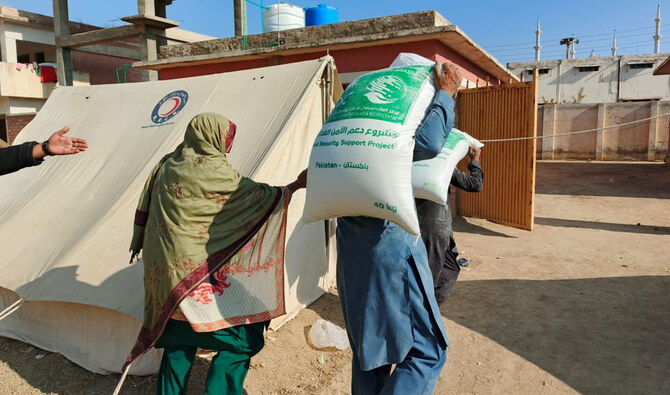
This photo, released on December 26, 2024, shows people carrying flour bag leave aid distribution point setup by Saudi KSrelief in Kurram district, Khyber Pakhtunkhwa. (APP)
Short Url
Updated 26 December 2024
Follow

KSrelief distributes food aid to displaced persons from Pakistani district facing sectarian clashes

  • 500 food packages distributed to people from Kurram district currently residing in Tehsil Thall and facing urgent food insecurity
  • KSrelief has implemented 210 projects in Pakistan worth millions of dollars to improve the lives of vulnerable communities

ISLAMABAD: Saudi Arabia’s King Salman Humanitarian Aid and Relief Center (KSrelief) on Thursday launched a food security initiative in Pakistan’s northwestern Khyber Pakhtunkhwa province, distributing food packages to people from a district marred by sectarian clashes since last month. 
Kurram — a tribal district of around 600,000 in the northwestern Khyber Pakhtunkhwa where federal and provincial authorities have traditionally exerted limited control — has frequently experienced violence between its Sunni and Shia communities over land and power. Travelers to and from the town often ride in convoys escorted by security officials. The latest violence erupted on Nov. 21 when gunmen ambushed a vehicle convoy, killing 52 people, mostly Shias.
The assault triggered road closures and other measures that have disrupted people’s access to medicine, food, fuel, education and work. Over 130 people have been killed in the fighting that has ensued after the convoy attack, according to police records.
“As part of this effort, 500 food packages were distributed to displaced beneficiaries from Kurram district, who are currently residing in Tehsil Thall and facing urgent food insecurity,” the Saudi charity KSRelief said in a statement.
“The distribution took place in a camp in District Hangu, providing timely relief to displaced families in need.”
The initiative is part of KSrelief’s first phase of the Food Security Support Project for 2024-25, which aims to distribute 10,000 food packages among poor people across 14 districts in Khyber Pakhtunkhwa.
KSrelief has implemented 210 projects in Pakistan worth millions of dollars to improve the lives of vulnerable communities. Efforts include emergency relief for natural disasters, and long-term projects addressing food security, health care, education, and shelter. Shelter NFI and Winter Kits Project are notable initiatives providing essential items to families in harsh weather conditions, and food distribution programs that combat hunger and malnutrition.
In partnership with UNICEF, KSrelief supports critical health initiatives, such as vaccination campaigns to prevent polio and measles, safeguarding millions of children. The Noor Saudi Volunteer Project provides free eye care through eye camps, combating blindness among underprivileged populations.


Pakistan could double economic size to $1 trillion by 2035 if reforms accelerate — planning minister

Updated 5 sec ago
Follow

Pakistan could double economic size to $1 trillion by 2035 if reforms accelerate — planning minister

  • Ahsan Iqbal says remittances from nine million overseas Pakistanis almost equal exports from 240 million at home
  • The minister cites exports, artificial intelligence, climate resilience and governance overhaul as pillars of expansion

ISLAMABAD: Pakistan could more than double the size of its economy to $1 trillion by 2035 if it accelerates structural reforms and strengthens governance, Planning Minister Ahsan Iqbal said on Wednesday, setting out an ambitious growth target for the next decade.

Addressing the Pakistan Governance Forum 2026 in Islamabad, Iqbal said the country faced a strategic choice between maintaining its traditional growth trajectory or pursuing deeper reforms aimed at faster expansion. According to the International Monetary Fund (IMF), Pakistan’s economy was estimated at $410.5 billion in 2025.

“If Pakistan continues to grow at its traditional pace, the economy will reach $600 billion by 2035,” Iqbal said, according to an official statement. “However, with national cohesion, positive synergy and accelerated reforms, Pakistan can achieve the milestone of a $1 trillion economy.”

The minister maintained achieving the higher target would depend on leadership capacity, institutional effectiveness and coordinated efforts between the federal and provincial governments.

He said the government had stabilized the economy over the past two years through governance reforms and corrective measures, steering it away from what he described as the “brink of bankruptcy.” He added that international financial institutions were now citing Pakistan’s recovery as a case study.

Iqbal outlined the government’s “Five Es” framework — Exports, E-Pakistan, Environment and Climate Change, Energy and Infrastructure, and Equity and Empowerment — as the pillars of long-term growth.

He said the strategy aimed to push exports beyond $100 billion, promote technology and artificial intelligence, address climate risks, improve energy efficiency and invest in human capital.

The minister acknowledged structural challenges including a 2.55 percent annual population growth rate, 40 percent child stunting, 25 million out-of-school children and a tax-to-GDP ratio of around 10 percent, describing them as urgent governance issues.

He noted that about nine million overseas Pakistanis contribute roughly $40 billion in annual remittances, while exports from a domestic population of 240 million stand at a similar level, highlighting what he called a significant performance gap.

Iqbal urged political stakeholders to prioritize economic development over confrontation, calling for what he termed an “economic long march” driven by national unity and policy continuity.