KARACHI: At least 46 people including women and children were killed in Pakistani airstrikes in Afghanistan’s eastern border province of Paktika, Afghan officials said on Wednesday, while there was no comment from Islamabad on the latest attack.
Pakistani security forces targeted multiple suspected hideouts of the Pakistani Taliban, also known as the Tehreek-e-Taliban Pakistan (TTP), inside neighboring Afghanistan on Tuesday, dismantling a training facility and killing several insurgents, the Associated Press reported, citing Pakistani security officials.
Suhail Shaheen, head of the Afghan Taliban’s political office in Doha, confirmed the strikes.
“Around 46 innocent people have been killed and several others injured, which we strongly condemn,” he told Arab News.
Border tensions between the two countries have escalated since the Taliban government seized power in 2021, with Pakistan battling a resurgence of militant violence in its western border regions.
Islamabad has accused Kabul’s Taliban authorities of harboring militant fighters, allowing them to strike on Pakistani soil with impunity. Kabul has denied the allegations.
The Afghan defense ministry also issued a statement late on Tuesday condemning the latest strikes, calling them “barbaric” and “a clear act of aggression.”
“Mostly civilians, who are Waziristani refugees, were targeted, and a number of civilians including children were martyred and injured as a result of the bombings,” the statement read.
“The Pakistani side should know that such arbitrary actions are not the solution to the problems,” the statement added, vowing that the Taliban government would not let the “act of cowardice” go unanswered.
Pakistan’s Foreign Ministry spokesperson Mumtaz Zahra Baloch did not respond to requests seeking comment and the military’s media wing, the Inter-Services Public Relations (ISPR), declined to confirm the airstrikes.
The banned TTP group said in a statement the strikes had hit “the homes of defenseless refugees” on Tuesday evening, killing at least 50 civilians, including 27 women and children.
Deadly air strikes by Pakistan’s military in the border regions of Afghanistan in March that the Taliban authorities said killed eight civilians had prompted skirmishes on the frontier.
The latest strikes coincided with a visit to Kabul by Mohammad Sadiq, Pakistan’s special representative for Afghanistan, to discuss bilateral trade and regional ties. Sadiq met Sirajuddin Haqqani, Afghanistan’s acting interior minister, to offer condolences over the Dec. 11 killing of his uncle, Khalil Haqqani, the minister for refugees and repatriation, in a suicide bombing claimed by the regional affiliate of the Daesh group.
In a post on X, Sadiq said he also met Afghan Foreign Minister Amir Khan Muttaqi and held “wide-ranging discussions,” with both sides agreeing “to work together to further strengthen bilateral cooperation as well as for peace and progress in the region.”


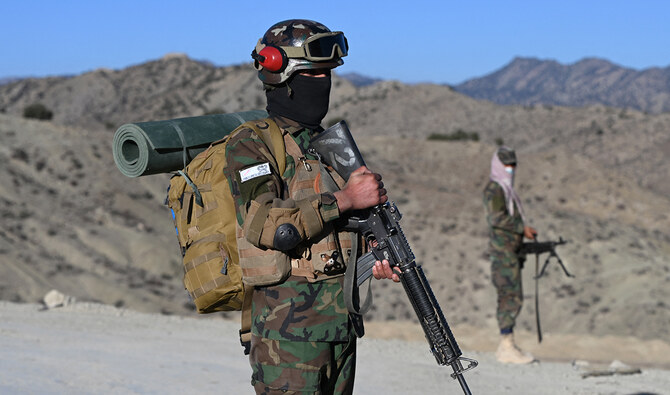
Taliban officials say Pakistan airstrikes in Afghanistan kill 46
https://arab.news/z7cyt
Taliban officials say Pakistan airstrikes in Afghanistan kill 46

- Afghan defense ministry condemns the latest strikes as “barbaric, clear act of aggression”
- Media reports say Pakistan had hit militant hideouts, no official comment from Islamabad

Pakistan PM convenes political leaders to discuss Iran crisis, regional tensions
- Leaders of major parties attend meeting on regional security and Pakistan’s military campaign
- Parliamentarians call for national unity and cohesion under current circumstances, says PMO
ISLAMABAD: Prime Minister Shehbaz Sharif briefed leaders of various parliamentary parties on Wednesday about the ongoing crisis in Iran and Pakistan’s ongoing military conflict with Afghanistan, his office said in a statement.
The meeting comes as Pakistan has intensified military operations against the Afghan Taliban and militant groups targeting its civilians and security forces along its western frontier, while the wider region faces growing instability after recent US-Israeli strikes on Iran and subsequent attacks across the Gulf.
Sharif decided to convene the session to update the leaders of various political parties in parliament on the security situation and Pakistan’s diplomatic outreach as tensions spread across the region.
“Participants emphasized the need for national unity, consensus and cohesion in the current circumstances,” the Prime Minister’s Office (PMO) said in a statement.
The statement said parliamentarians appreciated Pakistan’s diplomatic efforts for peace in the region and stressed the need to accelerate them further.
They presented suggestions to the government on what its future course of action should be.
“All participants reaffirmed their strong resolve to eliminate terrorism from the country,” the statement said.
Representatives of major political parties, including the ruling Pakistan Muslim League-Nawaz, Pakistan Peoples Party, Jamiat Ulema-e-Islam, Muttahida Qaumi Movement and other parliamentary groups attended the briefing.
Pakistan has accused Afghanistan’s Taliban authorities of allowing militant groups such as the Tehreek-e-Taliban Pakistan (TTP) to operate from Afghan territory, allegations Kabul denies. Islamabad says it has targeted militant hideouts across the border after repeatedly raising the issue with Afghan officials.
The briefing also comes as the government closely monitors developments in the Middle East, where regional tensions have heightened concerns about energy supplies and broader security implications for the country.


