Taliban officials say Pakistan airstrikes in Afghanistan kill 46

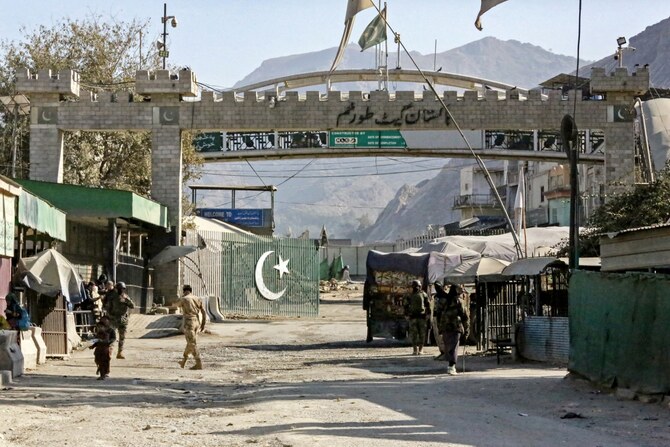
File photo of Border security personnel of Afghanistan and Pakistan stand guard at the zero point Torkham border crossing between the two countries (AFP)
Short Url
Updated 25 December 2024
Follow

Taliban officials say Pakistan airstrikes in Afghanistan kill 46

  • Afghan Defense Ministry labels attacks ‘barbaric’
  • No comment from Islamabad on the latest strikes

KARACHI: At least 46 people including women and children were killed by Pakistani airstrikes in Afghanistan’s eastern border province of Paktika, Afghan officials claimed on Wednesday, while there was no comment from Islamabad on the latest attack.

Pakistani security forces targeted multiple suspected hideouts of the Pakistani Taliban, also known as the Tehreek-e-Taliban Pakistan, on Tuesday, dismantling a training facility and killing several insurgents, the Associated Press reported, citing Pakistani security officials.

Suhail Shaheen, head of the Afghan Taliban’s political office in Doha, confirmed the strikes.

“Around 46 innocent people have been killed and several others injured, which we strongly condemn,” he told Arab News.

Border tensions between the two countries have escalated since the Taliban government seized power in 2021, with Pakistan battling a resurgence of militant violence in its western border regions.

Islamabad has accused Kabul’s Taliban authorities of harboring militant fighters, allowing them to strike on Pakistani soil with impunity. Kabul has denied the allegations.

The Afghan Defense Ministry issued a statement late on Tuesday condemning the latest strikes, calling them “barbaric” and “a clear act of aggression.”

“Mostly civilians, who are Waziristani refugees, were targeted, and a number of civilians including children were martyred and injured as a result of the bombings,” the statement read.

“The Pakistani side should know that such arbitrary actions are not the solution to the problems,” the statement added, vowing that the Taliban government would not let the “act of cowardice” go unanswered.

Pakistan’s Foreign Ministry spokesperson Mumtaz Zahra Baloch did not respond to requests seeking comment, and the military’s media wing, the Inter-Services Public Relations, declined to confirm the airstrikes.

The banned TTP group said in a statement the strikes had hit “the homes of defenseless refugees” on Tuesday evening, killing at least 50 civilians, including 27 women and children.

Deadly air strikes by Pakistan’s military in the border regions of Afghanistan in March, that the Taliban authorities said killed eight civilians, had prompted skirmishes on the frontier.

The latest strikes coincided with a visit to Kabul by Mohammad Sadiq, Pakistan’s special representative for Afghanistan, to discuss bilateral trade and regional ties.

Sadiq met Sirajuddin Haqqani, Afghanistan’s acting interior minister, to offer condolences over the Dec. 11 killing of his uncle, Khalil Haqqani, the minister for refugees and repatriation, in a suicide bombing claimed by the regional affiliate of the Daesh group.

In a post on X, Sadiq said he also met Afghan Foreign Minister Amir Khan Muttaqi and held “wide-ranging discussions,” with both sides agreeing “to work together to further strengthen bilateral cooperation as well as for peace and progress in the region.”


Uganda partially restores internet after president wins 7th term

Supporters of President Yoweri Museveni celebrate his winning the polls. (AFP)
Updated 18 January 2026
Follow

Uganda partially restores internet after president wins 7th term

  • “The internet shutdown implemented two days before the elections limited access to information, freedom ‌of association, curtailed economic activities ... it also created suspicion and mistrust on the ‍electoral process,” the team said in ‍their report

KAMPALA: Ugandan authorities have partially restored internet services late after 81-year-old President Yoweri Museveni won a seventh term to extend his rule into a fifth decade with a landslide ​victory rejected by the opposition.
Users reported being able to reconnect to the internet and some internet service providers sent out a message to customers saying the regulator had ordered them to restore services excluding social media.
“We have restored internet so that businesses that rely on internet can resume work,” David Birungi, spokesperson for Airtel Uganda, one of the country’s biggest telecom companies said. He added that the state communications regulator had ordered that social media remain shut down.
The state-run Uganda Communications Commission said it had cut off internet to ‌curb “misinformation, disinformation, ‌electoral fraud and related risks.” The opposition, however, criticized the move saying ‌it was ​to ‌cement control over the electoral process and guarantee a win for the incumbent.
The electoral body in the East African country on Saturday declared Museveni the winner of Thursday’s poll with 71.6 percent of the vote, while his rival pop star-turned-politician Bobi Wine was credited with 24 percent of the vote.
A joint report from an election observer team from the African Union and other regional blocs criticized the involvement of the military in the election and the authorities’ decision to cut off internet.
“The internet shutdown implemented two days before the elections limited access to information, freedom ‌of association, curtailed economic activities ... it also created suspicion and mistrust on the ‍electoral process,” the team said in ‍their report.

In power since 1986 and currently Africa’s third longest-ruling head of state, ‍Museveni’s latest win means he will have been in power for nearly half a century when his new term ends in 2031.

He is widely thought to be preparing his son, Muhoozi Kainerugaba, to take over from him. Kainerugaba is currently head of the military and has expressed presidential ambitions.
Wine, who was taking on ​Museveni for a second time, has rejected the results of the latest vote and alleged mass fraud during the election.
Scattered opposition protests broke out late on Saturday after results were announced, according to a witness and police.
In Magere, a suburb in Kampala’s north where Wine lives, a group of youths burned tires and erected barricades in the road prompting police to respond with tear gas.
Police spokesperson Racheal Kawala said the protests had been quashed and that arrests were made but said the number of those detained would be released later.
Wine’s whereabouts were unknown early on Sunday after he said in a post on X he had escaped a raid by the military on his home. People close to him said he remained at an undisclosed location in Uganda. Wine was briefly held under house arrest following the previous election in 2021.
Wine has said hundreds of his supporters were detained during the months leading up ‌to the vote and that others have been tortured.
Government officials have denied those allegations and say those who have been detained have violated the law and will be put through due process.