

Saudi non-oil exports jump 12.7% to $6.76bn in October: GASTAT

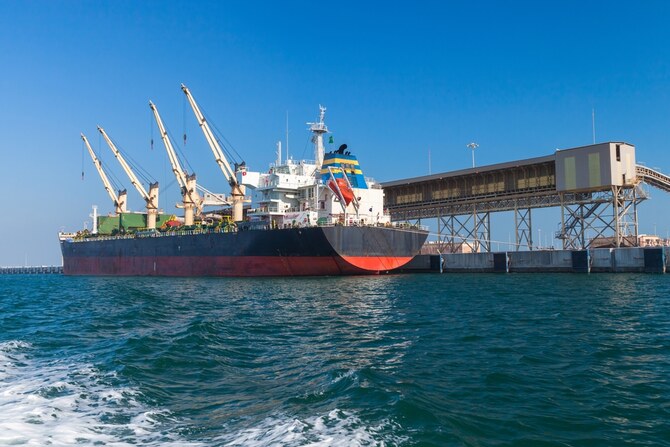
According to the General Authority for Statistics, chemical products led the non-oil export categories, accounting for 26.8 percent of the total, while plastics and rubber products followed, contributing 23.7 percent. Shutterstock
Short Url
Updated 25 December 2024
Follow

Saudi non-oil exports jump 12.7% to $6.76bn in October: GASTAT

  • Chemical products led the non-oil export categories, accounting for 26.8 percent of the total
  • On the import side, Saudi Arabia’s inbound shipments fell 3.8 percent year on year to SR72.01 billion

RIYADH: Saudi Arabia’s non-oil exports surged 12.7 percent year on year in October, reaching SR25.38 billion ($6.76 billion), underscoring the Kingdom’s push to diversify its economy away from oil dependence. 

According to the General Authority for Statistics, chemical products led the non-oil export categories, accounting for 26.8 percent of the total, while plastics and rubber products followed, contributing 23.7 percent.

The rise in non-oil exports is a cornerstone of Saudi Arabia’s broader Vision 2030 strategy, which aims to transform the Kingdom’s economic landscape and reduce reliance on oil revenues.

“The ratio of non-oil exports (including re-exports) to imports increased to 35.2 percent in October 2024 from 30.1 percent in October 2023. This was due to a 12.7 percent increase in non-oil exports and a 3.8 percent decrease in imports over that period,” GASTAT said in its report.

While non-oil trade climbed, total merchandise exports fell 10.7 percent in October, primarily driven by a 17.3 percent drop in oil exports. The share of oil in overall exports declined to 72.6 percent from 78.3 percent a year earlier, reflecting the Kingdom’s ongoing commitment to reducing its dependence on crude sales.

Saudi Arabia implemented a voluntary oil production cut of 500,000 barrels per day in April 2023, a measure that remains in place until December 2024 to stabilize global markets.

China remained Saudi Arabia’s largest trading partner, importing goods worth SR14.95 billion, or 16.1 percent of the Kingdom’s total exports in October. Other major destinations included India with SR8.79 billion, Japan with SR8.70 billion, and South Korea with SR8.31 billion.

On the import side, Saudi Arabia’s inbound shipments fell 3.8 percent year on year to SR72.01 billion. Machinery and equipment topped the list, comprising 25.7 percent of total imports, marking a 6.9 percent annual increase. However, transportation equipment imports declined 21.6 percent, representing 15.3 percent of the total.

China also dominated Saudi imports, sending goods worth SR17.58 billion in October, followed by the US with SR5.69 billion and the UAE with SR4.34 billion.

King Abdulaziz Sea Port in Dammam served as the leading entry point for imports, processing goods valued at SR21.16 billion, or 29.4 percent of total inbound shipments.

Saudi Arabia’s latest trade data highlights its progress in bolstering non-oil sectors while navigating global oil market challenges, aligning with its long-term economic transformation goals.


Saudi stock market opens its doors to foreign investors

Updated 06 January 2026
Follow

Saudi stock market opens its doors to foreign investors

RIYADH: Foreigners will be able to invest directly in Saudi Arabia’s stock market from Feb. 1, the Kingdom’s Capital Market Authority has announced.

The CMA’s board has approved a regulatory change which will mean the capital market, across all its segments, will be accessible to investors from around the world for direct participation.

According to a statement, the approved amendments aim to expand and diversify the base of those permitted to invest in the Main Market, thereby supporting investment inflows and enhancing market liquidity.

International investors' ownership in the capital market exceeded SR590 billion ($157.32 billion) by the end of the third quarter of 2025, while international investments in the main market reached approximately SR519 billion during the same period — an annual rise of 4 percent.

“The approved amendments eliminated the concept of the Qualified Foreign Investor in the Main Market, thereby allowing all categories of foreign investors to access the market without the need to meet qualification requirements,” said the CMA, adding: “It also eliminated the regulatory framework governing swap agreements, which were used as an option to enable non-resident foreign investors to obtain economic benefits only from listed securities, and the allowance of direct investment in shares listed on the Main Market.”

In July, the CMA approved measures to simplify the procedures for opening and operating investment accounts for certain categories of investors. These included natural foreign investors residing in one of the Gulf Cooperation Council countries, as well as those who had previously resided in the Kingdom or in any GCC country. 

This step represented an interim phase leading up to the decision announced today, with the aim of increasing confidence among participants in the Main Market and supporting the local economy.

Saudi Arabia, which ‌is more than halfway ‍through an economic plan ‍to reduce its dependence on oil, ‍has been trying to attract foreign investors, including by establishing exchange-traded funds with Asian partners in Japan and Hong Kong.