

Saudi non-oil exports jump 12.7% to $6.76bn in October: GASTAT

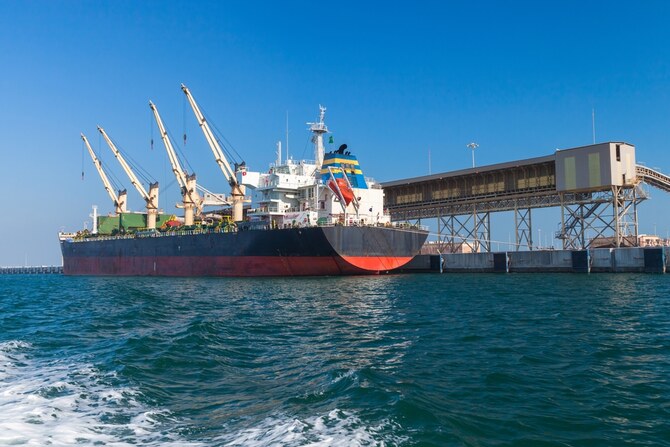
According to the General Authority for Statistics, chemical products led the non-oil export categories, accounting for 26.8 percent of the total, while plastics and rubber products followed, contributing 23.7 percent. Shutterstock
Short Url
Updated 25 December 2024
Follow

Saudi non-oil exports jump 12.7% to $6.76bn in October: GASTAT

  • Chemical products led the non-oil export categories, accounting for 26.8 percent of the total
  • On the import side, Saudi Arabia’s inbound shipments fell 3.8 percent year on year to SR72.01 billion

RIYADH: Saudi Arabia’s non-oil exports surged 12.7 percent year on year in October, reaching SR25.38 billion ($6.76 billion), underscoring the Kingdom’s push to diversify its economy away from oil dependence. 

According to the General Authority for Statistics, chemical products led the non-oil export categories, accounting for 26.8 percent of the total, while plastics and rubber products followed, contributing 23.7 percent.

The rise in non-oil exports is a cornerstone of Saudi Arabia’s broader Vision 2030 strategy, which aims to transform the Kingdom’s economic landscape and reduce reliance on oil revenues.

“The ratio of non-oil exports (including re-exports) to imports increased to 35.2 percent in October 2024 from 30.1 percent in October 2023. This was due to a 12.7 percent increase in non-oil exports and a 3.8 percent decrease in imports over that period,” GASTAT said in its report.

While non-oil trade climbed, total merchandise exports fell 10.7 percent in October, primarily driven by a 17.3 percent drop in oil exports. The share of oil in overall exports declined to 72.6 percent from 78.3 percent a year earlier, reflecting the Kingdom’s ongoing commitment to reducing its dependence on crude sales.

Saudi Arabia implemented a voluntary oil production cut of 500,000 barrels per day in April 2023, a measure that remains in place until December 2024 to stabilize global markets.

China remained Saudi Arabia’s largest trading partner, importing goods worth SR14.95 billion, or 16.1 percent of the Kingdom’s total exports in October. Other major destinations included India with SR8.79 billion, Japan with SR8.70 billion, and South Korea with SR8.31 billion.

On the import side, Saudi Arabia’s inbound shipments fell 3.8 percent year on year to SR72.01 billion. Machinery and equipment topped the list, comprising 25.7 percent of total imports, marking a 6.9 percent annual increase. However, transportation equipment imports declined 21.6 percent, representing 15.3 percent of the total.

China also dominated Saudi imports, sending goods worth SR17.58 billion in October, followed by the US with SR5.69 billion and the UAE with SR4.34 billion.

King Abdulaziz Sea Port in Dammam served as the leading entry point for imports, processing goods valued at SR21.16 billion, or 29.4 percent of total inbound shipments.

Saudi Arabia’s latest trade data highlights its progress in bolstering non-oil sectors while navigating global oil market challenges, aligning with its long-term economic transformation goals.



ACWA Power inks $400m deal to develop desalination plant in Azerbaijan 

Updated 18 sec ago
Follow

ACWA Power inks $400m deal to develop desalination plant in Azerbaijan 

RIYADH: Saudi utility giant ACWA Power has signed a public-private partnership agreement valued at SR1.5 billion ($400 million) to develop Azerbaijan’s first large-scale Caspian Sea water reverse osmosis desalination plant. 

In a Tadawul statement, ACWA Power said the agreement was signed with the government of Azerbaijan, represented by the Azerbaijan State Water Resources Agency as the public partner, and Caspian Sea Azerbaijan Project Co. in its capacity as the project company. 

The development aligns with ACWA Power’s expansion strategy as it seeks to establish itself as a key global player in renewable energy, water desalination, and green hydrogen through a growing portfolio of large-scale projects at home and abroad. 

In the Tadawul statement, ACWA Power stated: “The Public Private Partnership Agreement along with a series of agreements were signed to deliver Azerbaijan’s first large-scale Caspian Sea Water Reverse Osmosis Desalination Plant.”  

According to the statement, the contract term spans 27.5 years, including the construction period. 

The agreement covers the design, engineering, construction, financing, ownership, operation, and maintenance of the desalination plant, with ACWA Power holding a 100 percent shareholding in the project company. 

The financial impact of the contracted revenues is expected to be reflected after the early commercial operation date, which will be announced at the time of financial close. The company added that no related parties are involved in the transaction. 

Earlier this month, ACWA Power signed a cooperation framework agreement with the African Development Bank to enhance collaboration on power generation and water desalination projects across Africa. 

Under the agreement, the two parties will work together to identify, develop, and finance sustainable energy and water initiatives, with a target investment of up to $5 billion between 2025 and 2030. 

In December, ACWA Power also completed the refinancing of the Rabigh 3 Independent Water Project in Saudi Arabia’s western region. 

Rabigh 3 is a seawater desalination plant with a capacity of 600,000 cubic meters of potable water per day, using reverse osmosis technology. 

The company said the refinancing was executed through a capital-markets-led approach, anchored by the issuance of a long-term senior secured project bond.