

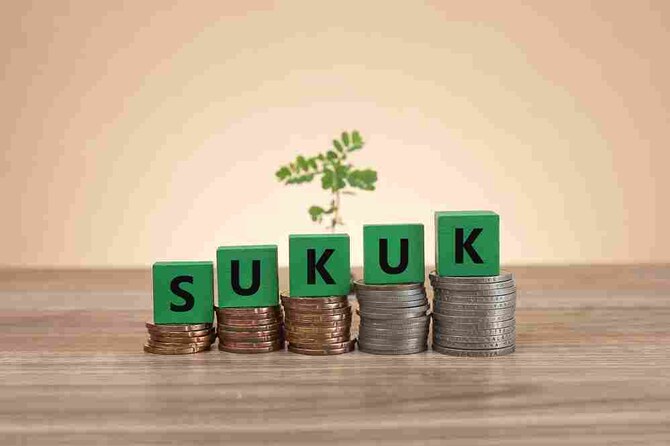
Saudi Arabia raises $3.09bn in sukuk issuances for December

Sukuk, which are Shariah-compliant Islamic bonds, provide investors with partial ownership of the issuer’s assets until the bonds mature. The rise in sukuk issuance aligns with positive global market projections. File
Short Url
Updated 24 December 2024
Follow

Saudi Arabia raises $3.09bn in sukuk issuances for December

RIYADH: Saudi Arabia’s National Debt Management Center has successfully concluded its riyal-denominated sukuk issuance for December, raising SR11.59 billion ($3.09 billion).

This marks a substantial 239.88 percent increase from the previous month, when the Kingdom raised SR3.41 billion in sukuk. Saudi Arabia had raised SR7.83 billion in October and SR2.6 billion in September.

Sukuk, which are Shariah-compliant Islamic bonds, provide investors with partial ownership of the issuer’s assets until the bonds mature. The rise in sukuk issuance aligns with positive global market projections.

A Moody’s report released in September forecasted that the global sukuk market would remain robust in 2024, with total issuance expected to reach between $200 billion and $210 billion, an increase from just under $200 billion in 2023.

The December sukuk issuance by NDMC was structured into four tranches, each with varying maturities. The largest tranche, valued at SR5.58 billion, is set to mature in 2027. Another tranche, worth SR3.90 billion, will mature in 2029, while a third tranche, valued at SR706 million, is due for repayment in 2031. The final tranche, amounting to SR1.4 billion, will mature in 2034.

This surge in sukuk issuance comes as the Kingdom is expected to lead the Gulf Cooperation Council region in bond and sukuk maturities between 2025 and 2029.

A report by Kamco Invest, released earlier this month, projected that Saudi Arabia’s total bond and sukuk maturities during this period would reach $168 billion, with government-issued bonds and sukuk accounting for $110.2 billion of that total.

In December, Fitch Ratings also highlighted that the GCC debt capital market crossed the $1 trillion threshold in outstanding debt by the end of November.

Earlier in October, Fitch had noted that the growth in sukuk issuance was driven by improving financing conditions, especially after the US Federal Reserve’s rate cut to 5 percent in September. Looking ahead, Fitch expects interest rates to decline further, reaching 4.5 percent by the end of 2024 and 3.5 percent by the end of 2025, which is likely to spur more sukuk issuances in the short term.


Saudi minister at Davos urges collaboration on minerals

Global collaboration on minerals essential to ease geopolitical tensions and secure supply, WEF hears. (Supplied)
Updated 20 January 2026
Follow

Saudi minister at Davos urges collaboration on minerals

  • The reason of the tension of geopolitics is actually the criticality of the minerals

LONDON: Countries need to collaborate on mining and resources to help avoid geopolitical tensions, Saudi Arabia’s minister of industry and mineral resources told the World Economic Forum on Tuesday.

“The reason of the tension of geopolitics is actually the criticality of the minerals, the concentration in different areas of the world,” Bandar Alkhorayef told a panel discussion on the geopolitics of materials.

“The rational thing to do is to collaborate, and that’s what we are doing,” he added. “We are creating a platform of collaboration in Saudi Arabia.”

Bandar Alkhorayef, Saudi Minister of Industry and Mineral Resources 

The Kingdom last week hosted the Future Minerals Forum in Riyadh. Alkhorayef said the platform was launched by the government in 2022 as a contribution to the global community. “It’s very important to have a global movement, and that’s why we launched the Future Minerals Forum,” he said. “It is the most important platform of global mining leaders.”

The Kingdom has made mining one of the key pillars of its economy, rapidly expanding the sector under the Vision 2030 reform program with an eye on diversification. Saudi Arabia has an estimated $2.5 trillion in mineral wealth and the ramping up of extraction comes at a time of intense global competition for resources to drive technological development in areas like AI and renewables.

“We realized that unlocking the value that we have in our natural resources, of the different minerals that we have, will definitely help our economy to grow to diversify,” Alkhorayef said. The Kingdom has worked to reduce the timelines required to set up mines while also protecting local communities, he added. Obtaining mining permits in Saudi Arabia has been reduced to just 30 to 90 days compared to the many years required in other countries, Alkhorayef said.

“We learned very, very early that permitting is a bottleneck in the system,” he added. “We all know, and we have to be very, very frank about this, that mining doesn’t have a good reputation globally.

“We are trying to change this and cutting down the licensing process doesn’t only solve it. You need also to show the communities the impact of the mining on their lives.”

Saudi Arabia’s new mining investment laws have placed great emphasis on the development of society and local communities, along with protecting the environment and incorporating new technologies, Alkhorayef said. “We want to build the future mines; we don’t want to build old mines.”