

Pakistan, UN agree to engage religious scholars, schools in combatting AIDS spread

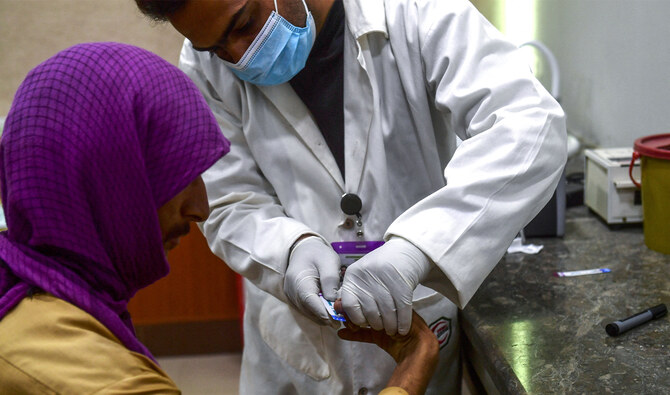
In this picture taken on March 26, 2021, a laboratory technician takes a blood sample from a man for an HIV test at a HIV treatment support centre in Rato Dero, in southern Sindh province. (AFP/File)
Short Url
Updated 24 December 2024
Follow

Pakistan, UN agree to engage religious scholars, schools in combatting AIDS spread

  • UN country director for AIDS urges Pakistani scholars to spread awareness about AIDS
  • Pakistan’s National AIDS Control Program has registered 72,515 HIV cases as of September

ISLAMABAD: Pakistan and the United Nations have agreed to strengthen cooperation to prevent Acquired Immunodeficiency Syndrome (AIDS) from spreading, state-run media reported on Tuesday, with both sides also exploring the possibility of employing religious scholars to raise awareness about the disease. 

HIV (human immunodeficiency virus) attacks and destroys infection-fighting CD4 cells (CD4 T lymphocytes) of the immune system, while AIDS is the most advanced stage of the disease. People with HIV who are not on medication and lack consistent control of the virus can transmit it through sexual intercourse, sharing needles, pregnancy, and breastfeeding. However, if HIV is properly controlled, the risk of transmission is nearly zero.

Pakistan is the second largest country in South Asia, only behind India and Nepal, in terms of the HIV epidemic, according to the National Institute of Health. Despite many efforts, the HIV infection rate has increased significantly over the past few years in the country. 

UN country director for AIDS, Trouble Chikoko, met with the Secretary of Religious Affairs and Interfaith Harmony Dr. Atta-ur-Rehman in Islamabad to discuss the various ongoing programs to curb the disease.

“Pakistan and the UN have agreed to enhance cooperation to curb the spread of AIDS,” Radio Pakistan said. “Chikoko said scholars and religious schools can play a positive role in raising awareness about AIDS prevention among the public.”

During the meeting, Rehman stressed the need for cooperation with relevant UN agencies and other partners to prevent AIDS, polio and other diseases from spreading across the country.

Pakistan’s National AIDS Control Program, established in 1986-87 aims to prevent and control the disease. It has registered 72,515 HIV cases as of September 2024, with 49,939 individuals currently on Antiretroviral Therapy (ART) in 94 centers across the country. 

According to the World Health Organization (WHO), since the start of the epidemic, 88.4 million people have been infected with HIV, and approximately 42.3 million have died from AIDS-related causes. By the end of 2023, an estimated 39.9 million people were living with HIV globally. 

Around 0.6 percent of adults aged 15–49 are living with HIV, although the impact of the epidemic varies significantly across countries and regions.


EU, Pakistan sign €60 million loan agreement for clean drinking water in Karachi

Updated 17 December 2025
Follow

EU, Pakistan sign €60 million loan agreement for clean drinking water in Karachi

  • Project will finance rehabilitation, construction of water treatment facilities in Karachi city, says European Investment Bank
  • As per a report in 2023, 90 percent of water samples collected from various places in city was deemed unfit for drinking

ISLAMABAD: The European Investment Bank (EIB) and Pakistan’s government on Wednesday signed a €60 million loan agreement, the first between the two sides in a decade, to support the delivery of clean drinking water in Karachi, the EU said in a statement. 

The Karachi Water Infrastructure Framework, approved in August this year by the EIB, will finance the rehabilitation and construction of water treatment facilities in Pakistan’s most populous city of Karachi to increase safe water supply and improve water security. 

The agreement was signed between the two sides at the sidelines of the 15th Pak-EU Joint Commission in Brussels, state broadcaster Radio Pakistan reported. 

“Today, the @EIB signed its first loan agreement with Pakistan in a decade: a €60 million loan supporting the delivery of clean drinking water for #Karachi,” the EU said on social media platform X. 

Radio Pakistan said the agreement reflects Pakistan’s commitment to modernize essential urban services and promote climate-resilient infrastructure.

“The declaration demonstrates the continued momentum in Pakistan-EU cooperation and highlights shared priorities in sustainable development, public service delivery, and climate and environmental resilience,” it said. 

Karachi has a chronic clean drinking water problem. As per a Karachi Water and Sewerage Corporation (KWSC) study conducted in 2023, 90 percent of water from samples collected from various places in the city was deemed unsafe for drinking purposes, contaminated with E. coli, coliform bacteria, and other harmful pathogens. 

The problem has forced most residents of the city to get their water through drilled motor-operated wells (known as ‘bores’), even as groundwater in the coastal city tends to be salty and unfit for human consumption.

Other options for residents include either buying unfiltered water from private water tanker operators, who fill up at a network of legal and illegal water hydrants across the city, or buying it from reverse osmosis plants that they visit to fill up bottles or have delivered to their homes.

The EU provides Pakistan about €100 million annually in grants for development and cooperation. This includes efforts to achieve green inclusive growth, increase education and employment skills, promote good governance, human rights, rule of law and ensure sustainable management of natural resources.