Special force set up to police road in Pakistani district wracked by sectarian feuding

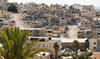
This photograph taken on December 3, 2024, shows local residents walking across a market reopened after sectarian clashes in Parachinar, Khyber Pakhtunkhwa province. (AFP/File)
Short Url
Updated 24 December 2024
Follow

Special force set up to police road in Pakistani district wracked by sectarian feuding

  • Police say at least 136 killed in fresh sectarian feuds in Kurram that started last month
  • Northwestern district has for decades seen fighting between Shia and Sunni groups

PESHAWAR: The government of Pakistan’s northwestern Khyber Pakhtunkhwa province said on Monday it was establishing a special force to ensure that a main road in Kurram district remained open, after its blockade since last month following sectarian clashes in the region has triggered a humanitarian crisis.

Kurram, a tribal district of around 600,000 where federal and provincial authorities have traditionally exerted limited control, has frequently experienced violence between its Sunni and Shia communities over land and power. Travelers to and from the town often ride in convoys escorted by security officials. 

The latest feuding started on Nov. 21 when gunmen ambushed a vehicle convoy and killed 52 people, mostly Shias. The assault triggered road closures and other measures that have disrupted people’s access to medicine, food, fuel, education and work. Over 130 people have been killed in the fighting that has ensued after the convoy attack.

The provincial government and Edhi Foundation charity last week started sending medicines to the region via helicopters.

“It has been decided to establish a special police force to secure the Parachinar Road in connection with the restoration of land connectivity to Kurram,” the KP government said in a statement after a cabinet meeting chaired by Chief Minister Ali Amin Gandapur. 

Parachinar is the main town in Kurram and a main road that connects the region to Peshawar, the provincial capital of KP, has been blocked since sectarian fighting began late last month. 

“A total of 399 personnel will be recruited for this new force,” the statement said. “It has been decided to set up temporary posts initially to secure the road, while permanent posts will be set up in the future.”

The statement said the road would be opened after an agreement was reached between the two warring sides. A grand jirga of tribal and political heavyweights was set up earlier this month to convince the two sides to shun violence. The council will resume peace talks later this week. 

Kurram police spokesman Riaz Khan told Arab News on Monday least 136 people had been killed in the violence since last month. If you added those who had died due to lack of access to hospitals and medicines following the road closures, the number reached at least 200, the police officer said. 

Meanwhile, the KP government has launched a helicopter service to evacuate people and transport aid and medicines to Kurran amid the closer of the Parachinar-Peshawar road since last month, triggering a humanitarian crisis with reports of starvation, lack of medicine and oxygen shortages.

On Sunday, two flights evacuated 27 individuals and 16 government staffers and jirga members, according to KP chief minister’s office. Since last week, over 180 people, including women, children and patients, have been transported via helicopter, with priority given to those in need of urgent medical attention.

Last week, KP government spokesman Muhammad Ali Saif said authorities had decided to dismantle private bunkers — observation posts used in the fighting by both sides — and given a deadline of Feb. 1 for tribesmen in Kurram to handover heavy weapons. 

Local tribesmen have so far reportedly refused to surrender their weapons, citing concerns about their safety.


Pakistan to promote mineral sector at Saudi forum this month with 13 companies

Updated 02 January 2026
Follow

Pakistan to promote mineral sector at Saudi forum this month with 13 companies

  • Delegation will take part in the Future Minerals Forum in Riyadh from Jan. 13-15
  • Petroleum minister will lead Pakistan, participate in a 90-minute country session

ISLAMABAD: Around 13 Pakistani state-owned and private companies will attend the Future Minerals Forum (FMF) in Saudi Arabia from Jan. 13 to 15, an official statement said on Friday, as the country seeks to ramp up global engagement to develop its mineral resources.

The FMF is an international conference and investment platform for the mining sector, hosted by mineral-rich countries to attract global investors, companies and governments.

Petroleum Minister Ali Pervaiz Malik confirmed Pakistan’s participation in a meeting with the Saudi envoy, Nawaf bin Said Al-Malki.

Pakistan hosts one of the world’s largest copper-gold zones. The Reko Diq mine in southwestern Balochistan, with an estimated 5.9 billion tons of ore, is partly owned by Barrick Gold, which calls it one of the world’s largest underdeveloped copper-gold deposits. Its development is expected to boost Pakistan’s struggling economy.

“Upon an invitation of the Government of the Kingdom of Saudi Arabia, the Federal Minister informed the Ambassador that Pakistan will fully participate in the upcoming Future Minerals Forum (FMF), scheduled to be held in Riyadh later this month,” Pakistan’s Press Information Department (PID) said in an official statement.

The Pakistani minister will lead his country’s delegation at the FMF and take part in a 90-minute country showcase session titled “Unleashing Potential: Accelerating Pakistan’s Mineral Revolution” along with local and foreign investors.

Pakistan will also establish a dedicated pavilion to highlight the vast potential of its rich geological landscape to the global mineral community.

The Saudi envoy welcomed Pakistan’s decision to participate in the forum and discussed enhancing bilateral cooperation in the minerals and energy sectors during the meeting.

According to the statement, he highlighted the potential for cooperation between Saudi Arabia and Pakistan in the minerals and energy sectors, expressing confidence that the FMF would provide a platform to expand collaboration.
Pakistan’s mineral sector, despite its rich reserves of salt, copper, gold and coal, contributes only 3.2 percent to the country’s GDP and just 0.1 percent to global mineral exports.

However, many countries, including the United States, have shown interest in Pakistan’s underdeveloped mineral sector, particularly in copper, gold and other critical resources.

In October, Pakistan dispatched its first-ever shipment of rare earth and critical minerals to the United States, according to a Chicago-based US public relations firm’s report.