

IFC backs Pakistani firm, UAE subsidiary to set up tire manufacturing unit in Sindh

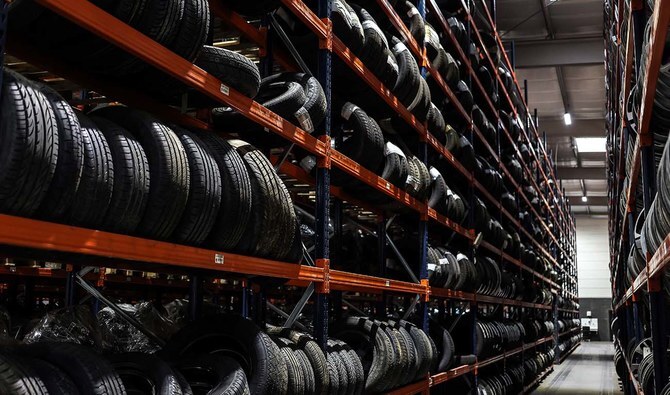
In this photograph taken on on October 6, 2022, reusable tires removed from damaged cars are stocked at the “Surplus Recyclage” company in Gaillac, France. (AFP/File)
Short Url
Updated 23 December 2024
Follow

IFC backs Pakistani firm, UAE subsidiary to set up tire manufacturing unit in Sindh

  • IFC and group of local banks will provide up to $50.2 million to Armstrong ZE to increase local production of tires
  • The project is expected to create over 1800 jobs and bolster local manufacturing and supply chains, IFC said

ISLAMABAD: The International Finance Corporation (IFC) and a consortium of Pakistani banks will provide up to $50.2 million-equivalent in financing to support Pakistan’s Armstrong ZE Pvt. Ltd. and its UAE subsidiary Zafco Group Holding in developing a greenfield tire manufacturing facility in the Sindh province, IFC said on Monday. 

The number of registered vehicles in Pakistan has grown steadily over the last decade, reaching approximately 30 million vehicles in 2023, including 23 million two-wheelers. However, local tire manufacturing remains constrained due to a lack of technical expertise and technology and a substantial informal market, making the country heavily dependent on imports.

IFC, a member of the World Bank Group, is the largest global development institution focused on the private sector, working in more than 100 countries. It has invested approximately $13 billion in Pakistan since 1956, supporting diverse sectors such as renewable energy, financial inclusion, infrastructure development, agribusiness, manufacturing, housing, health care, and trade, among others.

“Armstrong ZE is deeply honored to have earned the trust and support of IFC and our partner banks, HBL, Meezan Bank, Bank Alfalah and Habib Metropolitan Bank. Their investment in this transformative project is not just a financial endorsement but also a strong vote of confidence in our vision, capabilities, and potential to shape the future of tire manufacturing,” Azim Yusufzai, the chairman of Armstrong ZE, said in a statement released by IFC. 

“Together, we aim to foster innovation, create employment opportunities, and contribute to sustainable development in our communities and beyond. This collaboration marks a monumental step forward in advancing our mission to deliver world-class, sustainable, and innovative tire solutions to the Pakistani market.”

The financing comprises a $25 million loan from IFC alongside an up to $25.2 million equivalent investment in Pakistani rupees from local banks. The project is expected to create over 1,800 direct and indirect jobs and help increase the competitiveness of the tire sector through technology and know-how transfers.

The project will utilize the company’s long-standing experience in the tire industry, through its UAE-based company, Zafco Group Holding, which operates as a global importer and exporter of tires, batteries, and lubricants, with a presence in over 85 countries, as well as Zafar Enterprises, a leading tire distributor in Pakistan.

IFC will also be supporting Armstrong through its Responsible Investing Support in Emerging Economies (RISE) advisory program, which will strengthen Armstrong’s climate risk management, resource efficiency, and environmental and social processes.

“IFC is committed to improving Pakistan’s value-added manufacturing capacity by partnering with strong companies that can scale up production,” said Khawaja Aftab Ahmed, IFC’s Regional Director for the Middle East, Pakistan, and Afghanistan. 

“This investment exemplifies this commitment and will help improve consumer access to tires while spurring the economy through job creation, increased productivity, and reduced reliance on imports.”

IFC said the project will introduce a locally manufactured international brand to Pakistan, which will improve consumer access to quality, affordable tires, while strengthening local supply chains, creating jobs and boosting private sector-led growth.

Armstrong ZE Pvt. Ltd. is a wholly owned company established by the Pakistan-origin Hussain and Yusufzai families who have over fifty years of experience in the tire business with operations in more than eighty-five countries. The families also own, Zafar Enterprises, a leading tire distribution company in Pakistan, and UAE based Zafco Group Holding, a global importer and exporter of tires, batteries, and lubricants, with a presence in over 85 countries.


Pakistan, UK sign £35 million Green Compact to strengthen climate resilience

Updated 21 December 2025
Follow

Pakistan, UK sign £35 million Green Compact to strengthen climate resilience

  • Pakistan ranks among nations most vulnerable to climate change and has seen erratic changes in its weather patterns
  • UK will help Pakistan mobilize climate finance, strengthen regulatory frameworks and develop bankable climate projects

ISLAMABAD: Pakistan and the United Kingdom (UK) have formalized a comprehensive climate partnership with the launch of a Green Compact that aims to enhance climate resilience, accelerate clean energy transition and scale up nature-based solutions, including mangrove conservation, Pakistani state media reported on Sunday.

The agreement, signed in Islamabad by Federal Minister for Climate Change and Environmental Coordination Dr. Musadik Malik and UK Minister for International Development Jennifer Chapman, unlocks £35 million in targeted support for green development and long-term climate action, according to Radio Pakistan broadcaster.

Pakistan ranks among nations most vulnerable to climate change and has seen erratic changes in its weather patterns that have led to frequent heatwaves, untimely rains, storms, cyclones, floods and droughts in recent years. In 2022, monsoon floods killed over 1,700 people, displaced another 33 million and caused over $30 billion losses, while another 1,037 people were killed in floods this year.

Mohammad Saleem Shaikh, a spokesperson for Pakistan’s Ministry of Climate Change, described the compact as a “decisive move toward action-oriented climate cooperation,” noting that its implementation over the next decade will be critical for Pakistan which regularly faces floods, heatwaves and water stress.

“The Compact is structured around five core pillars: climate finance and investment, clean energy transition, nature-based solutions, innovation and youth empowerment, and adaptation and resilience,” the report read.

“Under the agreement, the UK will work with Pakistan to mobilize public and private climate finance, strengthen regulatory frameworks for green investment, and develop bankable climate projects.”

Clean energy forms a central component of Pakistan’s transition, with Islamabad planning to expand solar and wind generation to reduce fossil fuel dependence, improve energy security and stabilize power costs, according to Shaikh.

“Renewable energy is now economically competitive, making the transition both environmentally and financially viable,” he was quoted as saying.

“Nature-based solutions, particularly large-scale mangrove restoration, will protect coastal communities from storm surges and erosion while enhancing biodiversity and carbon sequestration.”

Under the Compact, technical support, mentoring and access to investors will be provided to climate-smart startups and young innovators, reflecting Pakistan’s recognition of youth-led initiatives as central to future climate solutions.

On the occasion, Chapman, on her first official visit to Pakistan, underscored the urgency of climate action, highlighting the UK’s support for renewable energy, mangrove and ecosystem restoration, early-warning systems, climate budgeting and international investment flows into Pakistan.

Shaikh described the Green Compact as “a strategic turning point” in Pakistan–UK relations on climate change, saying its effective implementation is essential for Pakistan to meet its national climate targets.