

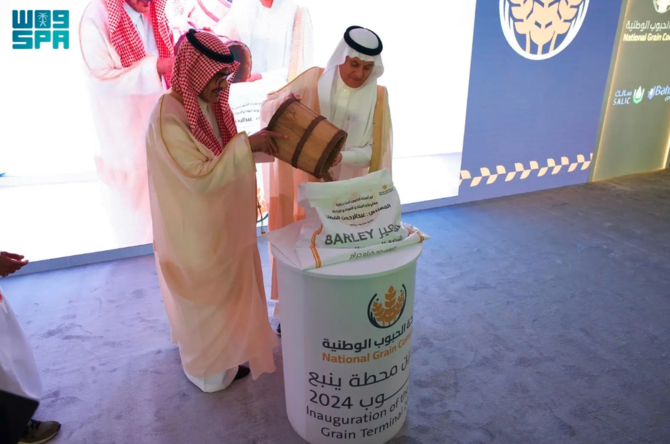

RIYADH: Saudi Arabia has inaugurated the Yanbu Grain Handling Terminal, underscoring the Kingdom’s efforts to strengthen public-private partnerships, enhance agricultural trade, and bolster food security across the region.
The event was attended by Abdulrahman Al-Fadli, minister of environment, water and agriculture, and by various government and private sector officials, according to the Saudi Press Agency.
The Yanbu Grain Handling Terminal will serve public and private sector importers, and boasts a storage capacity of 156,000 tonnes, including 12 silos with a combined capacity of 96,000 tonnes.
Food security has risen up the agenda in recent years, as countries in the Gulf contend with the impacts of climate change, the consequences of trade-disrupting conflicts such as the Ukraine-Russia war, and interruptions to supply routes through the Red Sea.
In September 2022, in response to these challenges, the Kingdom collaborated with regional partners to launch a food security action plan with an initial funding of $10 billion.
The Yanbu Grain Handling Terminal will be operated by the National Grains Co., a joint venture between the national shipping carrier Bahri and the Saudi Agricultural and Livestock Investment Co.
It features a 650-meter conveyor belt and a discharge rate of 800 tonnes per hour directly from ships, with an annual handling capacity exceeding 3 million tonnes of grain.
According to Bahr’s statement to the Saudi Stock Exchange, the inauguration delay was caused by the inclusion of additional requirements to enhance future operational efficiency, along with the construction of extra infrastructure to accommodate potential future expansions.
The company said that because of this the total project cost rose by 7 percent from the initially allocated SR412.5 million ($109.7 million), though the increase is not deemed significant.
The Yanbu Grain Handling Terminal aims to become a world-class logistics hub, connecting three continents and supporting the Kingdom’s vision for a resilient and efficient agricultural supply chain.
Established in 2020 as a strategic partnership between SALIC and Bahri, the National Grain Co. aims to fulfill the Kingdom’s future feed grain requirements while enhancing its global competitiveness.
It is committed to advancing grain trade, handling, and storage through the Yanbu terminal, strengthening supply chains and ensuring price stability across Saudi Arabia.
SALIC, a Public Investment Fund-owned company, was formed in 2011 to secure food supply for Saudi Arabia through mass production and investment.
When the project was announced in 2020, Al-Fadli, who is also the chairman of SALIC’s board of directors, said: “The project aims to enhance the velocity of the main grain influx to Saudi Arabia and is considered the first regional center for grains in the commercial port of Yanbu.”
He added that SALIC relies on the geographical location of the Kingdom and the port infrastructure to enhance food distribution in the region by linking the Kingdom to global grain sources, especially countries where SALIC is investing.
A grain delivery service to customers within the Kingdom has been introduced as part of the project, ensuring greater proximity to clients, enhanced customer experience, and improved profitability margins.


