

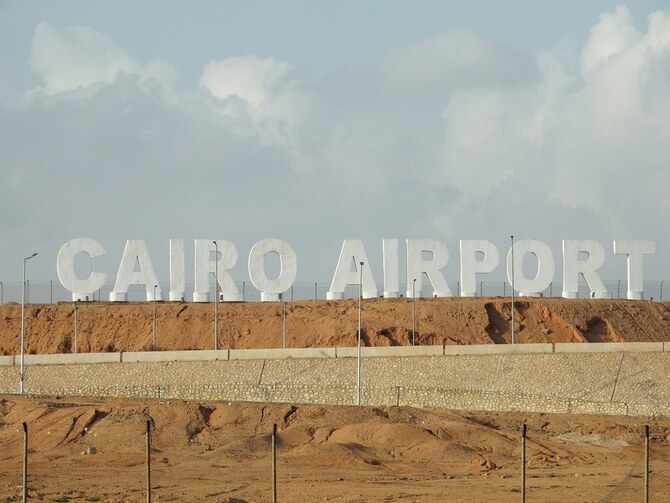
Terminal 4 at Cairo International Airport to boost Egypt’s aviation and tourism sectors

This year, Egypt’s government announced plans to involve the private sector in airport management. Shutterstock
Short Url
Updated 23 December 2024
Follow

Terminal 4 at Cairo International Airport to boost Egypt’s aviation and tourism sectors

  • Project is expected to bolster the country’s tourism goals and improve traveler experiences
  • Egypt’s aviation sector also improved 36 spots to 27th in the 2024 edition of the Air Transport Infrastructure Index

RIYADH: Egypt is advancing its aviation sector with the ongoing development of Terminal 4 at Cairo International Airport, set to accommodate 30 million passengers annually.

According to a statement from the Cabinet, the “New Republic Air Gateway” project is expected to bolster the country’s tourism goals, improve traveler experiences, and position Egypt as an international aviation hub.

This year, the government announced plans to involve the private sector in airport management, including a global tender for Cairo International.

Egypt’s aviation sector also improved 36 spots to 27th in the 2024 edition of the Air Transport Infrastructure Index, aligning with Vision 2030’s focus on sustainable development, innovation, and global competitiveness.

Prime Minister Mostafa Madbouly, during a meeting at the New Administrative Capital, reviewed progress on the project alongside Minister of Civil Aviation Sameh El-Hefny. The session focused on the terminal’s specifications, implementation strategy, and potential to reshape the African nation’s aviation and tourism landscapes.

“Airport development works come within the framework of presidential directives to upgrade the Egyptian airport system, raise its capacity and improve the level of services provided to passengers,” he said.

At the meeting, Madbouly emphasized the importance of creating world-class facilities to accommodate rising traveler numbers. 

El-Hefny outlined the project’s phased execution, with completion expected within four to five years. He also revealed that negotiations are underway with international firms specializing in airport construction and management to ensure world-class execution. 

The minister emphasized the cutting-edge features of the new terminal, including its ability to initially handle 30 million passengers annually, with expansion potential to 40 million. 

In September 2023, Cairo Airport Co. partnered with Pangiam, a trade and travel technology company, and signed two agreements to develop the new terminal. These deals, focused on enhancing the airport’s operations with advanced technology, include a feasibility study to incorporate emerging technologies and deliver a seamless travel experience.

The terminal will feature a state-of-the-art runway equipped with advanced navigation and lighting technologies that meet international standards. 

Once operational, Terminal 4 is expected to elevate Cairo International Airport’s global status, making it a hub for regional and international travel. 


Saudi Arabia’s cultural sector is a new economic engine between Riyadh and Paris, says ambassador

Updated 25 January 2026
Follow

Saudi Arabia’s cultural sector is a new economic engine between Riyadh and Paris, says ambassador

RIYADH: Culture has become a fundamental pillar in bilateral relations between France and Saudi Arabia, according to the French Ambassador to the Kingdom, Patrick Maisonnave.

Maisonnave noted its connection to the entertainment and tourism sectors, which makes it a new engine for economic cooperation between Riyadh and Paris.

He told Al-Eqtisadiah during the opening ceremony of La Fabrique in the Jax district of Diriyah that cultural cooperation with Saudi Arabia is an important element for its attractiveness in the coming decades.

La Fabrique is a space dedicated to artistic creativity and cultural exchange, launched as part of a partnership between the Riyadh Art program and the French Institute in Riyadh. 

Running from Jan. 22 until Feb 14, the initiative will provide an open workspace that allows artists to develop and work on their ideas within a collaborative framework.

Launching La Fabrique as a space dedicated to artistic creativity

The ambassador highlighted that the transformation journey in the Kingdom under Vision 2030 has contributed to the emergence of a new generation of young artists and creators, alongside a growing desire in Saudi society to connect with culture and to embrace what is happening globally. 

He affirmed that the relationship between the two countries is “profound, even cultural par excellence,” with interest from the Saudi side in French culture, matched by increasing interest from the French public and cultural institutions unfolding in the Kingdom.

Latest estimates indicate that the culture-based economy represents about 2.3 percent of France’s gross domestic product, equivalent to more than 90 billion euros ($106.4 billion) in annual revenues, according to government data. The sector directly employs more than 600,000 people, making it one of the largest job-creating sectors in the fields of creativity, publishing, cinema, and visual arts.

Saudi Arabia benefiting from French experience in the cultural field

Maisonnave explained that France possesses established cultural institutions, while Saudi Arabia is building a strong cultural sector, which opens the door for cooperation opportunities.

This comes as an extension of the signing of 10 major cultural agreements a year ago between French and Saudi institutions, aiming to enhance cooperation and transfer French expertise and knowledge to contribute to the development of the cultural system in the Kingdom.

He added that experiences like La Fabrique provide an opportunity to meet the new generation of Saudi creators, who have expressed interest in connecting with French institutions and artists in Paris and France.

La Fabrique encompasses a space for multiple contemporary artistic practices, including performance arts, digital and interactive arts, photography, music, and cinema, while providing the public with an opportunity to witness the stages of producing artistic works and interact with the creative process.