

Pakistan defense minister blames judiciary for delayed verdicts in May 9 cases

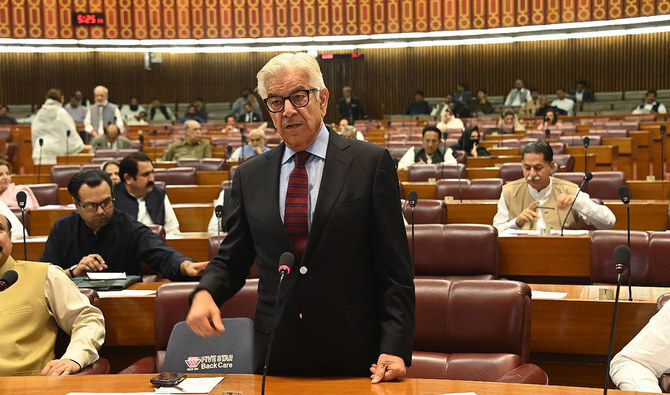
Pakistan Defense Minister Khawaja Asif addresses on the floor of the National Assembly of Pakistan in the federal capital Islamabad on May 3, 2023. (National Assembly of Pakistan/File)
Short Url
Updated 23 December 2024
Follow

Pakistan defense minister blames judiciary for delayed verdicts in May 9 cases

  • National problems require decisions at the earliest, says Khawaja Asif while talking to media in London
  • Protests erupted in several Pakistani cities on May 9, 2023, over ex-PM Imran Khan’s arrest in a graft case

ISLAMABAD: Pakistan’s Defense Minister Khawaja Asif on Sunday blamed the judiciary for delaying verdicts in the May 9, 2023, cases, which have so far led to the conviction of 25 supporters of former Prime Minister Imran Khan’s Pakistan Tehreek-e-Insaf (PTI) party for attacking government buildings and military properties last year.

On Dec. 21, the Pakistan Army sentenced 25 people for participating in the violent protests that erupted in several Pakistani cities following Khan’s brief detention on corruption charges, resulting in damage to major military facilities and martyrs’ monuments in the country.

However, several suspects are also facing legal charges in anti-terrorism courts, with the military hoping for early verdicts in their cases, according to a statement announcing the sentencing of the 25 individuals, which described the rioting as “politically provoked violence.”

The PTI has denied any involvement in the violence, describing the May 9 incident as a “false flag” operation aimed at crushing the party.

“The judiciary created the biggest hurdle in this [the conviction of May 9 suspects] while this thing was allowed to linger for one and a half years,” Asif said while speaking to the media in London, the city he is currently visiting.

Describing the May 9 protests as a national problem, he said all the cases related to it required verdicts at the earliest.

The conviction of the 25 individuals followed a ruling by a seven-member Constitutional Bench of the Supreme Court of Pakistan on Dec. 13, allowing military courts to share their verdicts. Prior to that, the court had unanimously declared last year that prosecuting civilians in military courts violated the Constitution.

Khan’s PTI party rejected the military’s announcement, with opposition leader Omar Ayub Khan saying they were “against the principles of justice.”

The sentencing of the 25 individuals also raises concerns about Khan, who faces charges of inciting attacks against the armed forces and may potentially be tried in a military court.

Earlier, Asif had regretted the delay in announcing the verdicts, saying that it “raised the morale of the accused and their facilitators.”

“Right now, only the workers, who were used [to generate violence], have been punished under the law,” he had said. “This will not end until the ones, who planned this terrible day, are not brought before the law.”


Firefighter killed in Karachi blaze leaves family to mourn second generation lost in line of duty

Updated 4 sec ago
Follow

Firefighter killed in Karachi blaze leaves family to mourn second generation lost in line of duty

  • Father of fallen firefighter also died in service years earlier, leaving family to mourn second line-of-duty death
  • Chronic shortages of fire engines, protective gear and trained staff strain Karachi’s emergency response

KARACHI: When flames tore through Karachi’s Gul Plaza last weekend, 29-year-old firefighter Furqan Shaukat moved deeper into the burning building as its structure weakened, responding to calls for help from inside moments before the plaza collapsed.

The category-three fire gutted around 1,200 shops in one of Karachi’s busiest commercial districts, killed scores of people and left dozens missing. It also exposed, once again, the extreme risks faced by firefighters in Pakistan’s largest city, particularly when battling intense blazes inside sealed commercial structures built with little regard for safety standards.

Karachi, home to more than 20 million people, operates with just over 20 fire stations and an estimated 120–140 fire tenders, many of them aging or partially functional, according to figures cited by the Karachi Metropolitan Corporation and provincial officials over the years. The city’s fire brigade is believed to have fewer than 2,000 firefighters, far below international benchmarks for a megacity of its size, with no citywide hydrant system and chronic shortages of modern protective gear.

“We are told that someone shouted from inside [the building], saying, ‘Save me,’” Shaukat’s brother Muhammad Nauman told Arab News. “Many people were standing outside, but it was him who said, ‘No, I have to save this man.’”

For Shaukat’s family, the loss is not a single tragedy, but the second in a line of service stretching across generations.

Born into a household tied to Karachi’s Fire Brigade, Shaukat followed his father into a profession defined by danger and limited protection. His father served for 35 years, was paralyzed on duty, and later died while still in service in 2018.

“Furqan was my youngest brother,” his sister Shumaila Shaukat said, struggling to contain her grief. “He was very talented, good and intelligent.”

“Since childhood, he had a passion for helping people,” she added. “We didn’t know that our brother would pass away so soon.”

Shaukat had joined the Karachi Fire Brigade just three years ago and was the youngest member of his team. He leaves behind a young widow and an infant son, Muhammad Rahim.

“Furqan wanted to make him [Rahim] a lawyer,” Shumaila said. “I will teach him law.”

SEALED INFERNOS

Fires inside enclosed commercial buildings like Gul Plaza are among the most dangerous scenarios firefighters face anywhere in the world. In Karachi, those dangers are magnified by overcrowded markets, illegal structural modifications, poor access routes and the absence of sprinkler systems, fire exits and heat-resistant materials.

Compounding those risks is the lack of equipment. Fire officials and court submissions have repeatedly pointed to shortages of breathing apparatus, fire-resistant suits, thermal imaging cameras and high-rise rescue training, leaving firefighters to confront extreme heat and toxic smoke with minimal protection.

On the night of the fire, Shaukat’s family remained awake, tracking updates and waiting anxiously.

“We were all restless that night,” Nauman recalled. “We knew he was in the fire, and we were all worried.”

Veteran fire officer Wajid Ali, who was working alongside Shaukat, said he spoke to him shortly before the collapse.

“He told me to be careful … I told him, ‘You do the same as you are young and a newcomer,’” Ali said.

As the blaze intensified and the building’s integrity failed, Ali said Shaukat attempted to retreat.

“When the building collapsed his team ran away,” he said. “Furqan also tried to run but stumbled and fell. The debris fell all over him and he died because of that.”

His injuries reflected both the intensity of the fire and the lack of protective equipment.

“His entire back was burned. His face was burned. His hands were burned. His entire body was burned,” Nauman said, rejecting claims circulating online that firefighters had been idle during the operation.

Nauman said Shaukat and his colleagues were confronting a modern, high-risk blaze without the gear such conditions demand.

“Firefighters must care about their safety,” he said. “As I told you they should get a [protective] suit as we saw Furqan going inside in a uniform only.”

“What safety did he have,” he asked. “Furqan would not have burned so badly if he had some safety. Give them the equipment they need.”

Ali said fires like Gul Plaza increasingly fall into the most dangerous category, requiring specialized training, protective suits and breathing equipment, resources firefighters in Pakistan often lack.

Karachi Chief Fire Officer Muhammad Humayun Khan said negligence in basic fire-safety measures continues to fuel deadly blazes across the city.

“If you are doing a business, then try to get a fire extinguisher or get some consultancy, there is no harm in that,” he said.

For Shaukat’s family, however, the policy failures and structural weaknesses translate into something deeply personal.

“We lost our little hero,” Shumaila said. “He left the world, but he will always be with us.”