



DHAKA: For generations, the small Hindu temple outside the capital in Muslim-majority Bangladesh was a quiet place to pray — before arsonists ripped open its roof this month in the latest post-revolution unrest.
It is only one of a string of attacks targeting religious minorities since a student-led uprising toppled long-time autocratic leader Sheikh Hasina in August.
“We don’t feel safe,” said Hindu devotee Swapna Ghosh in the village of Dhour, where attackers broke into the 50-year-old family temple to the goddess Lakshmi and set fire to its treasured idols on December 7.
“My son saw the flames and doused them quickly,” said temple custodian Ratan Kumar Ghosh, 55, describing how assailants knew to avoid security cameras, so they tore its tin roof open to enter.
“Otherwise, the temple — and us — would have been reduced to ashes.”
Hindus make up about eight percent of the mainly Muslim nation of 170 million people.
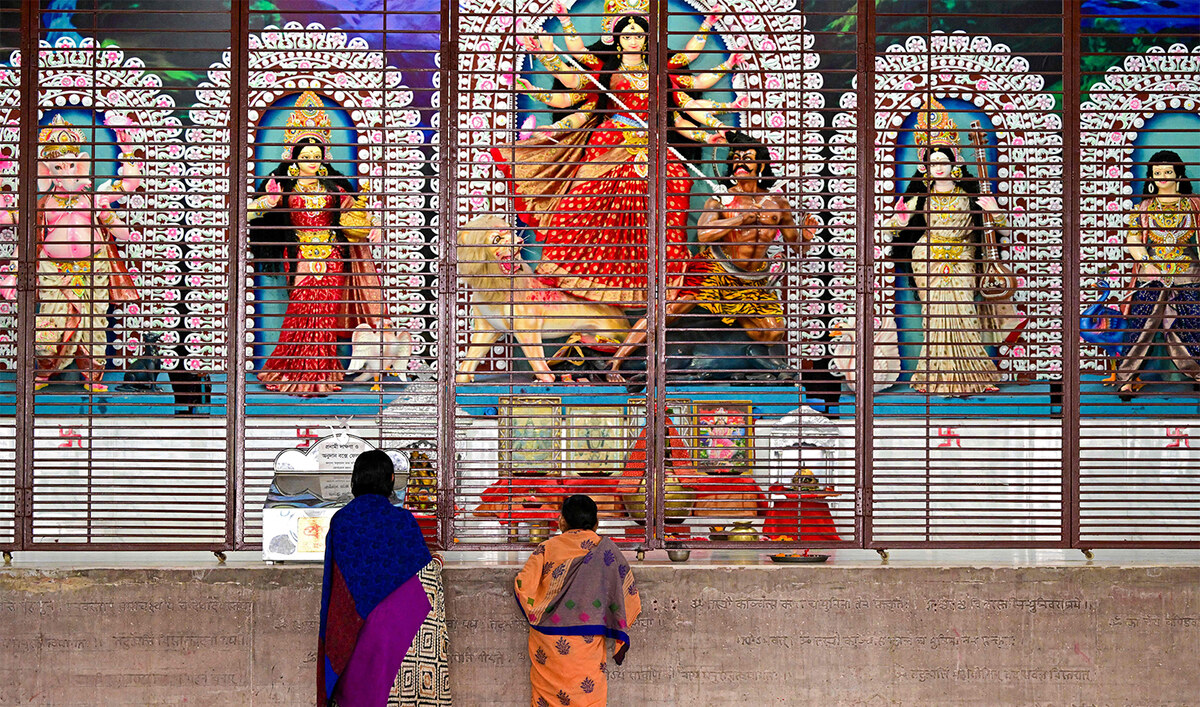
In this photograph taken on December 3, 2024, Hindu devotees pray at Dhakeshwari Temple in Dhaka. (AFP)
In the chaotic days following Hasina’s August 5 ouster there was a string of attacks on Hindus — seen by some as having backed her rule — as well as attacks on Muslim Sufi shrines by religious hard-liners.
“Neither I, my forefathers or the villagers, regardless of their faith, have ever witnessed such communal attacks,” temple guardian Ghosh told AFP.
“These incidents break harmony and trust.”
Hasina, 77, fled by helicopter to India, where she is hosted by old allies in New Delhi’s Hindu-nationalist government, infuriating Bangladeshis determined that she face trial for alleged “mass murder.”
Attacks against Hindu temples are not new in Bangladesh, and rights activist Abu Ahmed Faijul Kabir said the violence cannot be regarded out of context.
Under Hasina, Hindus had sought protection from the authorities. That meant her opponents viewed them as partisan loyalists.
“If you analyze the past decade, there has not been a single year without attacks on minorities,” Kabir said, from the Dhaka-based rights group Ain o Salish Kendra.
This year, from January to November, the organization recorded 118 incidents of communal violence targeting Hindus.
August saw a peak of 63 incidents, including two deaths. In November, there were seven incidents.
While that is significantly more than last year — when the group recorded 22 attacks on minorities and 43 incidents of vandalism — previous years were more violent.
In 2014, one person was killed, two women were raped, 255 injured, and 247 temples attacked. In 2016, seven people were killed.
“The situation has not worsened, but there’s been no progress either,” said businessman and Hindu devotee Chandan Saha, 59.
Political rulers had repeatedly “used minorities as pawns,” Saha added.
The caretaker government has urged calm and promised increased security, and accused Indian media of spreading disinformation about the status of Hindus in Bangladesh.
Dhaka’s interim government this month expressed shock at a call by a leading Indian politician — chief minister of India’s West Bengal state Mamata Banerjee — to deploy UN peacekeepers.
Hefazat-e-Islam, an association of Islamic seminaries, has led public protests against India, accusing New Delhi of a campaign aimed at “propagating hate” against Bangladesh. India rejects the charges.
Religious relations have been turbulent, including widespread unrest in November in clashes between Hindu protesters and security forces.
That was triggered by the killing of a lawyer during protests because bail was denied for an outspoken Hindu monk accused of allegedly disrespecting the Bangladeshi flag during a rally.
Bangladeshi hard-line groups have been emboldened to take to the streets after years of suppression.
Muslim Sufi worshippers as well as members of the Baul mystic sect — branded heretics by some hard-liners — have also been threatened.
“There’s been a wave of vandalism,” said Syed Tarik, a devotee documenting such incidents.
Muhammad Yunus, the 84-year-old Nobel Peace Prize winner appointed the country’s “chief adviser,” has called for dialogue between groups.
Critics say it is not enough.
“To establish a peaceful country where all faiths coexist in harmony, the head of state must engage regularly with faith leaders to foster understanding,” said Sukomal Barua, professor of religion at Dhaka University.
Sumon Roy, founder of Bangladesh’s association of Hindu lawyers, said members of the minority were treated as a bloc by political parties.
“They have all used us as tools,” Roy said, explaining that Hindus had been previously threatened both by Hasina’s Awami League and its rival Bangladesh National Party.
“If we didn’t support AL we faced threats, and the BNP blamed us for siding with the AL,” he said. “This cycle needs to end.”


