

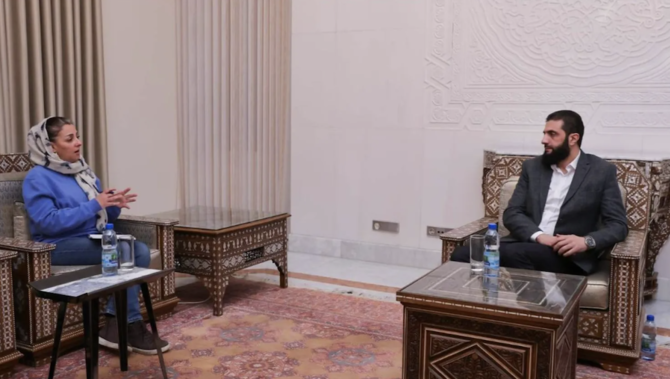

DAMASCUS: Ahmed Al-Sharaa, the head of the new Syrian administration, praised progress made by Saudi Arabia and neighboring Gulf countries in an interview with Asharq Al-Awsat published on Friday.
Speaking to the newspaper’s Bissane El-Cheikh at the Presidential Palace in Damascus on Thursday, he lauded the Gulf’s development, saying: “We admire the development in Gulf countries, particularly Saudi Arabia’s bold plans and vision, and we aspire to achieve similar progress for Syria.”
He added: “There are many opportunities for cooperation, especially in economic and developmental areas, where we can align our goals.”
During the interview, he also said that “the Syrian revolution ended with the regime's fall, and we will not allow it to spread elsewhere.”
Al-Sharaa stressed that Syria “will not be used to attack or destabilize any Arab or Gulf country.”
He said the Syrian opposition’s actions had “set the Iranian project in the region back by 40 years.”
Asked why Syria has yet to send a direct message to the Gulf and major Arab nations, Al-Sharaa responded by saying that his country has much to say to its Arab neighbors.
“Syria had become a platform for Iran to control key Arab capitals, spread wars, and destabilize the Gulf with drugs like Captagon,” he said.
He added: “By removing Iranian militias and closing Syria to Iranian influence, we’ve served the region’s interests—achieving what diplomacy and external pressure could not, with minimal losses.”
Al-Sharaa also criticized efforts to restore ties with the former Syrian regime, including its return to the Arab League in exchange for concessions.
“We were confident this would fail because we knew the regime would not make any genuine concessions or approach these overtures in good faith,” he said.
He claimed that during a meeting with Jordanian officials, the former regime was asked why it insisted on exporting Captagon to Jordan.
“The response was that it would not stop unless sanctions were lifted," Al-Sharaa said, adding “this is not how the regime operates.”
He emphasized that Gulf strategic security has since improved. “Today, the Iranian project in the region has been pushed back 40 years, making the Gulf more secure and stable.”
When asked if he would give reassurances on Syria not becoming a refuge for certain figures, Al-Sharaa dismissed concerns about hosting figures who cause concern for some Arab nations, saying Syria will not become a haven for controversial individuals.
“We are now focused on state-building. The revolution ended with the regime's fall, and we will not allow it to spread elsewhere. Syria will not be a platform to threaten or unsettle any Arab or Gulf country,” he said.
Al-Sharaa stressed that Syria seeks to rebuild and strengthen ties with Arab nations. “Syria is tired of wars and being used for others’ agendas. We want to restore trust and rebuild our country as part of the Arab world.”
On Syria’s relationship with its neighbor Lebanon, Al-Sharaa acknowledged concerns raised by Lebanese counterparts about him reaching Damascus, fearing it could strengthen one faction over another in Lebanon.
“We are not seeking any form of dominance over Lebanon,” he said. “We want a relationship based on mutual respect and exchange, without interfering in Lebanon’s internal affairs. We have enough work to do in our own country.”
Al-Sharaa emphasized Syria’s intention to maintain balanced relations, saying he aims “to stand equally with all Lebanese groups, and what pleases them, pleases us.”
Al-Sharaa was asked about a national dialogue conference and a new constitution to guide Syria’s future, and the mechanism that he plans to ensure inclusivity for all Syrians in the process, especially among the base of supporters and fighters who do not necessarily agree with his current moderate speech.
Al-Sharaa acknowledged differing opinions but emphasized he does not want to impose his personal views on Syrians.
“I believe in letting legal experts shape the relationship between citizens, with the law as the guide,” he said.
“Syria is diverse, and it's natural for there to be different opinions. This difference is healthy.”
Al-Sharaa stressed that the recent victory is for all Syrians, not one group over another.
“Even those we thought were loyal to the old regime expressed joy, as they had not been able to openly express their feelings before,” he noted.
He expressed confidence that Syrians, regardless of their background, are aware enough to protect their country.
“My aim is to reach a broad agreement and build a country where the rule of law helps resolve our differences,” Al-Sharaa concluded.
On the complex issue of forced disappearances and individuals missing in prisons and mass graves, Al-Sharaa said the previous regime was a criminal gang, not a political system.
“We fought a brutal group that committed crimes like arrests, forced disappearances, killings, displacement, starvation, chemical attacks, and torture,” he said.
He stressed that while the regime is gone, the focus should be on justice, not revenge.
“We must not approach this with a desire for vengeance,” he said.
Al-Sharaa stated that those responsible for crimes like the Saydnaya prison and chemical attacks must be held accountable.
“Their names are known and they must be pursued,” he said. He also affirmed that families have the right to file complaints against unknown perpetrators.
Al-Sharaa outlined efforts to address the issue of missing persons. “We’ve broken the barriers, and specialized organizations are now helping with this task,” he said.
A new ministry will be set up to track the fate of the missing, both the deceased and the living.
“This will also assist families with documents like death certificates and inheritance,” he added.
He acknowledged the challenge ahead but emphasized the need to uncover the truth. “This is a big task, but we must find the truth,” Al-Sharaa said.
When asked about hosting the interview at the People’s Palace, the same location where Bashar al-Assad once sat, Al-Sharaa responded with a light-hearted laugh.
“To be honest, I don’t feel comfortable at all,” he said. “But this is a place that should be open to the people, a site where they can visit and where children can play in these courtyards.”
* This article was originally published by Asharq Al-Awsat and can be read here.


