Pakistan stocks bounce back strongly a day after ‘massacre’ at bourse

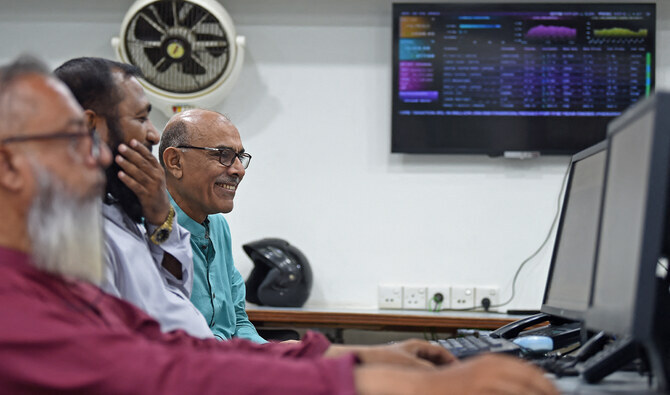
Stockbrokers monitor the latest share prices at the Pakistan Stock Exchange (PSX) in Karachi on July 3, 2023. (AFP/File)
Short Url
Updated 20 December 2024
Follow

Pakistan stocks bounce back strongly a day after ‘massacre’ at bourse

  • The KSE-100 index gained 3238 points to close the weekend trading session at 109,513 points
  • Stock analysts attribute strong recovery of the market to easing pressure at local mutual funds

ISLAMABAD: The Pakistan Stock Market on Friday bounced back strongly and gained more than 3,000 points, stock analysts said, a day after it witnessed a “massacre” on the back of significant redemptions from local mutual funds and year-end profit-taking.
The benchmark KSE-100 index gained 3238.17 points to close the weekend trading session at 109,513.14 points. On Thursday, the index plummeted by 5,132 points, or 4.32 percent, to close at 106,274.97 points, compared to Wednesday’s close of 111,070.29 points.
Stock analysts attributed the strong recovery to easing pressure at local mutual funds.
“Likely easing redemption pressure at local mutual funds together with the opening up of attractive valuations encouraged value buyers to reenter the market,” Raza Jafri, head of equities at Intermarket Securities, told Arab News.
Thursday’s slump was led by Hub Power Company Limited, United Bank Limited, Oil and Gas Development Company, and ENGRO, cumulatively contributing a staggering 1,556 points to the index’s overall decline, according to Topline Securities.
The sharp sell-off was triggered by significant redemptions from local mutual funds, compounded by year-end profit-taking by institutions, that dragged the market into a “turmoil,” it added.
The decline came days after Pakistan’s central bank cut its key interest rate by 200 basis points to 13 percent, marking the fifth straight reduction since June.
Yousuf M. Farooq, head of research at Chase Securities, said the market had entered a corrective phase, following a significant rally over the past year.
“We believe that earnings will now drive market performance rather than valuation rerating,” he added.


Planning minister says Pakistan to set up advanced technology centers to support economic growth

Updated 13 sec ago
Follow

Planning minister says Pakistan to set up advanced technology centers to support economic growth

  • Ahsan Iqbal says planned centers to focus on artificial intelligence, quantum computing and nanotechnology
  • He also cites satellite technology as key tool for climate monitoring, early warning and disaster management

ISLAMABAD: Pakistan plans to set up technology Centers of Excellence, including facilities focused on quantum computing and nanotechnology, as it seeks to benefit from rapid advances in artificial intelligence and emerging technologies, state media reported on Friday.

The announcement was made by Planning and Development Minister Ahsan Iqbal, who said the government aims to position Pakistan to compete in future technologies that are expected to drive economic growth and reshape global industries.

Quantum computing, which uses the principles of quantum mechanics to process information far more quickly than conventional computers, has applications ranging from complex data analysis and cryptography to climate modeling and materials science. Nanotechnology focuses on engineering materials at the molecular level and is widely used in energy storage, medicine and electronics.

Addressing a ceremony in Islamabad, Iqbal said countries that master artificial intelligence, robotics, quantum computing and space technologies would lead the global economy in the coming decades.

“During the address, the minister said Pakistan’s efforts to align itself with rapid advancements in artificial intelligence, robotics, space innovation and emerging technologies reflect the country’s ambition to participate confidently in shaping the future,” Radio Pakistan reported.

“Ahsan Iqbal further announced that the government plans to establish three Centers of Excellence, including a National Center for Quantum Computing and a National Center for Nanotechnology, aimed at upgrading the national economy,” it added.

He informed the ceremony that measures were underway to develop a new Silicon Valley in Pakistan “to promote cross-fertilization of ideas and innovation by bringing talent, research and industry together under one roof.”

The minister also highlighted the role of technology in tackling climate challenges, noting that satellite systems are increasingly used worldwide for disaster management, early warning systems and climate monitoring.

Pakistan, one of the world’s most climate-vulnerable countries, can benefit from satellite technology to track weather patterns, manage floods and improve disaster preparedness, he said, adding that more than 9,000 satellites currently orbit the Earth and are transforming how economies and governments operate.

Iqbal said the planned centers would support Pakistan’s broader “Uraan Pakistan” vision, which focuses on exports, digital development, energy and infrastructure, environmental resilience and social equity, Radio Pakistan reported.