

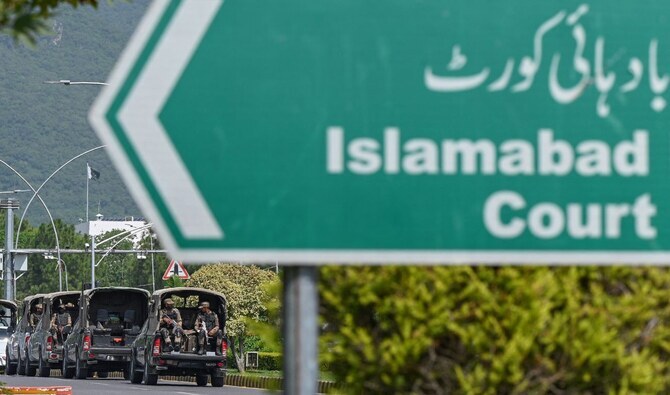

ISLAMABAD: Justice Babar Sattar of the Islamabad High Court (IHC) this week suspended an order by the Pakistan Electronic Media Regulatory Authority instructing TV channels to seek clearance from the military’s media wing before inviting retired military officers on current affairs programs as analysts.
Sattar was hearing a case challenging the much-debated April 2019 PEMRA notification, following which the Inter-Services Public Relations (ISPR) had released a list of 26 retired officers that it said were allowed to appear as defense analysts.PEM
“The Islamabad High Court has suspended a Pemra’s notification requiring defense analysts to obtain clearance from the ISPR before appearing on television programs,” Pakistan’s Dawn newspaper reported.
Most major Pakistani media outlets also reported on the development.
“Based on the presented arguments, the court suspended the notification, stating that it would remain ineffective until a final decision is announced in the case.”
The next hearing is scheduled for Feb. 11, 2025.
At a hearing of the case in September, Sattar had questioned the federal government on the military media wing’s “exclusive right” to decide who qualified to appear on TV as a defense analyst. The court also questioned why PEMRA had issued that notification in the first place and whether it had received a request from within the Pakistan army or ISPR.
PEMRA’s lawyer sought more time from the court to respond.
“Let PEMRA produce before the Court the original noting file on the basis of which the impugned notification was processed, recommended and issued to assist the Court as to why PEMRA felt the need to issue the said notification,” Justice Sattar wrote.
During that hearing, the court had asked PEMRA’s counsel about the watchdog’s authority to regulate the content of discussions on TV and issue directions for the pre-clearance of individuals by ISPR or others.
PEMRA’s lawyer pointed to Section 20-A of the PEMRA Ordinance, which relates to the obligation of licensees to uphold the sovereignty, integrity and security of Pakistan.
“When asked as to what does pre-clearance of individuals providing content on TV have to do with the sovereignty or security of Pakistan and how can PEMRA impose a prior restraint on speech, the learned counsel for PEMRA seeks further time to assist the Court,” the written order had read.
Pakistani journalist bodies and many journalists have long accused the government and the powerful military of censoring the press. Both deny allegations and insist they do not suppress the freedom of the press.
Sattar’s new order is not his first challenge to the army. He was among six Islamabad High Court judges who earlier this year wrote a letter to the Supreme Judicial Council watchdog and accused the military’s ISI spy agency of intimidating and coercing them over legal cases, particularly “politically consequential” ones.
The judges provided various examples of alleged interference, including a case concerning Pakistan’s imprisoned former prime minister Imran Khan. The letter also mentioned incidents where the judges said their relatives were abducted and tortured and their homes were secretly surveilled, aiming to coerce them into delivering favorable judgments in specific cases.
The army denies it interferes in political matters. It has so far refrained from commenting on the judges’ letter regarding the ISI’s alleged interference and intimidation.


