

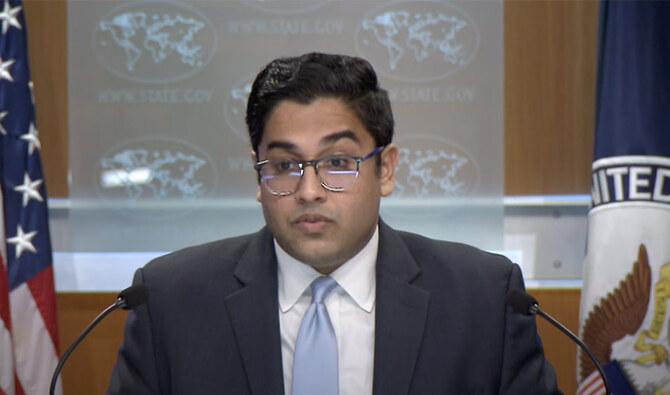

ISLAMABAD: Vedant Patel, a spokesman for the US Department of State, said on Thursday Washington hoped to continue to engage “constructively” with the Pakistani government on nuclear issues, including its concerns over the South Asian nation’s long-range ballistic missile program.
On Wednesday, the US said it was imposing new sanctions related to Pakistan’s long-range ballistic-missile program, including on the state-owned defense agency that oversees the program, the National Development Complex. State Department spokesperson Matthew Miller said the measures slapped on the NDC and three firms were imposed under an executive order that “targets proliferators of weapons of mass destruction and their means of delivery.” The sanctions freeze any US property belonging to the targeted entities and bars Americans from doing business with them.
Pakistan’s foreign ministry has called the US actions “unfortunate and biased” and said they would harm regional stability by “aiming to accentuate military asymmetries,” an apparent reference to the country’s rivalry with nuclear-armed India.
“The US is committed to maintaining the global nonproliferation regime, and Pakistan is an important partner in that. However, we have been clear and consistent about our concerns with Pakistan’s long-range ballistic missile program,” Patel told reporters at a press briefing, adding that it was a longstanding policy by Washington to deny support to Pakistan’s long-range ballistic missile program.
“The Department of State will continue to use sanctions and other tools to protect our national security and ensure that US exporters and US financial systems cannot be abused by proliferators. And it’s our hope to continue to engage constructively with the Pakistani Government on these issues,” the spokesman added.
He said the latest designations were based on US concerns regarding Pakistan’s long-range ballistic missile program, but didn’t affect other areas of US-Pakistan cooperation.
A State Department factsheet said the Islamabad-based NDC had sought to obtain components for the country’s long-range ballistic-missile program and missile-testing equipment. It said the NDC “is responsible for the development of Pakistan’s ballistic missiles,” including the Shaheen family of missiles.
The other entities slapped with sanctions were Affiliates International, Akhtar and Sons Private Limited and Rockside Enterprise, all located in Karachi, the factsheet said. It said the companies worked with the NDC to acquire equipment.
The Bulletin of the Atomic Scientists research organization says the Shaheen series of missiles is nuclear-capable.
Pakistan conducted its first nuclear-weapons test in 1998, becoming the seventh country to do so. The Bulletin estimates Pakistan’s arsenal at about 170 warheads.
Separately, US Deputy National Security Adviser Jon Finer on Thursday said Pakistan was developing long-range ballistic missile capabilities that eventually could allow it to strike targets well beyond South Asia, making it an “emerging threat” to the United States.
The senior White House official’s surprise revelation underscored how far the once-close ties between Washington and Islamabad have deteriorated since the 2021 US troop withdrawal from Afghanistan. It also raised questions about whether Pakistan has shifted the objectives of nuclear weapons and ballistic missile programs long intended to counter those of India, with which it has fought three major wars since 1947.
Speaking to the Carnegie Endowment for International Peace, Finer said Pakistan has pursued “increasingly sophisticated missile technology, from long-range ballistic missile systems to equipment, that would enable the testing of significantly larger rocket motors.”
If those trends continue, Finer said, “Pakistan will have the capability to strike targets well beyond South Asia, including in the United States.”
The number of nuclear-armed states with missiles that can reach the US homeland “is very small and they tend to be adversarial,” he continued, naming Russia, North Korea and China.
“So, candidly, it’s hard for us to see Pakistan’s actions as anything other than an emerging threat to the United States,” Finer said.
With inputs from Reuters


