

Pakistan naval chief holds defense cooperation, regional security talks during visit to Oman

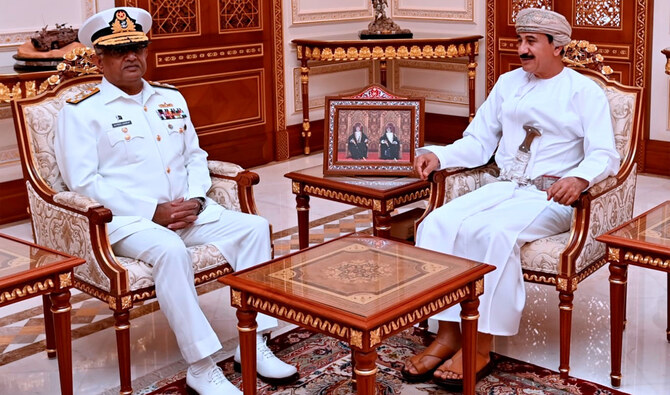
In this handout photograph released by the Pakistan Navy on December 19, 2024, Pakistan’s Chief of the Naval Staff, Admiral Naveed Ashraf, meets the Minister of Royal Office, General Sultan Mohammad Al Nu’amani in Muscat, Oman. (Photo Courtesy: Pakistan Navy)
Short Url
Updated 19 December 2024
Follow

Pakistan naval chief holds defense cooperation, regional security talks during visit to Oman

  • Oman is the nearest Arab country to Pakistan, because of which they share a maritime boundary
  • Last week, the Pakistan navy conducted joint naval exercises and drills with the Royal Oman ship ‘Alseeb’

ISLAMABAD: Pakistani naval chief Admiral Naveed Ashraf is on an official visit to Oman to discuss defense cooperation, smuggling and regional maritime security, the military’s media wing said on Thursday.

Oman is the nearest Arab country to Pakistan, because of which they share a maritime boundary. Pakistan shares a unique ‘blood bond’ with Oman, one third of whose population originates from Pakistan’s Balochistan province, while the southwestern port city of Gwadar, which is 200 nautical miles from Oman, was transferred to Pakistan in 1958, before which it had remained gifted to the Sultan of Oman for 175 years.

“During the meetings, the security situation in the Indian Ocean and joint defense cooperation were discussed,” the military’s media wing said after Ashraf had separate meetings with the minister of the Royal Office of the Sultanate of Oman, and the commanders of the Omani Royal Navy and National Defense College.

“Naval Chief highlighted the role of Pakistan Navy in preventing piracy and smuggling,” the statement said. “Pakistan Navy is a strong supporter of promoting maritime security in collaboration with other regional countries.”

Last week, the Pakistan navy conducted joint naval exercises and drills with Royal Oman ship ‘Alseeb.’ The bilateral naval exercise, “Samar Al-Tayeb,” is conducted regularly between the navies of the two nations.


Pakistan mulls space-based monitoring to support port expansion, maritime safety

Updated 10 sec ago
Follow

Pakistan mulls space-based monitoring to support port expansion, maritime safety

  • Minister says satellite technology could aid port planning and environmental protection
  • Islamabad seeks to modernize ports as it eyes transshipment role, Central Asian trade

KARACHI: Pakistan is considering the use of space-based monitoring systems to support port expansion, maritime safety and environmental protection, the country’s maritime affairs minister said on Wednesday, as he visited the headquarters of the national space agency.

The visit comes as Islamabad seeks to position itself as a transshipment hub by upgrading cargo handling, streamlining import and export processes and offering its southern ports on the Arabian Sea to landlocked Central Asian states as trade gateways.

“Advanced space-based monitoring systems can play a vital role in safeguarding seas, improving maritime management and strengthening responses to environmental threats,” Maritime Affairs Minister Muhammad Junaid Anwar Chaudhry said, according to a statement released after his visit.

Chaudhry was briefed on satellite-based assessments identifying potential sites for new ports, as well as tools for maritime traffic monitoring and disaster response.

Pakistan has been working to expand and modernize its port infrastructure to improve efficiency and attract regional cargo flows, particularly as it seeks to enhance connectivity through its coastline along the Arabian Sea.

During the visit, officials from the Pakistan Space and Upper Atmosphere Research Commission (SUPARCO) outlined the use of high-resolution satellite imagery, artificial intelligence and digital modelling to monitor ports, track cargo dwell time, detect oil spills and support search-and-rescue operations at sea.

“We can benefit from continuous monitoring of coastal ecosystems to assess water quality, sediment dispersion and overall environmental health,” Chaudhry said, adding that data-driven approaches were essential for informed policymaking in the maritime sector.

He also highlighted the growing risks posed by climate change, including rising sea levels, coastal erosion and extreme weather events, and said stronger cooperation between maritime authorities and scientific institutions was needed to protect coastal communities and infrastructure.

SUPARCO officials said the agency was ready to develop artificial intelligence-based solutions for ports and maritime operations, including systems to address customs-related inefficiencies and improve emergency response times.
The minister said the ministry and SUPARCO would move toward formalizing cooperation through a structured framework to support joint initiatives.
