

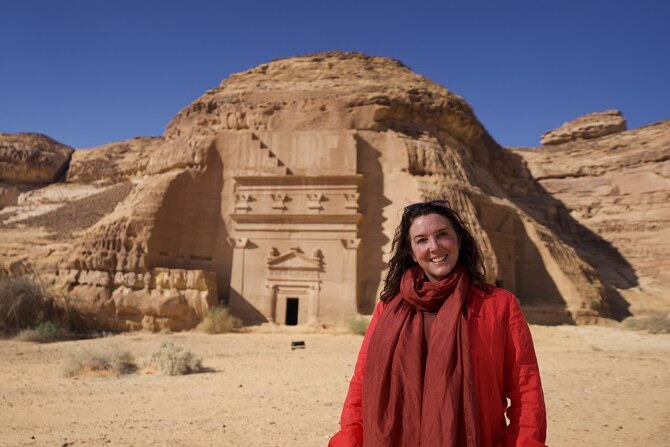

JEDDAH: For British historian Bettany Hughes, the story of the Nabateans is as vital as those of the ancient Greeks, Romans or Egyptians.
In a new three-part series, “Bettany Hughes' Lost Worlds: The Nabataeans,” Hughes traces the titular civilization’s incense trade routes from the Arabian Peninsula to the Mediterranean, accessing newly revealed research across Saudi Arabia’s Al Ula, Jordan, Greece, Italy and Oman.
“For me, you can’t understand the classical world unless you understand the Nabataeans — they are the missing link in the story of society, because, in many ways, they were the engine that drove many other civilizations. They connected the far edges of the Arabian Peninsula with the center of Europe, and without them, that line of connection wouldn’t have happened,” Hughes told Arab News on the sidelines of this month’s Red Sea International Film Festival, where the show’s first episode was screened.
Her decades of research have revealed that Petra, the Nabateans’ iconic capital, was just a small part of a vast empire that is only now revealing its secrets.
“When you say, ‘These are the guys that built Petra,’ then people go, ‘Oh, yeah. I always wondered.’ But that’s why we’re doing this series; to remind the world that they have this whole other story, whole other centers of operation. And to try to write them back into history. They’re a very cool culture. I’m very impressed by them.
“They love happiness. They love liberty. Women seem to have a really strong role in their society. They’re all about trade and communication — and therefore understanding people beyond borders and boundaries. So, I think there’s a lot that we can learn from them as a culture,” she continued.
Hughes’ entry point to the Nabateans came almost three decades ago.

Hughes with local desert guides in Wadi AlFann, AlUla. (Supplied)
“It was initially through trying to do detective work on the trade network,” she explained. “I knew that the Romans were obsessed with incense. I knew that Tutankhamun was buried with incense balls in his tomb. And I thought, ‘So, who’s delivering that?’ Because I also knew that incense came from that southern edge of the Arabian Peninsula. So, who was in charge?
“And then I saw this coin of Aretas IV, who was probably the most powerful of all the Nabatean kings. And Huldu, his queen, was also on the coin. And I just thought that that doesn’t happen often. That’s really interesting, so I needed to get to the bottom of their story,” Hughes added.
And since Saudi Arabia’s AlUla has been opened up to the outside world over the past few years, Hughes jumped on the opportunity to learn more about the civilization that’s recurrently appeared on the edges of her research efforts.
She first travelled to the historic site in 2022, heading deep into the deserts of AlUla, even spending time with the still-existing Bedouin communities there, tracing how the Nabateans traversed the harsh landscape with their camels and the stars as guides.
The first episode of “Lost Worlds” is dedicated entirely to AlUla, in the second episode they visit Europe, before heading to Petra in the third and final episode.
Hughes credited her love for history to one of her schoolteachers.
“When I was growing up, history wasn’t fashionable. People would say, ‘Oh, it’s irrelevant. All the answers lie in the future.’ And I just knew that couldn’t be true — that there was this reservoir of ideas and inspiration and understanding that came in the past,” she said. “And then I had a brilliant teacher who said, ‘Go for it. Even if you’re unpopular, even if people are saying no, make it happen.’ That kind of gave me the confidence to plow ahead.
“I then went to Oxford to study history, and I was very aware that in the official stories of the world that I was reading as a student, women didn’t feature very much. Even though I knew, obviously, we’d been 50 percent of the human population forever, we only occupied a tiny percentage of recorded history. So I felt that was something I could help with,” she continued. “I don’t just write about women’s history, but I’m always looking for the gaps — and the story of the female role in history is one of those gaps that needs filling.”


