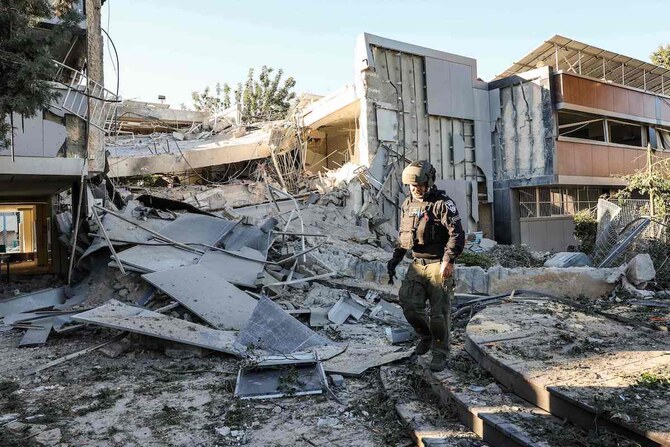
SANAA: Yemen’s Iran-backed Houthis said Israeli air strikes on Thursday killed nine people, after the group fired a missile toward Israel, badly damaging a school.
Israeli Prime Minister Benjamin Netanyahu threatened further retaliation.
The Houthis, who control most of Yemen’s population centers, have repeatedly launched missiles at Israel since the Gaza war broke out more than a year ago.
Israel has previously hit back against targets in Yemen, but Thursday’s were the first against the Houthi-held capital Sanaa.
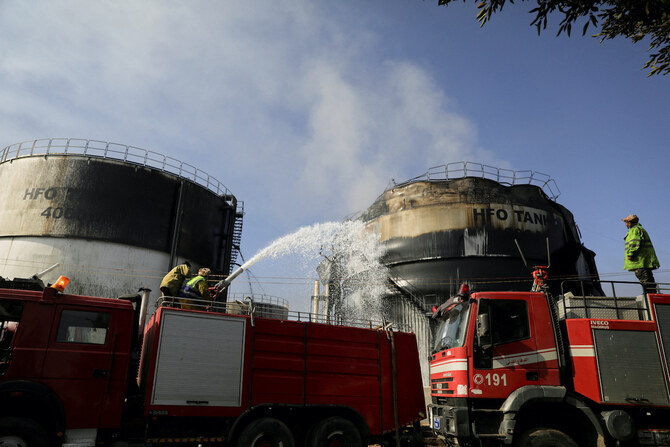
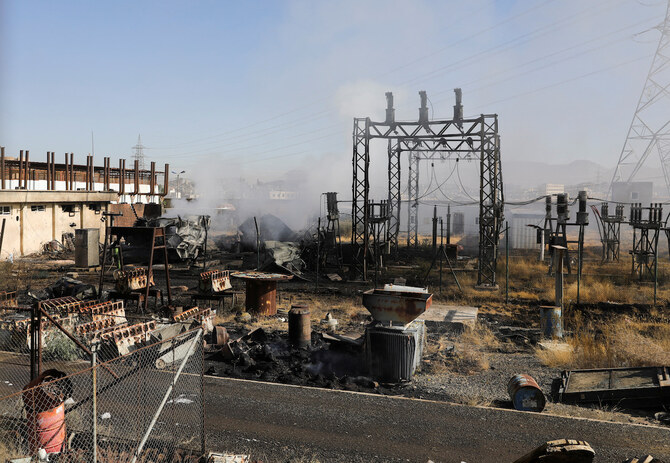
“The Israeli enemy targeted ports in Hodeida and power stations in Sanaa, and the Israeli aggression resulted in the martyrdom of nine civilian martyrs,” Houthi leader Abdul Malik Al-Houthi said in a lengthy speech broadcast by the Houthi’s Al-Masira TV.
Al-Masira had earlier reported the raids that “targeted two central power plants” in and around Sanaa, while in Hodeida it said “the enemy launched four aggressive raids targeting the port... and two raids targeting” an oil facility.
It said the strikes killed seven people at Al-Saleef port, while two more were killed and others wounded in the strike on the oil facility.
Hodeida is a key entry point for fuel and humanitarian aid to impoverished Yemen, which has been ravaged for years by its own war.
Israel said it struck the targets in Yemen after intercepting a missile fired from the country, a strike the Houthis subsequently claimed.
Houthi spokesman Yahya Saree said the militia fired ballistic missiles at “two specific and sensitive military targets... in the occupied Yaffa area,” referring to the Jaffa region near Tel Aviv.
Israel’s military said it “conducted precise strikes on Houthi military targets in Yemen — including ports and energy infrastructure in Sanaa, which the Houthis have been using in ways that effectively contributed to their military actions.”
AFP photos from Ramat Gan, in the Tel Aviv area, showed part of a school building pancaked from an explosion, behind a sculpture of an animal with polka dots.
The Houthis said later that they launched a drone at a “military target of the Israeli enemy in the occupied Yaffa area.” There was no confirmation from the Israeli side.
The military said inquiries into the initial attack showed “it is likely that the damage was caused by partial interception of the missile launched from Yemen and that the missile warhead was the part that exploded and damaged the school.”
The Houthis belong to the Iran-backed “axis of resistance,” along with Lebanese militant group Hezbollah, which has been weakened after a conflict with Israel and the loss of its Syrian supply line following former president Bashar Assad’s ouster.
“After Hamas, Hezbollah, and the Assad regime in Syria, the Houthis are almost the last remaining arm of Iran’s axis of evil,” Netanyahu said.
“The Houthis are learning and will learn the hard way, that those who strike Israel will pay a very heavy price for it.”
The Houthi leader retorted: “We are fully convinced of our position and are ready to confront any level of escalation.”
Israel’s military had initially announced the interception of a missile launched from Yemen “before it crossed into Israeli territory.”
Iran denounced the subsequent Israeli raids as a “flagrant violation of the principles and norms of international law and the UN Charter.”
Palestinian militant group Hamas, at war with Israel in Gaza, called Israel’s retaliatory strikes a “dangerous development.”
Thursday’s missile interception was the second this week, after Israel’s military said it intercepted a launch from Yemen on Monday. The Houthis also claimed that launch, saying it was aimed at “a military target of the Israeli enemy in the occupied area of Yaffa.”
Also Monday, an Israeli navy missile boat intercepted a drone in the Mediterranean after it was launched from Yemen, the military said.
The Houthis have said they are acting in solidarity with Palestinians and pledged Monday to continue operations “until the aggression on Gaza stops and the siege is lifted.”
On December 9, a drone claimed by Houthis exploded on the top floor of a residential building in the central Israel city of Yavne, causing no casualties.
In July, a Houthi drone attack in Tel Aviv killed an Israeli civilian, prompting retaliatory strikes on Hodeida which killed at least nine people, according to the Houthis.
The Houthis have also regularly targeted shipping in the Red Sea and the Gulf of Aden, leading to retaliatory strikes on Houthi targets by United States and sometimes British forces.
Israeli military spokesman Daniel Hagari said the Houthis had become a “global threat,” pointing to Iran’s support for the Houthis.
“We will continue to act against anyone, anyone in the Middle East, that threatens the state of Israel.”

Yemen’s Houthis say Israeli strikes kill 9 after missile attack
https://arab.news/bgsf3
Yemen’s Houthis say Israeli strikes kill 9 after missile attack
- Raids ‘targeted two central power plants’ in Yemen’s capital Sanaa
- Netanyahu says Houthis will pay 'very heavy price' for harming Israel
A year after Bashar Assad fled, Syria struggles to heal
HOMS, Syria: A year ago, Mohammad Marwan found himself stumbling, barefoot and dazed, out of Syria’s notorious Saydnaya prison on the outskirts of Damascus as rebel forces pushing toward the capital threw open its doors to release the prisoners.
Arrested in 2018 for fleeing compulsory military service, the father of three had cycled through four other lockups before landing in Saydnaya, a sprawling complex just north of Damascus that became synonymous with some of the worst atrocities committed under the rule of now ousted President Bashar Assad.
He recalled guards waiting to welcome new prisoners with a gauntlet of beatings and electric shocks. “They said, ‘You have no rights here, and we’re not calling an ambulance unless we have a dead body,’” Marwan said.
His Dec. 8, 2024 homecoming to a house full of relatives and friends in his village in Homs province was joyful.
But in the year since then, he has struggled to overcome the physical and psychological effects of his six-year imprisonment. He suffered from chest pain and difficulty breathing that turned out to be the result of tuberculosis. He was beset by crippling anxiety and difficulty sleeping.
He’s now undergoing treatment for tuberculosis and attending therapy sessions at a center in Homs focused on rehabilitating former prisoners, and Marwan said his physical and mental situations have gradually improved.
“We were in something like a state of death” in Saydnaya, he said. “Now we’ve come back to life.”
A country struggling to heal
Marwan’s country is also struggling to heal a year after the Assad dynasty’s repressive 50-year reign came to an end following 14 years of civil war that left an estimated half a million people dead, millions more displaced, and the country battered and divided.
Assad’s downfall came as a shock, even to the insurgents who unseated him. In late November 2024, groups in the country’s northwest — led by Hayat Tahrir Al-Sham, an Islamist rebel group whose then-leader, Ahmad Al-Sharaa, is now the country’s interim president — launched an offensive on the city of Aleppo, aiming to take it back from Assad’s forces.
They were startled when the Syrian army collapsed with little resistance, first in Aleppo, then the key cities of Hama and Homs, leaving the road to Damascus open. Meanwhile, insurgent groups in the country’s south mobilized to make their own push toward the capital.
The rebels took Damascus on Dec. 8 while Assad was whisked away by Russian forces and remains in exile in Moscow. But Russia, a longtime Assad ally, did not intervene militarily to defend him and has since established ties with the country’s new rulers and maintained its bases on the Syrian coast.
Hassan Abdul Ghani, spokesperson for Syrian Ministry of Defense, said HTS and its allies had launched a major organizational overhaul after suffering heavy losses in 2019 and 2020, when Assad’s forces regained control of a number of formerly rebel-controlled areas.
The rebel offensive in November 2024 was not initially aimed at seizing Damascus but was meant to preempt an expected offensive by Assad’s forces in opposition-held Idlib, Abdul Ghani said.
“The defunct regime was preparing a very large campaign against the liberated areas, and it wanted to finish the Idlib file,” he said. Launching an attack on Aleppo “was a military solution to expand the radius of the battle and thus safeguard the liberated interior areas.”
In timing the attack, the insurgents also aimed to take advantage of the fact that Russia was distracted by its war in Ukraine and that the Iran-backed Lebanese militant group Hezbollah, another Assad ally, was licking its wounds after a damaging war with Israel.
When the Syrian army’s defenses collapsed, the rebels pressed on, “taking advantage of every golden opportunity,” Abdul Ghani said.
Successes abroad, challenges at home
Since his sudden ascent to power, Al-Sharaa has launched a diplomatic charm offensive, building ties with Western and Arab countries that shunned Assad and that once considered Al-Sharaa a terrorist.
A crowning moment of his success in the international arena: in November, he became the first Syrian president since the country’s independence in 1946 to visit Washington.
But the diplomatic successes have been offset by outbreaks of sectarian violence in which hundreds of civilians from the Alawite and Druze minorities were killed by pro-government Sunni fighters. Local Druze groups have now set up their own de facto government and military in the southern Sweida province.
There are ongoing tensions between the new government in Damascus and Kurdish-led forces controlling the country’s northeast, despite an agreement inked in March that was supposed to lead to a merger of their forces.
Israel is wary of Syria’s new Islamist-led government even though Al-Sharaa has said he wants no conflict with the country. Israel has seized a formerly UN-patrolled buffer zone in southern Syria and launched regular airstrikes and incursions since Assad’s fall. Negotiations for a security agreement have stalled.
Meanwhile, the country’s economy has remained sluggish, despite the lifting of most Western sanctions. While Gulf countries have promised to invest in reconstruction projects, little has materialized on the ground. The World Bank estimates that rebuilding the country’s war-damaged areas will cost $216 billion.
Rebuilding largely an individual effort
The rebuilding that has taken place so far has largely been on a small scale, with individual owners paying to fix their own damaged houses and businesses.
On the outskirts of Damascus, the once-vibrant Yarmouk Palestinian camp today largely resembles a moonscape. Taken over by a series of militant groups then bombarded by government planes, the camp was all but abandoned after 2018.
Since Assad’s fall, a steady stream of former residents have been coming back.
The most heavily damaged areas remain largely deserted but on the main street leading into the camp, bit by bit, blasted-out walls have been replaced in the buildings that remain structurally sound. Shops have reopened and families have come back to their apartments. But any sort of larger reconstruction initiative appears to still be far off.
“It’s been a year since the regime fell. I would hope they could remove the old destroyed houses and build towers,” said Maher Al-Homsi, who is fixing his damaged home to move back to it even though the area doesn’t even have a water connection.
His neighbor, Etab Al-Hawari, was willing to cut the new authorities some slack.
“They inherited an empty country — the banks are empty, the infrastructure was robbed, the homes were robbed,” she said.
Bassam Dimashqi, a dentist from Damascus, said of the country after Assad’s fall, “Of course it’s better, there’s freedom of some sort.”
But he remains anxious about the still-precarious security situation and its impact on the still-flagging economy.
“The job of the state is to impose security, and once you impose security, everything else will come,” he said. “The security situation is what encourages investors to come and do projects.”
Marwan, the former prisoner, says the post-Assad situation in Syria is “far better” than before. But he has also been struggling economically.
From time to time, he picks up labor that pays only 50,000 or 60,000 Syrian pounds daily, the equivalent of about $5.
Once he finishes his tuberculosis treatment, he said, he plans to leave to Lebanon in search of better-paid work.