

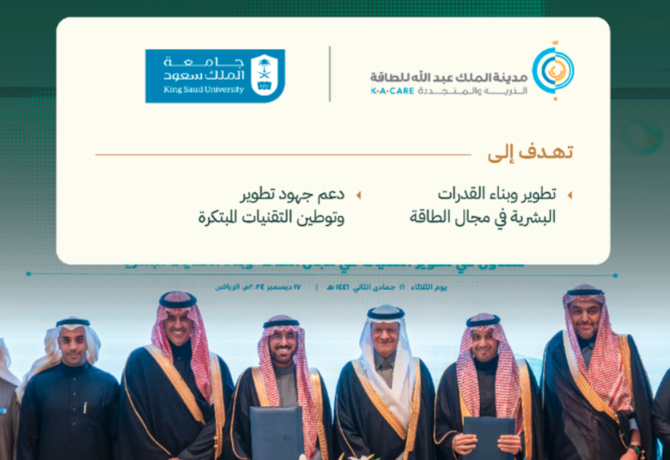
Saudi Arabia’s KACARE signs MoUs to propel energy innovation and empower women

King Abdullah City for Atomic and Renewable Energy has signed a range of agreements. X/@moenergy_saudi
Short Url
Updated 18 December 2024
Follow

Saudi Arabia’s KACARE signs MoUs to propel energy innovation and empower women

  • First MoU will focus on developing and localizing innovative technologies in the energy sector
  • Second deal signed with the Saudi Women and Energy Association will further reinforce the Kingdom’s commitment to empowering female workers

RIYADH: Saudi Arabia’s King Abdullah City for Atomic and Renewable Energy has signed new agreements to advance innovation, localize solutions, and empower women. 

The first memorandum of understanding, inked with King Saud University, will focus on developing and localizing innovative technologies in the energy sector, the Saudi Press Agency reported. 

The agreement also emphasizes building human capacity through training programs and the exchange of expertise, with a particular focus on technical and advisory services. 

This partnership supports Saudi Arabia’s Vision 2030, which aims to increase the Kingdom’s use of renewable energy and promote sustainability. 

It also aligns with Saudi Arabia’s goal of 50 percent of its electricity coming from renewable sources by the end of the decade.

In addition to these technological advancements, the MoU includes the development of educational programs and scholarships to help meet the growing demand for skilled professionals in the energy sector. 

The agreement also includes joint research initiatives in renewable energy, atomic energy, hydrogen technologies, and artificial intelligence applications within the energy field. This will provide valuable opportunities for students and researchers to contribute to the Kingdom’s energy transformation, the SPA report added.

KACARE also signed a second MoU with the Saudi Women and Energy Association, further reinforcing the Kingdom’s commitment to empowering female workers in the sector. 

This agreement focuses on launching comprehensive initiatives and programs aimed at supporting women to become leaders and innovators in energy. It includes training and development opportunities, such as the WE Spark program, which is dedicated to training women in renewable energy. 

This program is in partnership with King Abdullah University of Science and Technology and seeks to equip women with the skills necessary to excel in a rapidly evolving industry. 

The MoU also includes conducting studies to assess women’s participation in the energy sector. The research will identify key challenges and propose solutions to enhance women’s roles, ensuring equal opportunities in the workplace and supporting their development into leadership positions. 

In a further effort to empower women in the energy industry, KACARE signed another MoU with Princess Nourah University. This agreement aims to enhance female competencies in renewable energy through tailored training programs for female students pursuing engineering degrees. 

It also seeks to improve the capabilities of faculty members in providing specialized programs in solar energy, as well as upgrading infrastructure to support hydrogen production plants and solar photovoltaic energy projects. 


First EU–Saudi roundtable on critical raw materials reflects shared policy commitment

Updated 16 January 2026
Follow

First EU–Saudi roundtable on critical raw materials reflects shared policy commitment

RIYADH: The EU–Saudi Arabia Business and Investment Dialogue on Advancing Critical Raw Materials Value Chains, held in Riyadh as part of the Future Minerals Forum, brought together senior policymakers, industry leaders, and investors to advance strategic cooperation across critical raw materials value chains.

Organized under a Team Europe approach by the EU–GCC Cooperation on Green Transition Project, in coordination with the EU Delegation to Saudi Arabia, the European Chamber of Commerce in the Kingdom and in close cooperation with FMF, the dialogue provided a high-level platform to explore European actions under the EU Critical Raw Materials Act and ResourceEU alongside the Kingdom’s aspirations for minerals, industrial, and investment priorities.

This is in line with Saudi Vision 2030 and broader regional ambitions across the GCC, MENA, and Africa.

ResourceEU is the EU’s new strategic action plan, launched in late 2025, to secure a reliable supply of critical raw materials like lithium, rare earths, and cobalt, reducing dependency on single suppliers, such as China, by boosting domestic extraction, processing, recycling, stockpiling, and strategic partnerships with resource-rich nations.

The first ever EU–Saudi roundtable on critical raw materials was opened by the bloc’s Ambassador to the Kingdom, Christophe Farnaud, together with Saudi Deputy Minister for Mining Development Turki Al-Babtain, turning policy alignment into concrete cooperation.

Farnaud underlined the central role of international cooperation in the implementation of the EU’s critical raw materials policy framework.

“As the European Union advances the implementation of its Critical Raw Materials policy, international cooperation is indispensable to building secure, diversified, and sustainable value chains. Saudi Arabia is a key partner in this effort. This dialogue reflects our shared commitment to translate policy alignment into concrete business and investment cooperation that supports the green and digital transitions,” said the ambassador.

Discussions focused on strengthening resilient, diversified, and responsible CRM supply chains that are essential to the green and digital transitions.

Participants explored concrete opportunities for EU–Saudi cooperation across the full value chain, including exploration, mining, and processing and refining, as well as recycling, downstream manufacturing, and the mobilization of private investment and sustainable finance, underpinned by high environmental, social, and governance standards.

From the Saudi side, the dialogue was framed as a key contribution to the Kingdom’s industrial transformation and long-term economic diversification agenda under Vision 2030, with a strong focus on responsible resource development and global market integration.

“Developing globally competitive mineral hubs and sustainable value chains is a central pillar of Saudi Vision 2030 and the Kingdom’s industrial transformation. Our engagement with the European Union through this dialogue to strengthen upstream and downstream integration, attract high-quality investment, and advance responsible mining and processing. Enhanced cooperation with the EU, capitalizing on the demand dynamics of the EU Critical Raw Materials Act, will be key to delivering long-term value for both sides,” said Al-Babtain.

Valere Moutarlier, deputy director-general for European industry decarbonization, and directorate-general for the internal market, industry, entrepreneurship and SMEs at European Commission, said the EU Critical Raw Materials Act and ResourceEU provided a clear framework to strengthen Europe’s resilience while deepening its cooperation with international partners.

“Cooperation with Saudi Arabia is essential to advancing secure, sustainable, and diversified critical raw materials value chains. Dialogues such as this play a key role in translating policy ambitions into concrete industrial and investment cooperation,” she added.