

Pakistan postpones vaccine drive in province with highest number of cases this year

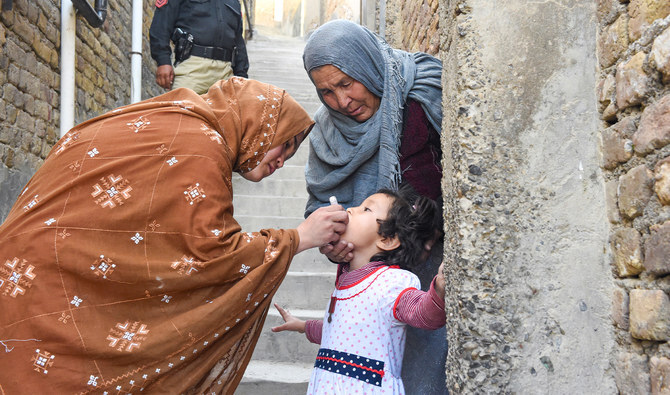
A health worker administers polio vaccine drops to a child during a vaccination campaign in Quetta, Pakistan, on October 24, 2022. (AFP/File)
Short Url
Updated 18 December 2024
Follow

Pakistan postpones vaccine drive in province with highest number of cases this year

  • Of 63 cases confirmed in Pakistan this year, 26 are from southwestern Balochistan province
  • Pakistan has launched nationwide drive to vaccinate 44 million children from Dec. 16-22

QUETTA: Authorities in Pakistan’s Balochistan on Tuesday cited a lack of preparedness as they announced that a planned polio vaccine campaign in the province was being postponed until Dec. 30, a staggering blow for a region that has reported the highest number of cases of the crippling virus this year. 

Pakistan on Monday launched the latest nationwide drive to vaccinate 44 million children in 143 districts from Dec. 16-22 amid a surge in polio cases compared to previous years, with the 2024 tally reaching 63 last week.

In Balochistan province, which has reported the highest number of polio cases this year, 26, the anti-polio drive was first postponed by a day on Monday due to security reasons.

However, the campaign was not launched on Tuesday as planned, with the Provincial Emergency Operation Center (EOC) saying it would now start on Dec. 30 in all 36 districts of the remote, impoverished province that has for decades been plagued by an insurgency by separatist militants who frequently attack government officials, security forces and investment projects.

“The campaign will now start on December 30th,” the EOC said in a statement. “The latest nationwide anti-polio campaign in Balochistan has been postponed due to required preparations at the district level.”

Dr. Aftab Kakar, a senior health official in Quetta, said provincial authorities had decided to delay the vaccination drive due to a boycott by the Grand Health Alliance Balochistan, an umbrella organization representing health care workers in the province.

“Paramedical staff was involved with us [previously] … but we have prepared a new strategy now,” he told Arab News. “We won’t hire those paramedics who boycotted the latest anti-polio drive in Balochistan, and a decision has been made to hire private staff who will serve in the next campaign starting from Decc. 30.”

Jamal Shah, a representative of the alliance, said the paramedics had not boycotted the campaign but were registering their protest against the involvement of “medically unskilled” people locally hired by deputy commissioners to take part in the campaigns.

“Balochistan has the highest number of polio cases in Pakistan this year due to the participation of non-technical government staff in anti-polio campaigns,” he told Arab News. “Negligence of unskilled staffers defames the provincial health department.”

Polio is a paralyzing disease with no cure. Multiple doses of the oral polio vaccine and completion of the routine vaccination schedule for all children under the age of five are essential to provide high immunity against the virus.

Pakistan’s polio eradication efforts have faced several challenges in recent years, including militant attacks and misinformation spread by militants and conservative clerics.

Pakistan, along with neighboring Afghanistan, remains the last polio-endemic country in the world. In the early 1990s, the country reported around 20,000 cases annually but in 2018 the number dropped to eight cases. Six cases were reported in 2023 and only one in 2021.


Pakistan, ADB sign $730 loan agreements to boost SOE reforms, energy infrastructure

Updated 25 December 2025
Follow

Pakistan, ADB sign $730 loan agreements to boost SOE reforms, energy infrastructure

  • Both sign $330 million Power Transmission Strengthening Project and $400 million SOE Transformation Program loan agreements
  • Economic Affairs Division official says Transmission Project will secure Pakistan’s energy future by strengthening national grid’s backbone

KARACHI: Pakistan and the Asian Development Bank (ADB) on Thursday signed two loan agreements totaling $730 million to boost reforms in state-owned enterprises (SOEs) and energy infrastructure in the country, the bank said.

The first of the two agreements pertains to the SOE Transformation Program worth $400 million while the second loan, worth $330 million, is for a Power Transmission Strengthening Project, the lender said. 

The agreements were signed by ADB Country Director for Pakistan Emma Fan and Pakistan’s Secretary of Economic Affairs Division Humair Karim. 

“The agreements demonstrate ADB’s enduring commitment to supporting sustainable and inclusive economic growth in Pakistan,” the ADB said. 

Pakistan’s SOEs have incurred losses worth billions of dollars over the years due to financial mismanagement and corruption. These entities, including the country’s national airline Pakistan International Airlines, which was sold to a private group this week, have relied on subsequent government bailouts over the years to operate.

The ADB approved the $400 million loan for SOE reforms on Dec. 12. It said the program seeks to improve governance and optimize the performance of Pakistan’s commercial SOEs. 

Karim highlighted that the Power Transmission Strengthening Project will enable reliable evacuation of 2,300 MW from Pakistan’s upcoming hydropower projects, relieve overloading of existing transmission lines and enhance resilience under contingency conditions, the Press Information Department (PID) said. 

“The Secretary emphasized that both initiatives are transformative in nature as the Transmission Project will secure Pakistan’s energy future by strengthening the backbone of the national grid whereas the SOE Program will enhance transparency, efficiency and sustainability of state-owned enterprises nationwide,” the PID said. 

The ADB has supported reforms by Pakistan to strengthen its public finance and social protection systems. It has also undertaken programs in the country to help with post-flood reconstruction, improve food security and social and human capital. 

To date, ADB says it has committed 764 public sector loans, grants and technical assistance totaling $43.4 billion to Pakistan.