Wooden wonders of Baha — female artists revive artistic cultural heritage

1 / 3
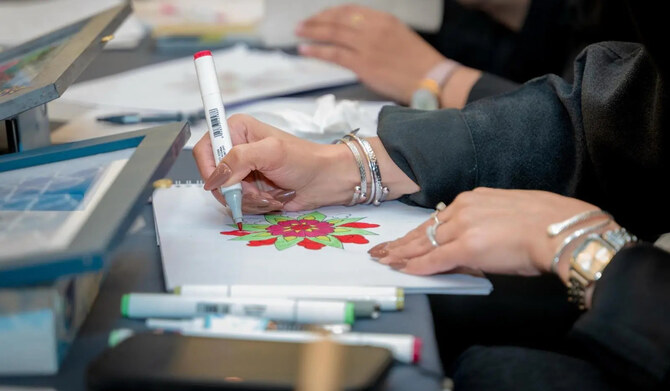
Those taking part learn traditional Islamic, geometric and floral decorative patterns, with several female artists creating striking designs. (SPA)
2 / 3
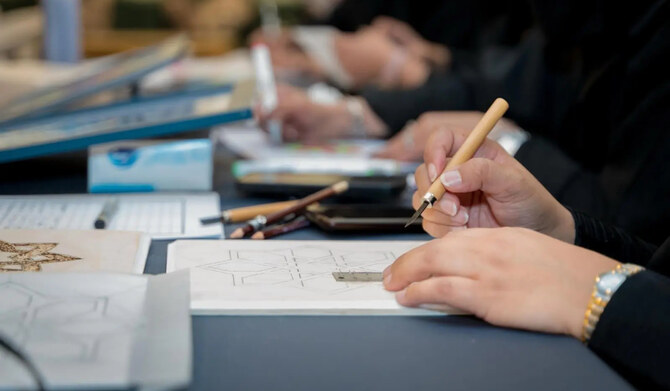
Those taking part learn traditional Islamic, geometric and floral decorative patterns, with several female artists creating striking designs. (SPA)
3 / 3
Those taking part learn traditional Islamic, geometric and floral decorative patterns, with several female artists creating striking designs. (SPA)
Short Url
Updated 17 December 2024
Follow

Wooden wonders of Baha — female artists revive artistic cultural heritage

  • The initiative particularly empowered women to master skills like wood carving, which are deeply embedded in the region’s cultural fabric and architectur

RIYADH: In the heart of Saudi Arabia’s Baha region a new wave of female artists is breathing life into centuries-old decorative arts, preserving a heritage once at risk of fading into obscurity.

The area’s architecture has long been a symbol of cultural richness. Visitors are intrigued by the artistry of Baha’s historic buildings with their carved wooden features. Etched, burned and painted, they are testimony to a vanishing craft.

The Saudi Arabian Society for Culture and Arts, backed by the Ministry of Culture, has initiated a series of workshops to revive these traditional skills.


Those taking part learn traditional Islamic, geometric and floral decorative patterns, with several female artists creating striking designs. (SPA)

Ali Al-Baidani, director of the society, said: “Through these workshops, notably the ornamental basics course, we preserve these centuries-old techniques while nurturing a new generation of interested individuals and artists,” he said.

So far, the 10-week program — which features a two-hour session every Saturday — has attracted 20 participants across a range of age groups. Those taking part learn traditional Islamic, geometric and floral decorative patterns, with several female artists creating striking designs.

Abdulaziz Al-Majthel, a calligrapher and visual artist, explained the curriculum covers these styles through both theoretical and hands-on training. Plans are also in hand to exhibit the most significant works produced during the workshops.

He added the initiative particularly empowered women to master skills like wood carving, which are deeply embedded in the region’s cultural fabric and architecture.

Laila Al-Hamid, who supervises the workshops, pointed out how art has historically been a marker of distinction in Baha, influencing everything from the decoration of doors, windows, and columns to personal artifacts.

Trainee Eidah Al-Zahrani said the workshop has transformed perspectives on wood carving and ornamentation, shifting it from a cultural identifier to a viable economic craft.

“Our ancestors carved wood with simple yet masterful strokes, creating a spiritual connection between artisan and craft that bridges time, place, authenticity, and history,” he said.

Badriya Al-Zahrani, another artist, added: “The workshop represents more than just skill development. This is about preserving a handicraft that has resisted both technology and time through programs and workshops organized by cultural institutions.”

In Baha, the legacy of ornamental art goes beyond architectural elements, influencing everyday items from farming tools to traditional attire, ensuring the region’s artistic heritage continues to thrive in contemporary times.


Saudi student Mohammed Al-Qasim ‘stabbed by stranger on drink, drugs,’ UK court hears

Updated 6 sec ago
Follow

Saudi student Mohammed Al-Qasim ‘stabbed by stranger on drink, drugs,’ UK court hears

  • 20-year-old ‘posed no threat to anybody’ when he was attacked in Cambridge last year
  • Jurors watch CCTV video of attack by man in high-vis jacket, BBC reports

LONDON: Saudi student Mohammed Al-Qasim died after being stabbed in Cambridge by a stranger who had been drinking and using drugs, prosecutors told a court in the UK city on Tuesday.

According to a BBC News website report of the trial at Cambridge Crown Court, prosecutor Nicholas Hearn said that the 20-year-old was sitting outside student accommodation on Aug. 1 last year when he was stabbed in the neck with a kitchen knife by Chas Corrigan.

CCTV cameras had recorded the attack along with Corrigan’s actions before and after the incident, he said.

Al-Qasim, a University of Jeddah student who had traveled to the UK to study at a language school during the summer, died just after midnight on Aug. 2.

Jurors watched CCTV video footage of the attack, which showed Al-Qasim running away after a confrontation with a man in a yellow high-vis jacket, the BBC report said.

The footage showed Corrigan, who was wearing the jacket, stabbing Al-Qasim, Hearn said.

“The reality is that, in this case, the footage speaks for itself,” he told the jurors.

Hearn said that Corrigan, 22, from Cambridge, had admitted being in possession of a knife at the time but denied murdering Al-Qasim.

Hearn said there was evidence that Corrigan had been drinking and taking drugs before the stabbing and had been “behaving crazily” in a pub.

“Mr Al-Qasim posed no threat to anybody. He was a student who had come to Cambridge to study from Saudi Arabia,” the lawyer said.

Hearn added that “the defendant was the aggressor here,” and that Al-Qasim had never met Corrigan.

Jane Osborne KC, Corrigan’s defense lawyer, said that her client had admitted he was the man in the CCTV video and that he had been carrying the knife, but had “no intention of using that knife,” the BBC report said.

Corrigan had aimed to wave the knife between himself and Al-Qasim, she said.

Corrigan denies murdering Al-Qasim and his trial is expected to last about two weeks.