
RIYADH: As Saudi Arabia’s cultural scene rapidly expands, Saudi female creatives are looking to the future but also the past by preserving and showcasing Saudi craftsmanship in their work.
Hana Almilli, Abeer AlRabiah and Rawan Al-Sehli weave their country’s heritage into innovative works that reflect today’s rapidly changing contemporary society.
Hana Almilli
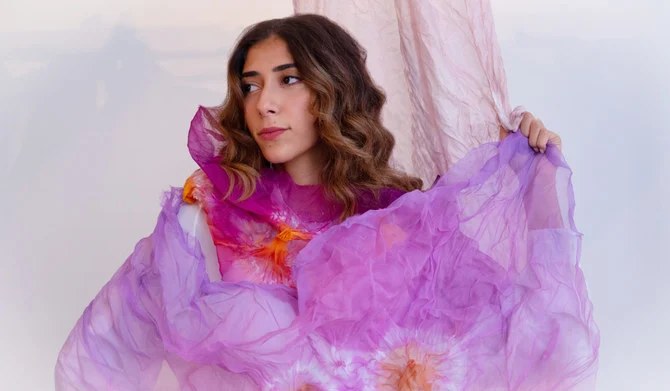
Riyadh-based multimedia artist, textile designer and poet Hana Almilli’s practice is research-based and explores the idea of resurrecting identities through the material culture of textiles and assemblages.

‘Memory Apparent’ by Abeer Alrabiah is a light sculpture that she calls the ‘evanescence of memories.’ the shadows represent forgotten memories. (Supplied/Abeer AlRabiah)
Almilli, who has Turkish, Syrian, Kurdish and Saudi heritage, explores questions of identity and alienation in her work, particularly through the representation of the term Al-Ghorba, which means estrangement in a foreign land in Arabic.
Her artwork incorporates elements of photography, embroidery, dyeing and weaving.
“My work ranges from embroidered printed silks, handwoven and naturally dyed textiles, and, lastly, jacquard woven textiles,” she told Arab News. “I incorporate craft by using traditional, yet, in a way, modern techniques of weaving, natural dyeing and embroidery to produce my work.”
HIGHLIGHT
As the Kingdom goes through cultural transformations, Saudi artists are embarking on an illustrious future with their pulse on the past. Hana Almilli, Abeer AlRabiah and Rawan Al-Sehli are Saudi women artists who are weaving their country’s heritage into innovative works of art that reflect today’s rapidly changing contemporary society.
In Riyadh-based Lakum Artspace’s recent exhibition “Performing Bodies,” Almilli presented “If Voice Has a Memory (2022).”
The work in a wood frame was made by weaving 100 percent naturally hand-dyed cotton threads, organic cotton, silk and stainless conductive thread.
Through the incorporation of mixed media, the installation focused on acts of remembering, nostalgia, and feelings of alienation from ancestry and heritage.

‘Memory transformed’ by Rawan Al-Sehli is ‘wearable art’ that preserves saudi heritage.
The sound component of the work incorporates found imagery and sound frequencies that Almilli relates to her Kurdish, Syrian, Turkish and Saudi heritage.
“Using found imagery and sound memories from Kurdistan, Syria, Turkiye and Saudi Arabia, the piece is a reflection of the interwoven cultures that make up my identity,” she said.
It not only explores sound as a medium for expression, but also investigates how different frequencies can act as a form of therapy, opening access to hidden memories, and building new avenues for recreating them.
“I have been constantly defined by topography and its alienness. Every piece of me has felt that I needed to belong somewhere, but have been longing for somewhere else, a home for my soul,” she said.
“In my years studying abroad, I have found that textiles have been the place where I belong, where that feeling of estrangement disappears. The act of embroidering, dyeing and shaping my textiles as if they were self-portraits was almost an act of shaping a home and my own geography. Within these pieces I lay the map of belonging, the map of being found.”
Abeer AlRabiah
As an industrial designer, Abeer AlRabiah, who recently completed a residency at the Misk Art Institute in Riyadh, incorporates various materials from different manufacturers, while imbuing her creations with references to Saudi heritage and craftmanship in a manner that is sustainable and environmentally friendly.
“In traditional Saudi crafts, people use materials that are available around them to create iconic traditional craftwork,” she told Arab News. “In a similar way, I picked existing used pieces of 7x7 cm wood that helped build multiple buildings in Saudi Arabia by holding concrete to be formed, and worked on them by hand to build my sculpture.”
During her residency with Misk Art, AlRabiah created “Memory Apparent,” a light sculpture embodying what she calls the “evanescence of memories.” It was made from 7x7 cm white-painted reclaimed wood pieces of various heights to form a 1x1x1-meter cube with a pulsating light inside.
“The cube looks more solid at the bottom, but at the top, I scattered the pieces of wood to create gaps between them that represent our memories that have faded,” she said.
“The light inside the sculpture deliberately casts shadows of the floating pieces of wood against the walls. These shadows are our forgotten memories; they are in the shadows and we can’t see them anymore. I created this light sculpture as a reminder for myself and others to try to enjoy the present since we don’t know if we’d be able to remember these moments in the future.”
AlRabiah is conducting research into traditional Saudi crafts. “I would like to design contemporary products while staying true to the local crafts we have in Saudi Arabia,” she said.
Rawan Al-Sehli
Jewelry designer Rawan Al-Sehli is on a mission to revive traditional Saudi jewelry through her hand-crafted contemporary designs.
Al-Sehli completed a residency at Misk Art Institute from September to December 2022, her first experience as a resident artist.
The collection she created during that time was titled “Memory Transformed.”
She often refers to her creations — a mix of jewelry techniques and research that revive and preserve Saudi architecture, history, culture and traditional jewelry — as “wearable art.”
“My research has been focused on reviving traditional practices used by our ancestors in Saudi Arabia that have faded due to globalization and technology, such as palm leaf and palm fronds, and the meaning of generosity in Saudi hospitality, and then reflected in modern jewelry pieces that were implemented in traditional ways,” she said.
“This is the art I present to the world. It is the jewelry stemming from research and facts that reflect the richness and diversity of the culture of Saudi Arabia.”
In each of her jewelry collections, Al-Sehli aims to reflect elements that profess the richness of Saudi architecture and heritage, as well as the diversity of cultures in the Kingdom.
Each collection is produced after recorded research with historians and facts, some of which require approval from Saudi universities and registered studies, she said.
“That’s really like winning a tough challenge, to reframe research and facts into wearable pieces of art,” Al-Sehli said.
“Words are not enough to describe my happiness with what Saudi Arabia is witnessing today regarding the country’s newfound interest in its traditional craftsmanship.
“I’m also proud to play a vital role, which is teaching traditional jewelry crafting in the Kingdom with the Royal Institute of Traditional Arts,” she said.
“I make sure that my jewelry is displayed internally and internationally. For me, it is a language, dialogue, and local and international discussion. There is a collection that reflects Islamic architecture and another that shows ancient civilizations, and more recently revives the traditional practices of our ancestors.”