ISLAMABAD: Pakistan’s telecom regulator on Tuesday proposed the establishment of a center of excellence at the Organization of Islamic Cooperation (OIC) to address cybersecurity challenges and ensure a secure digital future for its members.
The OIC is an intergovernmental organization comprising 57 Muslim countries. Established in 1969, it aims to promote unity, solidarity and cooperation among member states on political, economic, cultural and scientific issues.
The proposal to set up the center of excellence on cybersecurity was presented by Pakistan Telecommunication Authority (PTA) Chairman Major General (R) Hafeez Ur Rehman as he addressed the inaugural session of a two-day international workshop focusing on the issue that started earlier in the day.
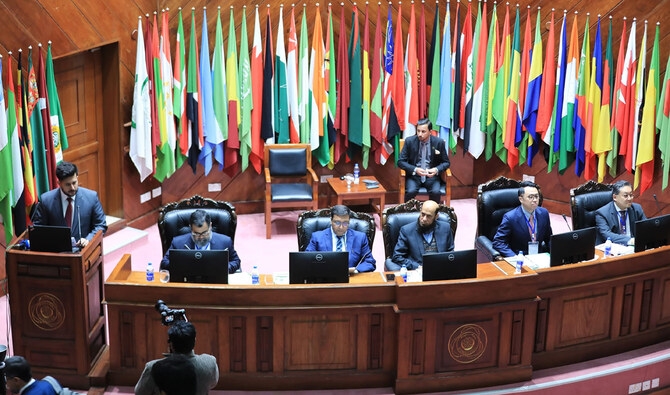
The workshop, jointly organized by the OIC Standing Committee on Scientific and Technological Cooperation (COMSTECH) and Huawei Technologies in Pakistan, has attracted over 300 participants from various countries, both in person and online.
Discussions focus on critical cybersecurity challenges and opportunities for OIC member countries.
“Cybersecurity is a subject which cannot be handled alone by an organization or a country,” Rehman said at the workshop. “We need collaborations by joining hands with each other, and we should establish a center of excellence at the OIC level to ensure a safe digital future for our people.”
The PTA chairman said that in an era where technology was pervasive, digitization had increased vulnerabilities, making it essential to adopt and deploy technologies that ensure safety, security and the protection of critical networks.
“In this collaboration, we can focus on research, training, sharing frameworks with each other and documenting our collective experiences,” he added.
Rehman highlighted that the PTA had developed vital regulations to guide the country’s telecom sector in protecting critical data infrastructure. He also pointed out that Pakistan currently ranks among the top 40 countries, according to the Global Cybersecurity Index (GCI) 2024 issued by the International Telecommunication Union (ITU).
“Previously, we were ranked 79th in the world,” he informed. “Now, we are 40th globally. This means we have advanced by nearly 30 positions in the cybersecurity domain.”
In his address, Prof. Dr. Muhammad Iqbal Choudhary, Coordinator General of COMSTECH, proposed an OIC ministerial conference on cybersecurity to facilitate experience sharing and the development of robust cyber defense systems across the Muslim world.
“To take this initiative forward, COMSTECH will organize two global cybersecurity forums in Central Asia and Africa in collaboration with Huawei and OIC-CERT [[Computer Emergency Response Team], focusing on capacity building and fostering linkages,” he added.
Sun Xiaofei, Chief Executive Officer of Huawei Technologies Pakistan, underscored the critical role played by tech firms in advancing cybersecurity initiatives and enhancing digital resilience.
“Huawei is committed to supporting OIC countries as they work to tackle cybersecurity challenges and protect their digital economies,” he said. “Being a technological leader in ICT, Huawei not only invests in cutting-edge technologies but also prioritizes securing the ecosystem, keeping cybersecurity at the top of its agenda.”
“Working with COMSTECH and OIC-CERT, we aim to help OIC countries formulate policies and frameworks to implement cybersecurity initiatives using our global experience and advanced technology,” he added.


![]()

Pakistan proposes cybersecurity center of excellence to bolster digital security for OIC nations
Short Url
https://arab.news/cwfts
Pakistan proposes cybersecurity center of excellence to bolster digital security for OIC nations
- Two-day workshop on cybersecurity challenges and opportunities for OIC nations is being hosted in Islamabad
- PTA chief informs the gathering Pakistan ranks among the top 40 nations in the Global Cybersecurity Index 2024
Latest updates





© 2026 SAUDI RESEARCH & PUBLISHING COMPANY, All Rights Reserved And subject to Terms of Use Agreement.