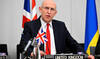
Saudi Arabia explores digital partnerships with Germany, Japan, France

1 / 2
Vice Minister of Communications and Information Technology Haytham Al-Ohali held discussions with officials from the three nations. SPA
2 / 2
Vice Minister of Communications and Information Technology Haytham Al-Ohali held discussions with officials from the three nations. SPA
Short Url
Updated 17 December 2024
Follow

Saudi Arabia explores digital partnerships with Germany, Japan, France

  • Vice minister of communications and information technology held discussions to strengthen collaboration in the digital economy space
  • Kingdom is working to position itself as a global leader in AI and digital transformation under Vision 2030

RIYADH: Saudi Arabia is exploring partnership opportunities with Germany, Japan, and France in emerging technologies, artificial intelligence, and digital infrastructure, as officials convened in Riyadh during the 19th Internet Governance Forum. 

Running from Dec. 15 to 19 at the King Abdulaziz International Conference Center, the UN-organized forum convened global leaders to promote international digital cooperation and address emerging challenges in Internet governance. 

On the sidelines, Vice Minister of Communications and Information Technology Haytham Al-Ohali held discussions with officials from the three nations to strengthen collaboration in the digital economy space. 

This comes as Saudi Arabia is working to position itself as a global leader in AI and digital transformation under Vision 2030. Goals include increasing the digital economy’s gross domestic product contribution from 14 percent in 2022 to 19.2 percent by 2025, digitizing 92 percent of government services, and raising the ICT sector’s GDP share to 4 percent. 

At the forum’s opening, the Kingdom unveiled the Riyadh Declaration, a commitment to developing inclusive and responsible AI technologies to address global challenges and drive economic value. 

Saudi Minister of Communications and Information Technology Abdullah Al-Swaha highlighted the declaration’s focus on AI’s role in increasing digital accessibility, enhancing digital literacy, protecting the environment, and promoting economic inclusion. 

He underscored the importance of ensuring fairness, inclusivity, and safety in the development and deployment of AI technologies while leveraging data for societal advancement. 

“The Kingdom is committed to addressing key challenges such as unequal access to algorithms, data, and computing resources,” Al-Swaha said. 

As part of its Vision 2030 goals, the Kingdom plans to provide high-speed broadband access to 90 percent of households in densely populated cities, implement nationwide e-invoicing to enhance tax compliance, and rank among the world’s top 15 countries in AI by the end of this decade. 

Al-Ohali’s meeting with Stefan Schnorr, state secretary at Germany’s Ministry for Digital and Transport, focused on strengthening technical cooperation and promoting innovation. 

His talks with Takuo Imagawa, the vice minister for international affairs at Japan’s Ministry of Internal Affairs and Communications, explored Saudi-Japanese partnerships in AI and emerging technologies. 

Similarly, Al-Ohali’s meeting with French Ambassador for Digital Affairs Henri Verdier centered on advancing joint initiatives in technical innovation and the digital economy. 

Gulf Cooperation Council Secretary-General Jasem Al-Budaiwi underscored the significance of Saudi Arabia hosting the IGF, reflecting the Kingdom’s leadership in digital governance and commitment to Vision 2030’s objectives. 

“This enhances the Kingdom’s position as a key destination for global events aimed at achieving sustainable development across various sectors,” he said. 

Al-Budaiwi added that the event highlights Saudi Arabia’s communications, information technology, and digital government capabilities. 

The forum, attended by over 9,000 participants from 170 countries, features more than 300 sessions under themes such as Harnessing Innovation and Balancing Risks in the Digital Space, Advancing Human Rights and Inclusion in the Digital Age, and Improving Digital Governance for the Internet We Want. 

The event highlights Saudi Arabia’s growing influence in digital governance and its efforts to harness innovation to drive global sustainability and digital inclusion. 


US allows countries to buy Russian oil stranded at sea for 30 days

Updated 14 sec ago
Follow

US allows countries to buy Russian oil stranded at sea for 30 days

  • US issues 30-day license for stranded Russian oil purchases
  • Measure the latest by Trump administration to calm energy markets jolted by Iran war

The United States issued ​a 30-day license for countries to buy Russian oil and petroleum products currently stranded at sea in what Treasury Secretary Scott Bessent said was a step to stabilize global energy markets roiled by the Iran war.
The announcement comes a day after the US Energy Department said that the US would be releasing 172 million barrels of oil from the strategic petroleum reserve in an effort to curb sky-rocketing oil prices in the wake of the war in Iran. That release was part of a broader commitment by the 32-nation International Energy Agency to release 400 million barrels of oil. The agency said earlier on Thursday that he war in the Middle East ‌was creating the ‌biggest oil supply disruption in history. Bessent, in a statement on X ​released ‌hours ⁠after benchmark ​oil prices ⁠shot above $100 a barrel, said the measure was “narrowly tailored” and “short-term” and would not provide significant financial benefit to the Russian government.
“The temporary increase in oil prices is a short-term and temporary disruption that will result in a massive benefit to our nation and economy in the long-term,” Bessent said in the statement, echoing President Donald Trump.
Thursday’s license, which authorizes the delivery and sale of Russian crude oil and petroleum products loaded on vessels as of March 12, will remain valid through midnight Washington time on April 11, according to the text of the license posted on ⁠the Treasury Department’s website. The US Treasury previously issued a 30-day waiver on March ‌5 specifically for India, allowing New Delhi to buy Russian oil stuck ‌at sea. Among other measures to tame energy prices, Trump has already ordered ​the US International Development Finance Corporation to provide political ‌risk insurance and financial guarantees for maritime trade in the Gulf and said the US Navy ‌could escort ships in the region. In another attempt to control prices, the Trump administration is considering temporarily waiving a shipping rule known as the Jones Act to ensure energy and agricultural products can move freely between US ports, the White House said. Waiving the rule would allow foreign ships to carry fuel between US ports, potentially lowering costs and speeding deliveries.
“The president ‌is taking every action he can to lower prices ... unsanctioned oil that’s at sea to get that into the market, continuing to push our own ⁠producers to drill and ⁠expand production as fast and as far as they can, providing regulatory relief, and you’re going to see more and more in the days to come,” White House Deputy Chief of Staff Stephen Miller told Fox News’ “Primetime” program on Thursday.
There were about 124 million barrels of Russian-origin oil on water across 30 different locations globally as of Thursday, Fox News reported, adding that the US license would provide around five to six days of supply when taking into account the daily loss of oil from the Strait. Trump said earlier on Thursday the United States stood to make significant money from oil prices driven higher by the war, prompting criticism from some lawmakers who accused him of caring only about rich people.
US and Israeli strikes on Iran and the subsequent response by Tehran have widened regional tensions and paralyzed shipping through the Strait of Hormuz, disrupting vital ​Middle East oil and gas flows and sending energy ​prices higher.
Raising the stakes for the global economy, Iran’s Islamic Revolutionary Guard Corps says it will block oil shipments from the Gulf unless the US and Israeli attacks cease.