Syria’s ports working normally as Ukraine looks to supply staple foods

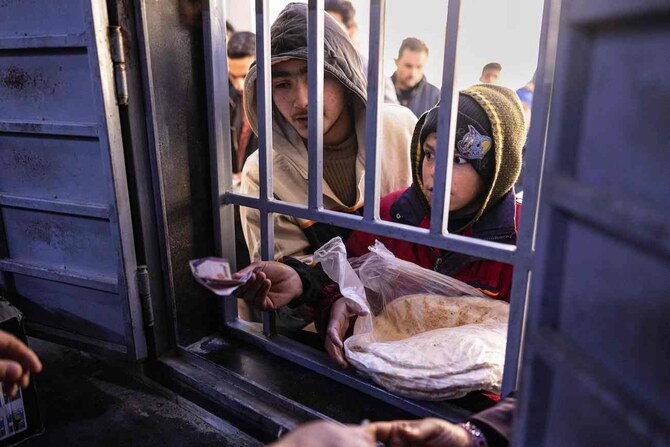
Syrians buy bread in the town of Douma on the outskirts of the capital Damascus on December 15, 2024. (AFP)
Short Url
Updated 16 December 2024
Follow

Syria’s ports working normally as Ukraine looks to supply staple foods

  • Ukrainian President Zelensky said on Saturday his government would set up mechanisms to deliver food to Syria together with international organizations

LONDON: Syria’s main ports are working normally after days of disruptions, maritime officials said on Monday, and Ukraine said it was in touch with the interim government about delivering staple foods.
President Bashar Assad was ousted on Dec. 8 by militant forces led by Hayat Tahrir Al-Sham. Since then, Israel has carried out airstrikes around Syria’s main port Latakia, and shipping sources also said ports had been short of workers.
On Monday, port official Hasan Jablawi told Reuters that Latakia was functioning normally and cargo ships that had been waiting for several days were unloading.
The Turkish-flagged Med Urla general cargo vessel was among the first ships to discharge and sail from Latakia on Monday, according to LSEG ship tracking data.
Shipping sources said Syria’s other main port Tartous was also operating, although there was a backlog to clear.
Russian and Syrian sources said on Friday that Russian wheat supplies to Syria had been suspended after two vessels carrying Russian wheat had failed to reach their destinations in Syria.
Russia, the world’s largest wheat exporter, had dominated wheat sales to Syria, according to shipping and trade sources, using complex financial and logistical arrangements to circumvent Western sanctions. Figures on Syria’s needs or stock levels were not readily available, however.
Ukrainian President Volodymyr Zelensky said on Saturday his government would set up mechanisms to deliver food to Syria together with international organizations and partners.
“We can help Syrians with Ukrainian wheat, flour, and oil,” he added in his daily wartime address on Sunday.
A Ukrainian industry source confirmed there was active communication with the Syrian administration over food shipments.


Syria Kurds impose curfew in Qamishli ahead of govt forces entry

Updated 58 min 34 sec ago
Follow

Syria Kurds impose curfew in Qamishli ahead of govt forces entry

  • The curfew came after Syrian security personnel entered the mixed Kurdish-Arab city of Hasakah and the countryside around the Kurdish town of Kobani on Monday

QAMISHLI: Kurdish forces imposed a curfew on Kurdish-majority Qamishli in northeastern Syria on Tuesday, ahead of the deployment of government troops to the city, an AFP team reported.
The curfew came after Syrian security personnel entered the mixed Kurdish-Arab city of Hasakah and the countryside around the Kurdish town of Kobani on Monday, as part of a comprehensive agreement to gradually integrate the Kurds’ military and civilian institutions into the state.
The Kurds had ceded territory to advancing government forces in recent weeks.
An AFP correspondent saw Kurdish security forces deployed in Qamishli and found the streets empty of civilians and shops closed after the curfew came into effect early on Tuesday.
It will remain in force until 6:00 am (0300 GMT) on Wednesday.
The government convoy is expected to enter the city later on Tuesday and will include a limited number of forces and vehicles, according to Marwan Al-Ali, the Damascus-appointed head of internal security in Hasakah province.
The integration of Kurdish security forces into the interior ministry’s ranks will follow, he added.
Friday’s deal “seeks to unify Syrian territory,” including Kurdish areas, while also maintaining an ongoing ceasefire and introducing the “gradual integration” of Kurdish forces and administrative institutions, according to the text of the agreement.
It was a blow to the Kurds, who had sought to preserve the de facto autonomy they exercised after seizing vast areas of north and northeast Syria in battles against Daesh during the civil war, backed by a US-led coalition.
Mazloum Abdi, head of the Kurdish-led Syrian Democratic Forces (SDF), had previously said the deal would be implemented on the ground from Monday, with both sides to pull forces back from frontline positions in parts of the northeast, and from Kobani in the north.
He added that a “limited internal security force” would enter parts of Hasakah and Qamishli, but that “no military forces will enter any Kurdish city or town.”