SAINT-DENIS DE LA REUNION: Rescuers raced against time Monday to reach survivors after a devastating cyclone ripped through the French Indian Ocean territory of Mayotte, destroying homes across the islands, with hundreds feared dead.
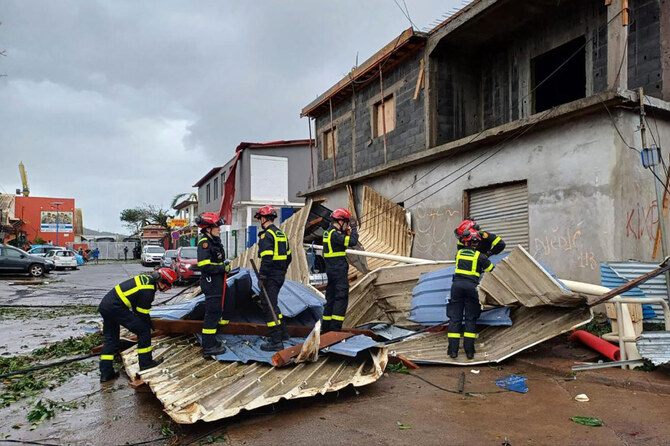
Images from Mayotte, which like other French overseas territories is an integral part of France and ruled from Paris, showed scenes of devastation, with homes reduced to piles of rubble.
The crisis, which erupted at the weekend the day after President Emmanuel Macron appointed Francois Bayrou as the sixth prime minister of his mandate, poses a major challenge for a government still only operating in a caretaker capacity.
The cyclone has left health services in tatters, with the hospital extremely damaged and health centers knocked out of operation, Health Minister Genevieve Darrieussecq told France 2.
“The hospital has suffered major water damage and destruction, notably in the surgical, intensive care, maternity and emergency units,” she said, adding that “medical centers were also non-operational.”
Macron was due to chair a crisis meeting in Paris at 1700 GMT, the Elysee said.
Interior Minister Bruno Retailleau, whose super ministry is responsible for Mayotte, arrived on the island.
Cyclone Chido caused major damage to Mayotte’s airport and cut off electricity, water and communication links when it barreled down on France’s poorest territory on Saturday.
Asked about the eventual death toll, Prefect Francois-Xavier Bieuville, the top Paris-appointed official on the territory, told broadcaster Mayotte la Premiere “I think there will definitely be several hundred, perhaps we will come close to a thousand or even several thousand.”
With roads closed, officials fear that many could still be trapped under rubble in the inaccessible areas.
The mayor of Mayotte’s capital Mamoudzou, Ambdilwahedou Soumaila, said the storm “spared nothing.”
“The hospital is hit, the schools are hit. Houses are totally devastated,” he said.
Some 160 additional soldiers and firefighters to reinforce the 110 already deployed.
The nearby French island of La Reunion was serving as a hub for the rescue operations.
Chido was packing winds of at least 226 kilometers per hour when it slammed into Mayotte, which lies to the east of Mozambique.
At least a third of the territory’s 320,000 residents live in shantytowns, where homes with sheet-metal roofs were flattened by the storm.
One resident, Ibrahim, said of “apocalyptic scenes” as he made his way through the main island, having to clear blocked roads himself.
As authorities assessed the scale of the disaster, a first aid plane reached Mayotte on Sunday.
It carried three tons of medical supplies, blood for transfusions and 17 medical staff, according to authorities in La Reunion.
Patrice Latron, prefect of Reunion, said residents of Mayotte were facing “an extremely chaotic situation, immense destruction.”
Two military aircraft are expected to follow the initial aid flight, while a navy patrol ship was also due to depart La Reunion.
There have been international pledges to help Mayotte, including from the regional Red Cross organization PIROI.
European Commission chief Ursula von der Leyen said the bloc is “ready to provide support in the days to come.”
The head of the World Health Organization, Tedros Adhanom Ghebreyesus, said the WHO “stands ready to support communities in need of essential health care.”
With around 100,000 people estimated to live clandestinely on Mayotte, according to France’s interior ministry, establishing how many people have been affected by the cyclone is proving difficult.
Ousseni Balahachi, a former nurse, said some people did not dare venture out to seek assistance, “fearing it would be a trap” designed to remove them from Mayotte.
Many had stayed put “until the last minute” when it proved too late to escape the cyclone, she added.
Chido is the latest in a string of storms worldwide fueled by climate change, according to experts.
The “exceptional” cyclone was super-charged by particularly warm Indian Ocean waters, meteorologist Francois Gourand of the Meteo France weather service said.
Chido blasted across the Indian Ocean and made landfall in Mozambique on Sunday, where officials said the death toll stood at three.
The UN humanitarian agency, OCHA, warned 1.7 million people were in danger and the remnants of the cyclone could also dump “significant rainfall” in Malawi through Monday.


![]()

Race against time for rescuers as hundreds feared dead in Mayotte
Short Url
https://arab.news/nwjd9
Race against time for rescuers as hundreds feared dead in Mayotte
- The cyclone has left French Indian Ocean territory’s health services in tatters
- Officials fear that many could still be trapped under rubble in the inaccessible areas


Latest updates




© 2026 SAUDI RESEARCH & PUBLISHING COMPANY, All Rights Reserved And subject to Terms of Use Agreement.