DAMASCUS: The United Nations told the leader of the Islamist Hayat Tahrir Al-Sham group which toppled Bashar Assad that Syria must have a “credible and inclusive” transition.
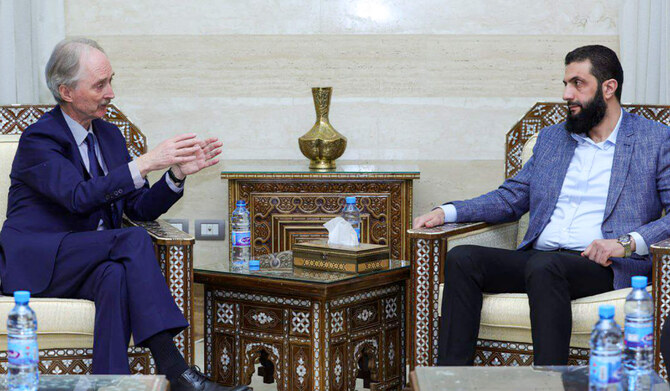
The UN special envoy for Syria, Geir Pedersen who arrived in Damascus on Sunday, has met Abu Mohammed Al-Golani — who now goes under his real name Ahmed Al-Sharaa — Pedersen’s office said Monday in a statement on Telegram.
He also met interim prime minister Mohammed Al-Bashir, it said.
Pedersen met them after Saturday’s international meeting on Syria in Jordan, and stressed “the need for a credible and inclusive Syrian-owned and led political transition based on the principles of United Nations Security Council resolution 2254 (2015).”
The UN envoy also underlined “the intention of the United Nations to render all assistance to the Syrian people,” and was briefed on their “challenges and priorities,” the statement added.
It said Pedersen had several engagements planned in the days ahead, but did not elaborate.
Assad was toppled by a lightning 11-day offensive that swept down from northwest Syria, with fighters entering the capital on December 8.
Abandoned by his Russian and Iranian backers, Assad fled into exile in Moscow, bring to an end five decades of abuses by his clan.
The HTS group that led his overthrow is a former branch of Al-Qaeda in Syria, and the United States and other Western governments still classify it as a “terrorist” group.
While hailing Assad’s downfall, several nations have said they will wait to see how Syria’s new Sunni Muslim authorities treat minorities in the multi-ethnic and multi-confessional country.
Several countries including the United States and Britain have said they have already made contact with Golani.


![]()


UN to HTS leader: Syria must have a ‘credible’ transition
Short Url
https://arab.news/2eyt9
UN to HTS leader: Syria must have a ‘credible’ transition
- Special envoy underlined ‘the intention of the United Nations to render all assistance to the Syrian people’


Sudan paramilitary used mass graves to conceal war crimes: ICC deputy prosecutor
UNITED NATIONS: Sudan’s paramilitary Rapid Support Forces carried out mass killings in Darfur and attempted to conceal them with mass graves, the International Criminal Court’s deputy prosecutor said on Monday.
In a briefing to the UN Security Council, Nazhat Shameem Khan said it was the “assessment of the office of the prosecutor that war crimes and crimes against humanity” had been committed in the RSF’s takeover of the city of El-Fasher in October.
“Our work has been indicative of mass killing events and attempts to conceal crimes through the establishment of mass graves,” Khan said in a video address, citing audio and video evidence as well as satellite imagery.
Since April 2023, a civil war between the Sudanese army and the RSF has killed tens of thousands, displaced 11 million and created the world’s largest displacement and hunger crisis.
Reports of mass killings, sexual violence, abductions and looting emerged in the wake of the RSF’s sweep of El-Fasher, which was the army’s last holdout position in the Darfur region.
Both warring sides have been accused of atrocities throughout the war.
Footage reviewed by the ICC, Khan said, showed RSF fighters detaining, abusing and executing civilians in El-Fasher, then celebrating the killings and “desecrating corpses.”
According to Khan, the material matched testimony gathered from affected communities, while submissions from civil society groups and other partners had further corroborated the evidence.
The atrocities in El-Fasher, she added, mirror those documented in the West Darfur capital of El-Geneina in 2023, where UN experts determined the RSF killed between 10,000 and 15,000 people, mostly from the Massalit tribe.
She said a picture was emerging of “appalling organized, widespread mass criminality.”
“It will continue until this conflict and the sense of impunity that fuels it are stopped,” she added.
Khan also issued a renewed call for Sudanese authorities to “work with us seriously” to ensure the surrender of all individuals subject to outstanding warrants, including former longtime president Omar Al-Bashir, former ruling party chairman Ahmed Haroun and ex-defense minister Abdul Raheem Mohammed Hussein.
She said Haroun’s arrest in particular should be “given priority.”
Haroun faces 20 counts of crimes against humanity and 22 war-crimes charges for his role in recruiting the Janjaweed militia, which carried out ethnic massacres in Darfur in the 2000s and later became the RSF.
He escaped prison in 2023 and has since reappeared rallying support for the Sudanese army.
Khan spoke to the UN Security Council via video link after being denied a visa to attend in New York due to sanctions in place against her by the United States.
In a briefing to the UN Security Council, Nazhat Shameem Khan said it was the “assessment of the office of the prosecutor that war crimes and crimes against humanity” had been committed in the RSF’s takeover of the city of El-Fasher in October.
“Our work has been indicative of mass killing events and attempts to conceal crimes through the establishment of mass graves,” Khan said in a video address, citing audio and video evidence as well as satellite imagery.
Since April 2023, a civil war between the Sudanese army and the RSF has killed tens of thousands, displaced 11 million and created the world’s largest displacement and hunger crisis.
Reports of mass killings, sexual violence, abductions and looting emerged in the wake of the RSF’s sweep of El-Fasher, which was the army’s last holdout position in the Darfur region.
Both warring sides have been accused of atrocities throughout the war.
Footage reviewed by the ICC, Khan said, showed RSF fighters detaining, abusing and executing civilians in El-Fasher, then celebrating the killings and “desecrating corpses.”
According to Khan, the material matched testimony gathered from affected communities, while submissions from civil society groups and other partners had further corroborated the evidence.
The atrocities in El-Fasher, she added, mirror those documented in the West Darfur capital of El-Geneina in 2023, where UN experts determined the RSF killed between 10,000 and 15,000 people, mostly from the Massalit tribe.
She said a picture was emerging of “appalling organized, widespread mass criminality.”
“It will continue until this conflict and the sense of impunity that fuels it are stopped,” she added.
Khan also issued a renewed call for Sudanese authorities to “work with us seriously” to ensure the surrender of all individuals subject to outstanding warrants, including former longtime president Omar Al-Bashir, former ruling party chairman Ahmed Haroun and ex-defense minister Abdul Raheem Mohammed Hussein.
She said Haroun’s arrest in particular should be “given priority.”
Haroun faces 20 counts of crimes against humanity and 22 war-crimes charges for his role in recruiting the Janjaweed militia, which carried out ethnic massacres in Darfur in the 2000s and later became the RSF.
He escaped prison in 2023 and has since reappeared rallying support for the Sudanese army.
Khan spoke to the UN Security Council via video link after being denied a visa to attend in New York due to sanctions in place against her by the United States.
Latest updates


© 2026 SAUDI RESEARCH & PUBLISHING COMPANY, All Rights Reserved And subject to Terms of Use Agreement.