

Israel aims to ‘double population’ in annexed Golan

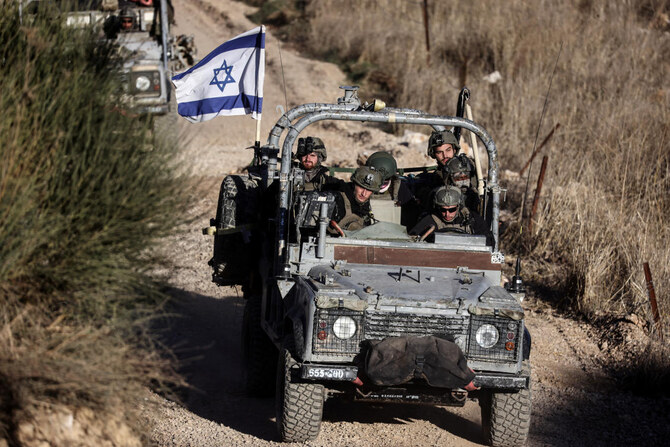
Israeli military vehicles ride through Syria close to the ceasefire line between the Israeli-occupied Golan Heights and Syria on December 15, 2024. (Reuters)
Short Url
Updated 16 December 2024
Follow

Israel aims to ‘double population’ in annexed Golan

  • Israel has occupied most of the Golan Heights since 1967 and annexed that area in 1981

JERUSALEM: The Israeli government approved on Sunday a plan to increase the population of the annexed Golan Heights, while insisting it had no intention of confronting Syria after seizing a UN-monitored buffer zone.

As Islamist-led militant forces swept Syrian president Bashar Assad out of power last week, Israeli Prime Minister Benjamin Netanyahu had ordered troops to seize the demilitarized zone between the two countries’ forces on the Golan Heights.

On Sunday, his office said the government approved a plan to double the population on the Israeli-held Golan Heights.

The government “unanimously approved” the 40 million shekel ($11 million) “plan for the demographic development of the Golan... in light of the war and the new front in Syria and the desire to double the population,” Netanyahu’s office said.

Israel has occupied most of the Golan Heights, a strategic plateau, since 1967 and annexed that area in 1981, a move recognized only by the United States.

Netanyahu said that “the strengthening of the Golan is that of the State of Israel, and it is particularly important at this time. We will continue to establish ourselves there, develop it and settle there.”

The occupied Golan is home to around 30,000 Israelis and about 23,000 Druze Arabs, whose presence predates the occupation and most of whom retain Syrian citizenship.

Saudi Arabia and Qatar swiftly denounced the Israeli move.

Riyadh’s foreign ministry expressed “condemnation and denunciation” of the plan in a statement, calling it part of the “continued sabotage of opportunities to restore security and stability in Syria.”

Doha said the Israeli declaration was a “new episode in a series of Israeli aggressions on Syrian territories and a blatant violation of international law.”

Last week, Netanyahu declared that the annexed Golan would be Israeli “for eternity.”

That followed an order he gave for troops to cross into the UN-patrolled buffer zone separating Israeli and Syrian forces since 1974. Troops have also operated in some areas outside the buffer zone “to maintain stability,” according to the military.

Israel portrayed the move, which drew international condemnation, as a temporary and defensive measure after what Netanyahu’s office called a “vacuum on Israel’s border and in the buffer zone,” following Assad’s fall.

A UN official in New York confirmed to AFP that peacekeeping force UNDOF “has noted a number of daily instances of the IDF (Israeli army) operating to the east of the buffer zone.”

Israeli Defense Minister Israel Katz has ordered troops to “prepare to remain” in the buffer zone throughout the winter months.

In the aftermath of Assad’s overthrow, Israel launched hundreds of strikes on Syria targeting strategic military sites and weapons, including chemical weapons.

On Sunday, the Israeli premier said his country had “no interest in confronting Syria. Israel’s policy toward Syria will be determined by the evolving reality on the ground.”

In a video statement following a phone call with US president-elect Donald Trump, Netanyahu said Syria had attacked Israel in the past and allowed others including Lebanese Hezbollah to do so from its territory.

“To ensure that what happened in the past does not happen again, we have taken a series of intensive actions in recent days,” he said.

“Within a few days, we destroyed capabilities that the Assad regime had built over decades.”

The Islamist militant leader whose group spearheaded the offensive that toppled Assad on Saturday accused Israel of “a new unjustified escalation in the region” by entering the buffer zone.

However, Abu Mohammed Al-Golani, who now goes by his real name Ahmed Al-Sharaa, said that “the general exhaustion in Syria after years of war and conflict does not allow us to enter new conflicts.”

Washington in 2019 became the first and only country to recognize Israeli sovereignty over the Golan, during Trump’s first term.

Israel has previously announced plans to increase the number of settlers in the Golan, with the government of then-premier Naftali Bennett approving a $317 million, five-year program to double the settler population in December 2021.

At the time, the Israeli population in the occupied Golan Heights was around 25,000.


The Iran war has upended flights across the Middle East. Here’s what travelers should know

Updated 4 sec ago
Follow

The Iran war has upended flights across the Middle East. Here’s what travelers should know

NEW YORK: The US and Israel’s joint war in Iran has already upended travel across the Middle East, stranding tens of thousands of people. And the future is anything but certain.
Experts stress that flights scheduled in the coming days and weeks could continue to see disruptions — causing ripple effects globally, especially as the war widens with retaliatory strikes in the Gulf states. Beyond the Middle East, airports in the Gulf serve as critical hubs connecting travelers going to Europe, Africa and Asia.
Amid airspace closures across the region, many carriers have been forced to either cancel flights or shift to longer routes. That’s straining operating costs and ticket prices, both of which could become more expensive if airlines have to pay more for fuel the longer the war drags on. In the near future, experts recommend postponing unnecessary travel if possible, checking refund or insurance policies and, most importantly, monitoring safety adviseries.
“This is not a normal delay story. This is a conflict zone airspace story,” said Hassan Shahidi, president and CEO of the Flight Safety Foundation — stressing that halted traffic and guidance from carriers, airports and governments may shift each day, if not by the hour. “Travelers should absolutely expect uncertainty.”
Here’s what travelers should know about upcoming trips.
Monitor adviseries and other safety information
Since the US and Israel launched attacks over the weekend, retaliatory strikes and other developments have unfolded rapidly. Iran says hundreds of people have been killed in the country. For travelers across the region, experts stress the importance of following safety guidance and updates from government officials.
A handful of governments have also issued travel adviseries and emergency evacuation orders. The US State Department on Monday urged all US citizens to immediately leave Iran and Israel, as well as Qatar, Bahrain, Egypt, Iraq, Jordan, Kuwait, Lebanon, Oman, the Palestinian territories, Saudi Arabia, Syria, the United Arab Emirates and Yemen using any available commercial transportation — and Secretary of State Marco Rubio pleaded for the media to publicize ways to help Americans evacuate. Meanwhile, countries like China, Italy, France and Germany moved to organize evacuation efforts for their citizens.
Experts like Shahidi say travelers should monitor these travel adviseries from governments and embassies to make sure they have the latest information. And because so many people are still stranded amid swaths of cancelations and airspace closures, he added that it’s wise to reconsider or rebook upcoming trips, if possible.
“If travel is optional, consider postponing it,” Shahidi said. “But if it’s necessary, then make sure that you get refundable or changeable fares.”
Travelers should also monitor updates from airports and airlines. Long-haul carriers Etihad Airways and Emirates, based in Abu Dhabi and Dubai, along with Doha-based Qatar Airways all temporarily suspended certain routes — citing airspace closures and safety requirements.
Read the fine print of refunds and insurance
Many airlines are taking refund requests or offering free rebooking — but such options are often limited to specific dates or routes, so it’s important for travelers to check carriers’ individual websites for more information. For future trips, buying refundable tickets now may provide more flexibility.
Beyond what individual airlines can offer, some may also be seeking travel insurance. But it’s important to read the fine print, particularly the exclusions listed under specific policies.
“Acts of war and civil unrest are typically excluded because they’re unpredictable,” said Suzanne Morrow, CEO of travel insurance agency InsureMyTrip. Consumers could still buy coverage for delays, she added, but travel insurance is “designed to make you whole,” and if an airline does everything to rebook you or offers a refund, you may not have an added claim.
Christina Tunnah, of World Nomads Travel Insurance, reiterates that the majority of her firm’s policies excludes coverage for losses resulting from acts of war, although someone might be able to get compensation in certain scenarios — such as if they purchase a “cancel for any reason” plan. Still, the traveler would have to cancel within a certain time frame.
Tunnah adds that once an event is known, it’s unlikely to be covered. So if a consumer has not already purchased traveler insurance, many insurers may have added restrictions to impacted destinations.
Brace for longer flights and higher ticket prices
Beyond cancelations, many carriers are now taking longer routes to avoid closed airspace. Shahidi noted that includes not only closures stemming from this current war but also previous conflicts worldwide.
Navigating these different conflict zones has become increasingly difficult for airlines, because longer routes can be more expensive. It’s industry standard for carriers to pay “overflight fees” when flying through other countries’ airspace — which there could be more of now. And, of course, longer flights need more fuel.
“Those costs will be passed on to the passengers,” explained Bryan Terry, managing director at Alton Aviation Consultancy. If the conflict continues, he said, travelers should “anticipate that some carriers will likely impose fuel surcharges” or increase existing fees.
Passengers have already reported seeing sky-high ticket prices. Experts say those immediate hikes more likely reflect supply and demand as thousands of flights were canceled in recent days. But the costs of those longer routes — paired with oil prices that have already spiked since the US and Israel launched their attacks — could trickle down to consumers further ahead.
The price of crude oil is a key component for jet fuel, which accounted for about 30 percent of airlines’ operating costs as of 2024, according to research from the International Air Transport Association.
Many routes within the next week are completely sold out or have exorbitant prices for last remaining seats. The market currently shows those costs, while still elevated, are lower for trips booked further out, Terry notes — but, again, if the war drags on or worsens, “those conditions could change at a moment’s notice.”