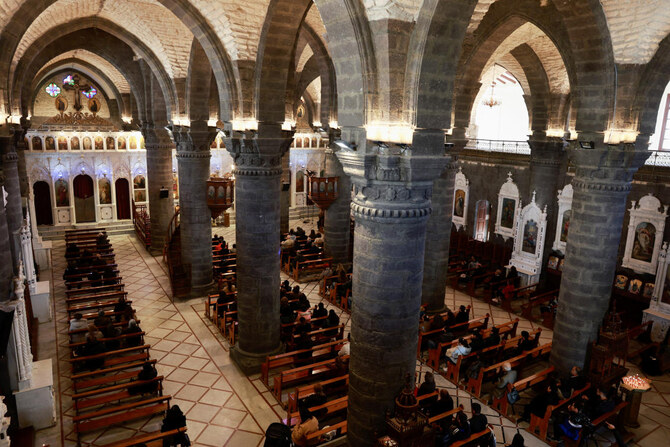
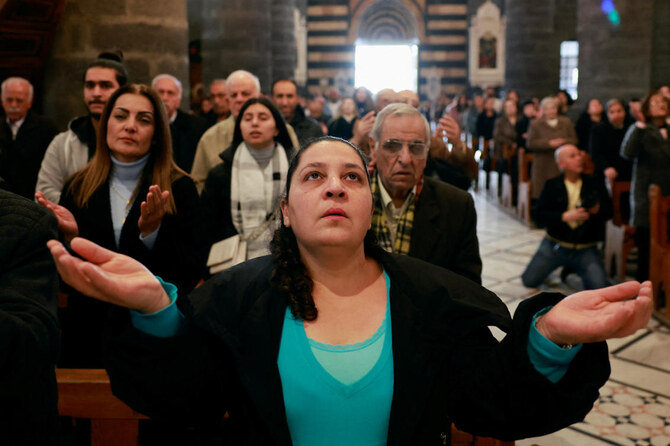
LATAKIA: In Syria’s northwestern port town of Latakia, Christian worshippers attending Mass on Sunday at St. George Greek Orthodox Cathedral were hopeful that the country’s new largely Sunni Muslim leadership would respect their religion.
Like other Christians around the country, they were attending the first Mass since militants overthrew President Bashar Assad a week ago.
Last Sunday, Church authorities warned people to stay away from worship amid the upheaval as militants — led by former al Qeada offshoot Hayat Tahrir Al-Sham — swept into Damascus and ended 50 years of brutal rule by the Assad family.
Athanasios Fahed, the Metropolitan of Latakia and its dependencies for the Greek Orthodox Church, led Sunday’s service in Latakia and the cathedral filled with people in brisk morning weather.
“Last Sunday, we were surprised just like all Syrian people, of the change that happened. Of course, we had many fears, especially for those who are called minorities,” Fahed told Reuters, although he added he did not consider Christians minorities since they were “part of this country.”
“But of course, a lot of questions rose because obviously there was chaos in the street due to the fall of the state and its security, military, official and civil institutions,” Fahed said.
Fahed said that while many Christians were displaced to other regions under Assad’s rule, the coastal regions such as areas around Latakia were unaffected. Latakia was a stronghold of Assad’s rule.
Syria’s population includes historic ethnic and religious minority communities including Christians, Armenians, Kurds and Shiite Muslims, who like many other Syrian Muslims had feared during the 13-year civil war that any future Islamist rule would imperil their way of life.
Lina Akhras, a parish council secretary at the church, said Christians had been “comfortable” under Assad in terms of their freedom of belief.
“It happened all of a sudden, we didn’t know what to expect. So in order to protect everybody, we stopped (worship) until we saw how it will develop,” she told Reuters.
“Thank God, we received a lot of assurances and we saw that members of the (HTS) committee reached out to our priest... God willing we will return to our previous lives and live in our beautiful Syria,” she told Reuters.
“Your religion is yours, but our country is for all of us.”


![]()
![]()
![]()

Hoping for religious harmony, Christians in a Syrian town attend Mass

Short Url
https://arab.news/b3txj
Hoping for religious harmony, Christians in a Syrian town attend Mass
- Syria’s population includes historic ethnic and religious minority communities including Christians, Armenians, Kurds and Shiite Muslims


Latest updates


© 2026 SAUDI RESEARCH & PUBLISHING COMPANY, All Rights Reserved And subject to Terms of Use Agreement.