PESHAWAR: Jailed former prime minister Imran Khan’s party on Sunday held a rally in Pakistan’s northwest to protest alleged killings of a dozen of its supporters during last month’s protest in Islamabad, but made no announcement regarding a civil disobedience movement Khan had hinted at this month.
Khan’s Pakistan Tehreek-e-Insaf (PTI) party on Nov. 24 led thousands of supporters to Islamabad, seeking to pressure the government to release the ex-premier from jail and order an audit of Feb. 8 national election results. The protests resulted in clashes that Pakistan’s government says killed four law enforcers and injured hundreds of others.
The PTI says at least 12 of its supporters were killed and another 37 sustained gunshot injuries due to firing by law enforcers near Islamabad’s Jinnah Avenue on Nov. 26, while 139 of its supporters were still “missing.” Pakistani authorities have denied the deaths, saying security personnel had not been carrying live ammunition during the protest.
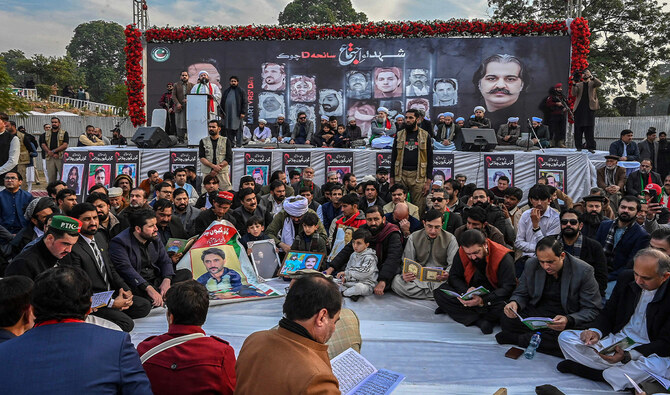
On Sunday, the party held a ‘martyrs’ day’ gathering in the northwestern Pakistani city of Peshawar, at which the attendees offered prayers for the ones who allegedly died during the Islamabad protest.
“The reason [to hold the gathering] was to offer prayers for those who were killed on [Islamabad’s] D-Chowk on November 26,” Khyber Pakhtunkhwa Excise and Taxation Minister Khaliq-ur-Rehman told Arab News.
“We had a peaceful protest.”
Speaking to international media journalists on Sunday afternoon, KP Chief Minister Ali Amin Gandapur said they were demanding the release of Khan and challenging the results of Feb. 8 polls, criticizing authorities for allegedly shooting unarmed protesters in Islamabad.
“Is this the state’s job to fire at unarmed people,” he questioned. “Is this the state’s job that it won’t allow a party hold a protest?“
Last week, the PTI filed a petition in an Islamabad court against Prime Minister Shehbaz Sharif, Interior Minister Mohsin Naqvi and other officials over “firing” on its supporters during the Islamabad protest. The government has accused the PTI of waging a “propaganda” regarding the Islamabad protest, following statements by several PTI members that gave varied accounts of casualties.
The PTI has staged several protests this year to demand the release of Khan and to challenge results of the Feb. 8 national election, which it says were manipulated to favor its opponents. The Pakistani government and election authorities deny this.
Last month’s protests were by far the largest to grip the capital since the poll, while Khan, who remains a popular figure in Pakistan despite being in prison and facing several court cases, on Dec. 6 threatened to launch a civil disobedience movement.
Asked about the movement, Ali Muhammad Khan, a PTI lawmaker, said Khan had formed a committee to hold talks with authorities on their demands for the release all political prisoners and for setting up judicial commissions to investigate the Nov. 24 protest and violence on May 9, 2023, which killed eight people.
“If anything comes out of the negotiations, well and good, otherwise, Khan will announce the next move,” Ali told Arab News at the Peshawar public gathering. “Whatever Khan orders, we will follow.”
Shandana Gulzar, another PTI lawmaker, said they were awaiting detailed instructions from the party founder about the movement.
“Whatever order Khan gives from the prison... we are ready,” she added.


![]()

Thousands gather in Peshawar to protest alleged killings at last month’s pro-Imran Khan protests
Short Url
https://arab.news/wkqea
Thousands gather in Peshawar to protest alleged killings at last month’s pro-Imran Khan protests
- The party remains short of announcing the start of a civil disobedience movement as was anticipated by many
- A Khan aide says they are awaiting outcome of talks with authorities and will follow whatever the ex-PM says
Latest updates





© 2026 SAUDI RESEARCH & PUBLISHING COMPANY, All Rights Reserved And subject to Terms of Use Agreement.