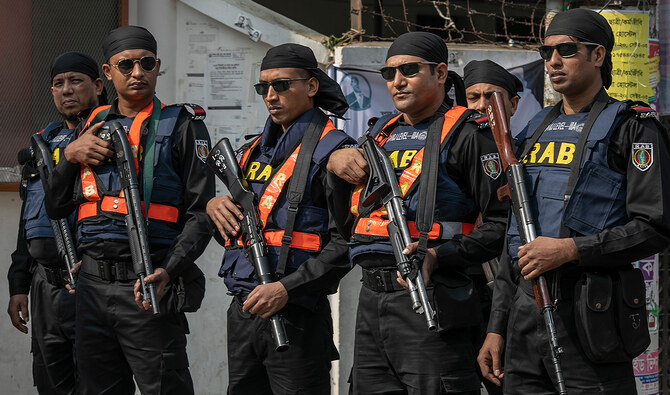
DHAKA: A Bangladesh commission probing abuses during the rule of toppled leader Sheikh Hasina has recommended a much-feared armed police unit be disbanded, a senior inquiry member said Sunday.
Hasina, 77, fled by helicopter to neighboring India on August 5 as a student-led uprising stormed the prime minister’s palace in Dhaka.
Her government was accused of widespread human rights abuses, including the extrajudicial killing of hundreds of political opponents and the unlawful abduction and disappearance of hundreds more.
The Commission of Inquiry into Enforced Disappearances, set up by the caretaker government, said it found initial evidence that Hasina and other ex-senior officials were involved in the enforced disappearances alleged to have been carried out by the Rapid Action Battalion (RAB).
The RAB paramilitary police force was sanctioned by the United States in 2021, alongside seven of its senior officers, in response to reports of its culpability in some of the worst rights abuses committed during Hasina’s 15-year-long rule.
“RAB has never abided by the law and was seldom held accountable for its atrocities, which include enforced disappearances, extrajudicial killings, and abductions,” Nur Khan Liton, a member of the commission, told AFP.
The commission handed its preliminary report to the leader of the interim government Muhammad Yunus late Saturday.
The Bangladesh Nationalist Party (BNP), one of the country’s largest political parties, also called for RAB’s abolition.
Senior BNP leader M. Hafizuddin Ahmed told reporters that the force was too rotten to be reformed.
“When a patient suffers from gangrene, according to medical studies, the only solution is to amputate the affected organ,” he said.
The elite police unit was launched in 2004, billed as a way to provide rapid results in a country where the judicial system was notoriously slow.
But the unit earned a grim reputation for extrajudicial killings and was accused of supporting Hasina’s political ambitions by suppressing dissent through abductions and murders.


![]()

Bangladesh inquiry recommends feared police unit shut over rights abuses
Short Url
https://arab.news/p9yph
Bangladesh inquiry recommends feared police unit shut over rights abuses
- The police unit was launched in 2004, billed as a way to provide rapid results in a country where the judicial system was slow
- But the unit earned a grim reputation for extrajudicial killings and was accused of supporting ec-PM Hasina’s political ambitions
Latest updates


© 2026 SAUDI RESEARCH & PUBLISHING COMPANY, All Rights Reserved And subject to Terms of Use Agreement.