

Top Arab, US diplomats meet to discuss Syria’s future

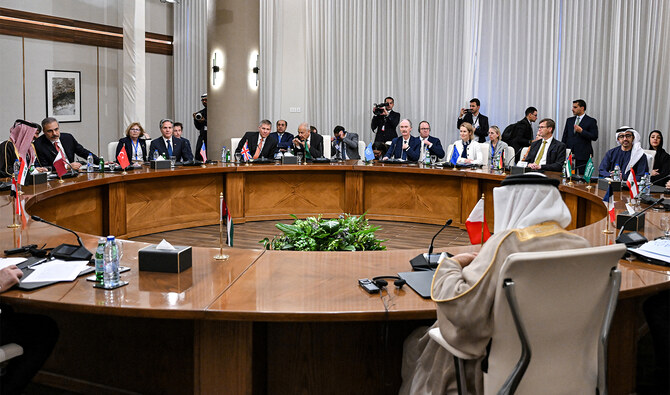
Qatar's Foreign Minister Sheikh Mohammed bin Abdulrahman bin Jassim al-Thani, Turkey's Foreign Minister Hakan Fidan, U.S. Secretary of State Antony Blinken, UN Special Envoy for Syria Geir Pedersen, UAE Foreign Minister Sheikh Abdullah bin Zayed al-Nahyan and others attend the meeting of the Arab Contact Group on Syria in Jordan's southern Red Sea coastal city of Aqaba on December 14, 2024. (REUTERS)
Short Url
Updated 14 December 2024
Follow

Top Arab, US diplomats meet to discuss Syria’s future

  • Syria’s northern neighbor Turkiye has for years supported Syrian opposition forces looking to oust Assad and is poised to play an influential role in Damascus
  • Arab diplomats attending the talks said they were seeking assurances from Turkiye that it supports an inclusive political process that prevents partition of Syria

AQABA, Jordan: Top diplomats from the United States, Turkiye, the European Union and Arab nations met in Jordan on Saturday for talks on Syria as regional and global powers scramble for influence over whatever government replaces ousted President Bashar Assad.

Outgoing US President Joe Biden’s administration has begun engaging with the victorious opposition groups including Hayat Tahrir Al-Sham (HTS), which led a lightning assault that ended in the capture of Damascus on Sunday.

Biden sent Secretary of State Antony Blinken to the region this week to seek support for principles that Washington hopes will guide Syria’s political transition, such as respect for minorities.

Meanwhile, Syria’s northern neighbor Turkiye has for years supported Syrian opposition forces looking to oust Assad and is poised to play an influential role in Damascus.

Turkish Foreign Minister Hakan Fidan said on Friday that his country’s embassy in the Syrian capital would resume work on Saturday, after Turkiye’s intelligence chief visited this week.
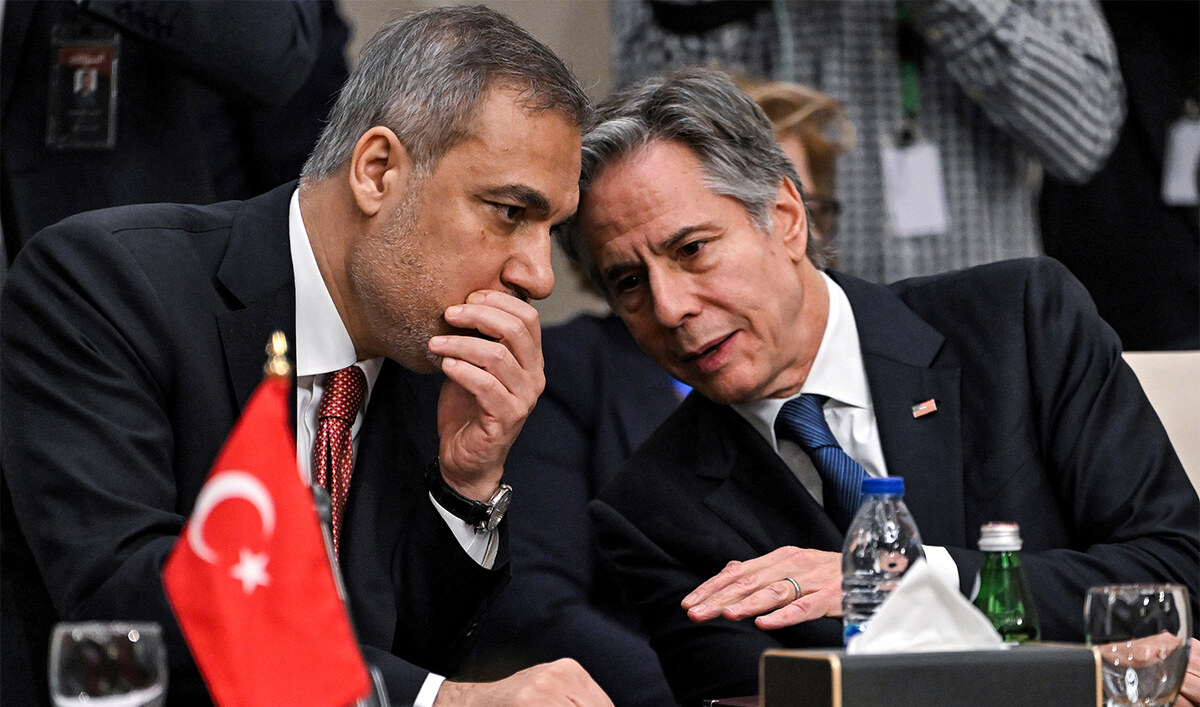


Turkey's Foreign Minister Hakan Fidan, left, speaks with US Secretary of State Antony Blinken during a meeting with the foreign ministers of the Arab Contact Group on Syria in Jordan's southern Red Sea coastal city of Aqaba, on Dec. 14, 2024. (AP)

Syria’s neighbor Jordan was hosting Saturday’s gathering in Aqaba. Russia and Iran, who were Assad’s key supporters, were not invited.

Blinken, UN Special Envoy for Syria Geir Pederson and EU foreign policy chief Kaja Kallas, Fidan and foreign ministers from Jordan, Saudi Arabia, Iraq, Lebanon, Egypt, the United Arab Emirates, Bahrain and Qatar met around a circular table at a Jordanian government guesthouse. There was no Syrian representative at the table.

The Arab diplomats earlier met separately.

Blinken, meeting Pederson at his hotel earlier on Saturday, said it was a time of “both opportunity but also real challenge” for Syria.

Arab diplomats attending the talks said they were seeking assurances from Turkiye that it supports an inclusive political process that prevents partition of Syria on sectarian lines.


Iraq's Foreign Minister Fuad Hussein and Qatar's Foreign Minister Sheikh Mohammed bin Abdulrahman bin Jassim Al-Thani attend a meeting with the foreign ministers of the Arab Contact Group on Syria in Jordan's southern Red Sea coastal city of Aqaba on December 14, 2024. (REUTERS)

Turkiye and the United States, both NATO members, have conflicting interests when it comes to some of the groups. Turkiye-backed groups in northern Syria have clashed with the Kurdish-led Syrian Democratic Forces (SDF).

The SDF, which controls some of Syria’s largest oil fields, is the main ally in a US coalition against Daesh militants. It is spearheaded by YPG militia, a group that Ankara sees as an extension of Kurdistan Workers Party (PKK) militants who have fought the Turkish state for 40 years and who it outlaws.

Blinken told Turkish officials during a visit to Ankara on Thursday and Friday that Daesh must not be able to regroup, and the SDF must not be distracted from its role of securing camps holding Daesh fighters, according to a US official with the US delegation. Turkish leaders agreed, the official said.

Fidan told Turkish TV later on Friday that the elimination of the YPG was Turkiye’s “strategic target” and urged the group’s commanders to leave Syria.


US forces withdraw from Syria’s Al-Tanf base: Syrian military sources

Updated 7 sec ago
Follow

US forces withdraw from Syria’s Al-Tanf base: Syrian military sources

  • The Americans had been moving equipment out of Al-Tanf base for the past 15 days, one source told AFP
  • Following the withdrawal from Al-Tanf, US troops are mainly now based at the Qasrak base in Hasakah

DAMASCUS: US forces have withdrawn to Jordan from Syria’s Al-Tanf base, where they had been deployed as part of the international coalition against the Daesh group, two Syrian military sources told AFP on Wednesday.
One source said “the American forces withdrew entirely from Al-Tanf base today” and decamped to another in Jordan, adding Syrian forces were being deployed to replace them.
A second source confirmed the withdrawal, adding the Americans had been moving equipment out for the past 15 days.
The second source said the US troops would “continue to coordinate with the base in Al-Tanf from Jordan.”
During the Syrian civil war and the fight against Daesh group, US forces were deployed in the country’s Kurdish-controlled northeast and at Al-Tanf, near the borders with Jordan and Iraq.
The Kurdish-led Syrian Democratic Forces (SDF) had been a major partner of the anti-Daesh coalition, and were instrumental in the group’s territorial defeat in Syria in 2019.
However, after the fall of longtime ruler Bashar Assad over a year ago, the United States has drawn closer to the new government in Damascus, recently declaring that the need for its alliance with the Kurds had largely passed.
Syria agreed to join the anti-Daesh coalition when President Ahmed Al-Sharaa visited the White House in November.
As Al-Sharaa’s authorities seek to extend their control over all of Syria, the Kurds have come under pressure to integrate their forces and de facto autonomous administration into the state, striking an agreement to do so last month after losing territory to advancing government troops.
Since then, the US has been conducting an operation to transfer around 7,000 suspected jihadists from Syria — where many were being held in detention facilities by Kurdish fighters — to neighboring Iraq.
Following the withdrawal from Al-Tanf and the government’s advances in the northeast, US troops are mainly now based at the Qasrak base in Hasakah.
Despite Daesh’s territorial defeat, the group remains active.
It was blamed for a December attack in Palmyra in which a lone gunman opened fire on American personnel, killing two US soldiers and a US civilian.
Washington later conducted retaliatory strikes on Daesh targets in Syria.