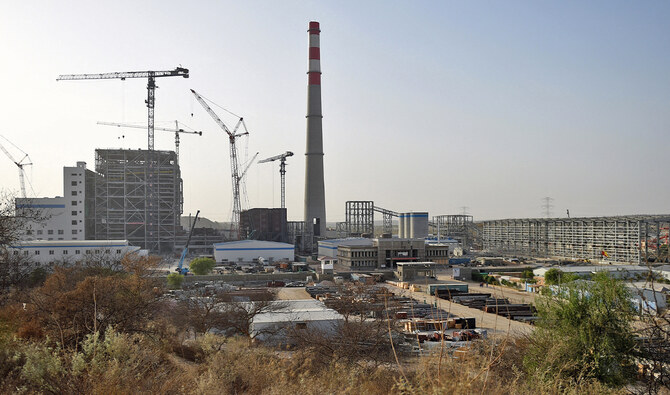
ISLAMABAD: Prime Minister Shehbaz Sharif on Friday called for shutting down inefficient and outdated power plants that produced less power with higher fuel consumption, Pakistani state media reported.
Pakistan produces expensive electricity due to a combination of factors, including outdated infrastructure and inadequate power plants, reliance on imported fossil fuels, inefficient energy mix, substantial transmission and distribution losses, and chronic issues like circular debt and regulatory inefficiencies.
Additionally, fluctuations in foreign exchange rates and complex tariff structures contribute to higher electricity prices, while underutilization of domestic resources such as hydropower and coal add to the problem. High power cost is one of the key factors that leads to inflation in the South Asian country.
On Friday, Sharif presided over a meeting in Islamabad to evaluate and discuss future plans for power generation in the country and said only low-cost power projects should be prioritized in the future, the Radio Pakistan broadcaster reported.
“The closure of such [outdated] power plants will not only save valuable foreign exchange spent on fuel imports, but also reduce the cost of electricity for consumers,” he was quoted as saying.
The prime minister called for expediting implementation of ongoing reforms and instructed officials to modernize the power transmission system as per international standards, according to the report.
In October, Sharif said his government was terminating purchase agreements with five independent power producers (IPPs) to rein in electricity tariffs as households and businesses buckled under soaring energy costs.
The need to revisit power deals was part of reforms for a critical staff-level pact in July with the International Monetary Fund (IMF) for a $7-billion bailout. The program was approved in September.
Pakistan has also begun talks to reprofile power sector debt owed to China and structural reforms, but progress has been slow. It has also promised to stop power sector subsidies.

Pakistan PM calls for shutting down outdated power plants with higher fuel consumption
https://arab.news/zvhab
Pakistan PM calls for shutting down outdated power plants with higher fuel consumption
- Pakistan produces expensive electricity due to outdated infrastructure, reliance on imported fuel, and substantial transmission losses
- PM Shehbaz Sharif calls for expediting implementation of ongoing reforms and modernization of the country’s power transmission system
Pakistan condemns Sudan attack that killed Bangladeshi UN peacekeepers, calls it war crime
- Six peacekeepers were killed in a drone strike in Kadugli as fighting between Sudan’s army and the RSF grinds on
- Pakistan, a major troop contributor to the UN, says perpetrators of the attack must be identified, brought to justice
ISLAMABAD: Pakistan on Sunday extended condolences to the government and people of Bangladesh after six United Nations peacekeepers from the country were killed in a drone strike in southern Sudan, condemning the attack and describing it as a war crime.
The attack took place amid a full-scale internal conflict that erupted in April 2023 between the Sudanese Armed Forces (SAF) and the Rapid Support Forces (RSF), a powerful paramilitary group, following a power struggle after the collapse of Sudan’s post-Bashir political transition.
Omar Al-Bashir, who ruled Sudan for nearly three decades, was ousted by the military in 2019 after months of mass protests, but efforts to transition to civilian rule later faltered, plunging the country back into violence that has since spread nationwide.
The drone strike hit a logistics base of the United Nations Interim Security Force for Abyei (UNISFA) in Kadugli, the capital of South Kordofan state, on Saturday, killing the Bangladeshi peacekeepers. Sudan’s army blamed the RSF for the attack, though there was no immediate public claim of responsibility.
“Pakistan strongly condemns the attack on @UNISFA in Kadugli, resulting in the tragic loss of 6 Bangladeshi peacekeepers & injuries to several others,” the country’s permanent mission to the UN said in a social media message. “We honor their supreme sacrifice in the service of peace, and express our deepest condolences to the government and people of #Bangladesh.”
“Such heinous attacks on UN peacekeepers amount to war crimes,” it added. “Perpetrators of this horrific attack must be identified and brought to justice. As a major troop-contributing country, we stand in complete solidarity with all Blue Helmets serving the cause of peace in the perilous conditions worldwide.”
According to Pakistan’s UN mission in July, the country has deployed more than 235,000 peacekeepers to 48 UN missions across four continents over the past eight decades.
Pakistan also hosts one of the UN’s oldest peacekeeping operations, the United Nations Military Observer Group in India and Pakistan (UNMOGIP), and is a founding member of the UN Peacebuilding Commission.
More than 180 Pakistani peacekeepers have lost their lives while serving under the UN flag.
Pakistan and Bangladesh have also been working in recent months to ease decades of strained ties rooted in the events of 1971, when Bangladesh — formerly part of Pakistan — became independent following a bloody war.
Relations have begun to shift following the ouster of former Bangladeshi prime minister Sheikh Hasina last year amid mass protests.
Hasina later fled to India, Pakistan’s neighbor and arch-rival, creating space for Islamabad and Dhaka to rebuild their relationship.


