France’s Macron names veteran centrist ally Bayrou as prime minister

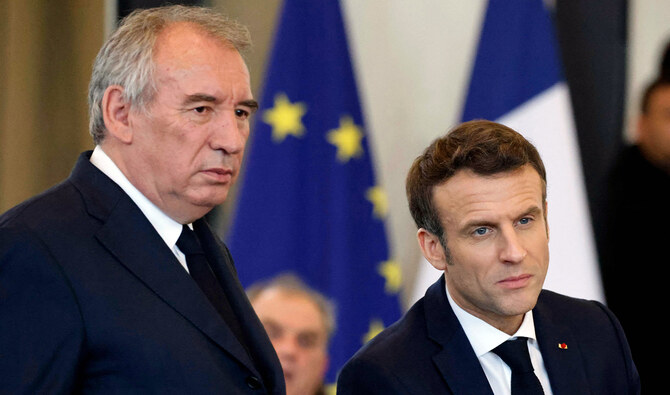
French President Emmanuel Macron (R) and French President of the Modem party Francois Bayrou (L) react during a meeting with citizens at the Palais Beaumont in Pau, southwestern France, on March 18, 2022, as part of the political campaign ahead of the presidential election in France. (AFP/File)
Short Url
Updated 13 December 2024
Follow

France’s Macron names veteran centrist ally Bayrou as prime minister

  • The priority for Francois Bayrou, a close Macron ally, will be passing a special law to roll over the 2024 budget
  • Parliamentary pushback over the 2025 bill led to the downfall of former Prime Minister Michel Barnier’s government

PARIS: French President Emmanuel Macron named Francois Bayrou as his fourth prime minister of 2024 on Friday, tasking the veteran centrist with steering the country out of its second major political crisis in the last six months.
The priority for Bayrou, a close Macron ally, will be passing a special law to roll over the 2024 budget, with a nastier battle over the 2025 legislation looming early next year. Parliamentary pushback over the 2025 bill led to the downfall of former Prime Minister Michel Barnier’s government.
Bayrou, 73, is expected to put forward his list of ministers in the coming days, but will likely face the same existential difficulties as Barnier in steering legislation through a hung parliament comprising three warring blocs. His proximity to the deeply unpopular Macron will also prove a vulnerability.
Jordan Bardella, the president of the far-right National Rally party, said they would not be calling for an immediate no-confidence motion against Bayrou.
France’s festering political malaise has raised doubts about whether Macron will complete his second presidential term, which ends in 2027. It has also lifted French borrowing costs and left a power vacuum in the heart of Europe, just as Donald Trump prepares to return to the White House.
Macron spent the days after Barnier’s ouster speaking to leaders from the conservatives to the Communists, seeking to lock in support for Bayrou. Marine Le Pen’s far-right National Rally and the hard-left France Unbowed were excluded.
Any involvement of the Socialist Party in a coalition may cost Macron in next year’s budget.
“Now we will see how many billions the support of the Socialist Party will cost,” a government adviser said on Friday.
NO LEGISLATIVE ELECTION BEFORE SUMMER
Macron will hope Bayrou can stave off no-confidence votes until at least July, when France will be able to hold a new parliamentary election, but his own future as president will inevitably be questioned if the government should fall again.
Bayrou, the founder of the Democratic Movement (MoDem) party which has been a part of Macron’s ruling alliance since 2017, has himself run for president three times, leaning on his rural roots as the longtime mayor of the south-western town of Pau.
Macron appointed Bayrou as justice minister in 2017 but he resigned only weeks later amid an investigation into his party’s alleged fraudulent employment of parliamentary assistants. He was cleared of fraud charges this year.
Bayrou’s first real test will come early in the new year when lawmakers need to pass a belt-tightening 2025 budget bill.
However, the fragmented nature of the National Assembly, rendered nigh-on ungovernable after Macron’s June snap election, means Bayrou will likely be living day-to-day, at the mercy of the president’s opponents, for the foreseeable future.
Barnier’s budget bill, which aimed for 60 billion euros in savings to assuage investors increasingly concerned by France’s 6 percent deficit, was deemed too miserly by the far-right and left, and the government’s failure to find a way out of the gridlock has seen French borrowing costs push higher still.


US intercepts fifth sanctioned tanker as it exerts control over Venezuelan oil distribution

Updated 4 sec ago
Follow

US intercepts fifth sanctioned tanker as it exerts control over Venezuelan oil distribution

WASHINGTON: US forces boarded another oil tanker in the Caribbean Sea on Friday, the US military said, as the Trump administration targets sanctioned tankers traveling to and from Venezuela as part of a broader effort to take control of the South American country’s oil.
The predawn raid was carried out by Marines and Navy sailors launched from the aircraft carrier USS Gerald R. Ford, part of the extensive force the US has built up in the Caribbean in recent months, according to US Southern Command, which declared “there is no safe haven for criminals” as it announced the seizure of the tanker called the Olina. The Coast Guard then took control of the vessel, officials said.
Southern Command and Homeland Security Secretary Kristi Noem both posted unclassified footage on social media Friday morning of a US helicopter landing on the vessel and US personnel conducting a search of the deck and tossing what appeared to be an explosive device in front of a door leading to inside the ship.
In her post, Noem said the ship was “another ‘ghost fleet’ tanker ship suspected of carrying embargoed oil” and it had departed Venezuela “attempting to evade US forces.”
The Olina is the fifth tanker that has been seized by US forces as part of the effort by President Donald Trump’s administration to control the production, refining and global distribution of Venezuela’s oil products, and the third since the US ouster of Venezuela President Nicolás Maduro in a surprise nighttime raid.
In a post on his social media network later in the day, Trump said the seizure was conducted “in coordination with the Interim Authorities of Venezuela” but offered no elaboration.
The White House did not immediately respond to requests for more details.
Venezuela’s government acknowledged in a statement that it was working with US authorities to return the tanker, “which set sail without payment or authorization from the Venezuelan authorities,” to the South American nation.
“Thanks to this first successful joint operation, the ship is sailing back to Venezuelan waters for its protection and relevant actions,” according to the statement.
Samir Madani, co-founder of TankerTrackers.com, said his organization used satellite imagery and surface-level photos to document that at least 16 tankers left the Venezuelan coast in contravention of the quarantine US forces have set up to block sanctioned ships from conducting trade. The Olina was among that flotilla.
US government records show that the Olina was sanctioned for moving Russian oil under its prior name, Minerva M, and flagged in Panama.
While records show the Olina is now flying the flag of Timor-Leste, it is listed in the international shipping registry as having a false flag, meaning the registration it is claiming is not valid. In July, the owner and manager of the ship on its registration was changed to a company in Hong Kong.
According to ship tracking databases, the Olina last transmitted its location in November in the Caribbean, north of the Venezuelan coast. Since then, however, the ship has been running dark with its location beacon turned off.
While Noem and the military framed the seizure as part of an effort to enforce the law, other officials in the Trump administration have made clear they see it as a way to generate cash as they seek to rebuild Venezuela’s battered oil industry and restore its economy.
In an early morning social media post, Trump said the US and Venezuela “are working well together, especially as it pertains to rebuilding, in a much bigger, better, and more modern form, their oil and gas infrastructure.”
The administration said it expects to sell 30 million to 50 million barrels of sanctioned Venezuelan oil, with the proceeds to go to both the US and Venezuelan people. But the president expects the arrangement to continue indefinitely. He met Friday with executives from oil companies to discuss his goal of investing $100 billion in Venezuela to repair and upgrade its oil production and distribution.
Vice President JD Vance told Fox News this week that the US can “control” Venezuela’s “purse strings” by dictating where its oil can be sold.
Madani estimated that the Olina is loaded with 707,000 barrels of oil, which at the current market price of about $60 a barrel would be worth more than $42 million.