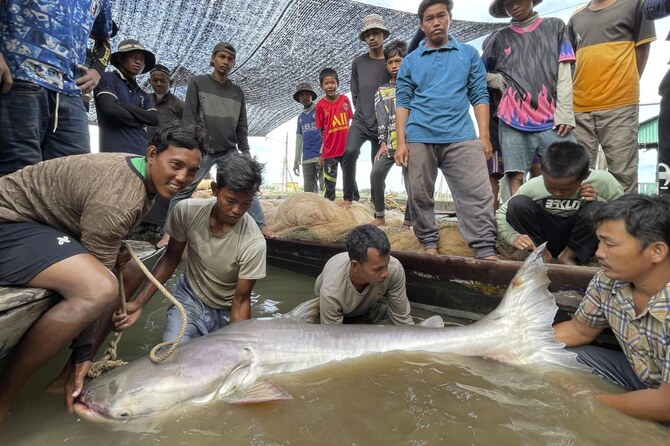
HANOI: Six critically endangered Mekong giant catfish — one of the largest and rarest freshwater fish in the world — were caught and released recently in Cambodia, reviving hopes for the survival of the species.
The underwater giants can grow up to 3 meters long and weigh up to 300 kilograms, or as heavy as a grand piano. They now are only found in Southeast Asia’s Mekong River but in the past inhabited the length of the 4,900-kilometer-long river, all the way from its outlet in Vietnam to its northern reaches in China’s Yunnan province.
The species’ population has plummeted by 80 percent in recent decades due to rising pressures from overfishing, dams that block the migratory path the fish follow to spawn and other disruptions.
Few of the millions of people who depend on the Mekong for their livelihoods have ever seen a giant catfish. To find six of the giants, which were caught and released within 5 days, is unprecedented.
The first two were on the Tonle Sap river, a tributary of the Mekong not far from Cambodian capital Phnom Penh. They were given identification tags and released. On Tuesday, fishermen caught four more giant catfish including two longer than 2 meters that weighed 120 kilograms and 131 kilograms, respectively. The captured fish were apparently migrating from their floodplain habitats near Cambodia’s Tonle Sap Lake northward along the Mekong River, likely to spawning grounds in northern Cambodia, Laos or Thailand.
“It’s a hopeful sign that the species is not in imminent, like in the next few years, risk of extinction, which gives conservation activities time to be implemented and to continue to bend the curve away from decline and toward recovery,” said Dr. Zeb Hogan, a University of Nevada Reno research biologist who leads the US Agency for International Development-funded Wonders of the Mekong project.
Much is still unknown about the giant fish, but over the past two decades a joint conservation program by the Wonders of the Mekong and the Cambodian Fisheries Administration has caught, tagged and released around 100 of them, gaining insights into how the catfish migrate, where they live and the health of the species.
“This information is used to establish migration corridors and protect habitats to try to help these fish survive in the future,” said Hogan.
The Mekong giant catfish is woven into the region’s cultural fabric, depicted in 3,000-year-old cave paintings, revered in folklore and considered a symbol of the river, whose fisheries feed millions and are valued at $10 billion annually.
Local communities play a crucial role in conservation. Fishermen now know about the importance of reporting accidental catches of rare and endangered species to officials, enabling researchers to reach places where fish have been captured and measure and tag them before releasing them.
“Their cooperation is essential for our research and conservation efforts,” Heng Kong, director of Cambodia’s Inland Fisheries Research and Development Institute, said in a statement.
Apart from the Mekong giant catfish, the river is also home to other large fish including the salmon carp, which was thought to be extinct until it was spotted earlier this year, and the giant sting ray.
That four of these fish were caught and tagged in a single day is likely the “big fish story of the century for the Mekong”, said Brian Eyler, director of the Washington-based Stimson Center’s Southeast Asia Program. He said that seeing them confirms that the annual fish migration was still robust despite all the pressures facing the environment along the Mekong.
“Hopefully what happened this week will show the Mekong countries and the world that the Mekong’s mighty fish population is uniquely special and needs to be conserved,” he said.


![]()

Huge and rare Mekong catfish spotted in Cambodia, raising conservation hopes
Short Url
https://arab.news/c6xje
Huge and rare Mekong catfish spotted in Cambodia, raising conservation hopes
- Few of the millions of people who depend on the Mekong for their livelihoods have ever seen a giant catfish
- The species’ population has plummeted by 80% due to rising pressures from overfishing, dams and other disruptions


Latest updates


© 2026 SAUDI RESEARCH & PUBLISHING COMPANY, All Rights Reserved And subject to Terms of Use Agreement.