

Pakistan Taliban emerging as Al-Qaeda arm with ‘regional, global terrorist agenda’ — envoy

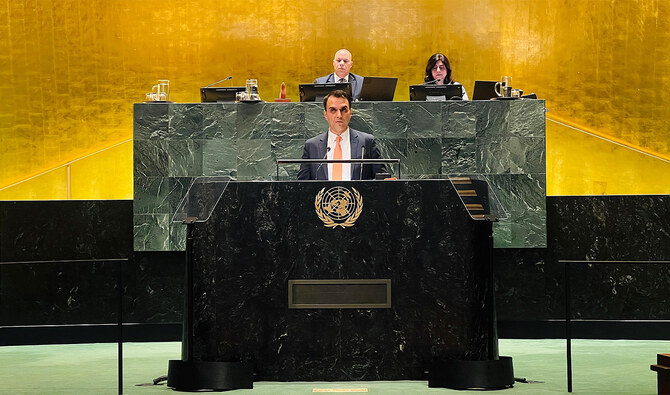
Pakistan’s acting UN envoy Usman Jadoon is addrressing a session in the United Nations General Assembly in New York, US, on December 13, 2024. (@PakistanUN_NY/X)
Short Url
Updated 13 December 2024
Follow

Pakistan Taliban emerging as Al-Qaeda arm with ‘regional, global terrorist agenda’ — envoy

  • Acting envoy to UN says Afghan government fighting Daesh but not addressing other groups such as Al Qaeda, TTP 
  • Says TTP also collaborating with suicide squad of separatist Baloch Liberation Army in Pakistan’s Balochistan province

ISLAMABAD: Pakistan’s acting UN envoy Usman Jadoon said this week the Tehreek-e-Taliban Pakistan (TTP) militant group, which Islamabad accuses of operating from safe havens in neighboring Afghanistan, was poised to become Al-Qaeda’s regional and global arm, with a far-reaching “terrorist agenda” that threatened international security.

Islamabad says the TTP uses Afghanistan as a base to launch attacks, accusing the ruling Taliban administration of providing safe havens to the group along their shared border. Pakistan also says Afghans have been found to be involved in multiple recent attacks, amid a militancy spike. The Taliban deny militants are using Afghan soil to launch attacks or that Afghans are involved in militancy in Pakistan. They say Pakistan’s security challenges are a domestic issue. 

The TTP is separate from the Afghan Taliban movement but pledges loyalty to the group that now rules Afghanistan after the US-led international forces withdrew in 2021.

“Given its long association with Al Qaeda, the TTP could emerge as Al Qaeda’s arm with a regional and global terrorist agenda,” Jadoon said on Thursday while addressing a UN Security Council meeting. 

“Terrorism within and from Afghanistan poses the single most serious threat to the country, to the region and the world … While the Afghan interim government is fighting Daesh, the threat from various other terrorist groups such as Al Qaeda, TTP and others is yet to be addressed.”

Jadoon said the TTP was fast emerging as an “umbrella organization” for other terror groups in the area with the “clear objective of destabilizing Afghanistan’s neighbors.”

“We have evidence of its collaboration with other terrorist groups like the Majeed brigade which is utilizing terrorism to disrupt Pakistan’s economic cooperation with China, especially the China-Pakistan Economic Corridor,” the diplomat added, referring to the suicide squad of the separatist Baloch Liberation Army which has been fighting a decades long insurgency in Pakistan’s southwestern Balochistan province. 

Jadoon said with 6,000 fighters, TTP was the largest listed militant group operating close to Pakistan’s borders.

“In countering the TTP cross-border operations, our security and border officials have confiscated some of the modern weapons acquired by the Afghan interim government from stocks left behind by foreign forces,” he said, adding that the TTP also received external support and financing from Pakistan’s adversary India. 

Last month, the Pakistan army said it had killed three militants trying to infiltrate its frontier with Afghanistan, calling on Kabul to ensure “effective border management” on its side. 

A deportation drive launched last year against Afghans living in Pakistan and border restrictions have also led to a spike in tensions between Pakistan and the Taliban rulers in Afghanistan. 


Curfew extended in Gilgit-Baltistan, probe ordered after deadly Khamenei protests

Updated 03 March 2026
Follow

Curfew extended in Gilgit-Baltistan, probe ordered after deadly Khamenei protests

  • At least 15 people were killed in clashes with law enforcement agencies over the weekend in Gilgit-Baltistan
  • Government also announces a de-weaponization campaign, crackdown on hate speech and cybercrime in region

ISLAMABAD: The government in Pakistan’s Gilgit-Baltistan (GB) region on Tuesday extended a curfew in Gilgit district and ordered a judicial probe into violent protests over the killing of Iranian Supreme Leader Ali Khamenei in US-Israeli strikes last week, an official said.

At least 15 people were killed in clashes with law enforcement agencies over the weekend in GB, where protesters torched and vandalized several buildings, including United Nations regional offices, an army-run school, software technology park and a local charity building.

The violence prompted regional authorities to impose curfew in Gilgit and Skardu districts on March 2-4 as officials urged people to stay indoors and cooperate with law enforcers, amid widespread anger in Pakistan, particularly among members of the Shiite minority, over Khamenei’s killing.

On Tuesday, the GB government convened to review the situation and announced the extension of curfew in Gilgit among a number of security measures as well as ordered the establishment of a judicial commission to investigate the weekend violence in the region.

“The government has made it clear that the law will strictly take its course against elements involved in vandalism at government institutions, private properties and incidents of vandalism in Gilgit and Skardu and no kind of mischief will be tolerated,” Shabbir Mir, a GB government spokesperson, said in a statement.

“In view of the security situation, curfew will remain in force in Gilgit, while the decision to extend the curfew in Skardu will be taken keeping the ground realities and the changing situation in view.”

The statement did not specify how long the curfew will remain in place in Gilgit.

Besides the formation of the judicial commission to investigate the violent clashes, the government also decided to launch a large-scale de-weaponization campaign in the entire Gilgit district, for which relevant institutions have been directed to immediately complete all necessary arrangements, according to Mir.

In addition, a crackdown has been ordered on hate speech, spread of fake news and cybercrime.

“The aim of these decisions is to ensure the rule of law, protect the lives and property of citizens and crack down on miscreants,” he said. “Approval has also been given to immediately survey the affected infrastructure and start their restoration work on priority basis.”

Demonstrators in Pakistan’s southern port city of Karachi also stormed the US Consulate on Sunday, smashing windows and attempting to burn the building. Police responded with batons, tear gas, and gunfire, leaving 10 people dead and more than 50 injured.

Pakistani authorities have since beefed up security at US diplomatic missions across the country, including around the US consulate building in Peshawar, to avoid any further violence.