

Thousands attend funeral of Afghan minister killed in Daesh attack 

Afghan men leave after attending the funeral ceremony of Khalil Ur-Rahman Haqqani, the Minister for Refugees and Repatriation, in Sarana of Paktia province, south of Kabul, on December 12, 2024. (REUTERS)
Short Url
Updated 13 December 2024
Follow

Thousands attend funeral of Afghan minister killed in Daesh attack 

  • Minister for Refugees Khalil Ur-Rahman Haqqani killed on Wednesday in suicide bombing 
  • Haqqani was the brother of Jalaluddin Haqqani, founder of the feared Haqqani network 

SARANA, Afghanistan: Thousands of Afghans on Thursday attended the funeral of the refugees minister, AFP journalists saw, after he was killed in a suicide bombing in Kabul the day before in an attack claimed by the Daesh group.

The Minister for Refugees and Repatriation, Khalil Ur-Rahman Haqqani, was killed on Wednesday afternoon in a suicide bombing at the ministry’s offices in the Afghan capital.

Thousands of men, many of them armed, gathered for Haqqani’s funeral in his home village of Sarana, in a mountainous area of Paktia province, south of Kabul.

The funeral included heavy security, with armored vehicles, snipers and personnel manning the area and the road from Kabul, which was jammed with hundreds of cars as mourners traveled from surrounding provinces.

Senior Taliban officials, including the Chief of Army Staff Qari Fasihuddin Fitrat, and Maulawi Abdul Kabir, political deputy of the prime minister’s office, attended the funeral, according to an AFP team on site.

The deceased’s nephew, the powerful interior minister, Sirajuddin Haqqani, also attended, along with foreign minister Amir Khan Muttaqi.

In a speech there, Muttaqi said the latest attacks had been planned “abroad,” denouncing, without naming them, “countries harboring” the organization.

“We call on all nations to work together to stop the common enemy, which does not recognize any kind of morality.”
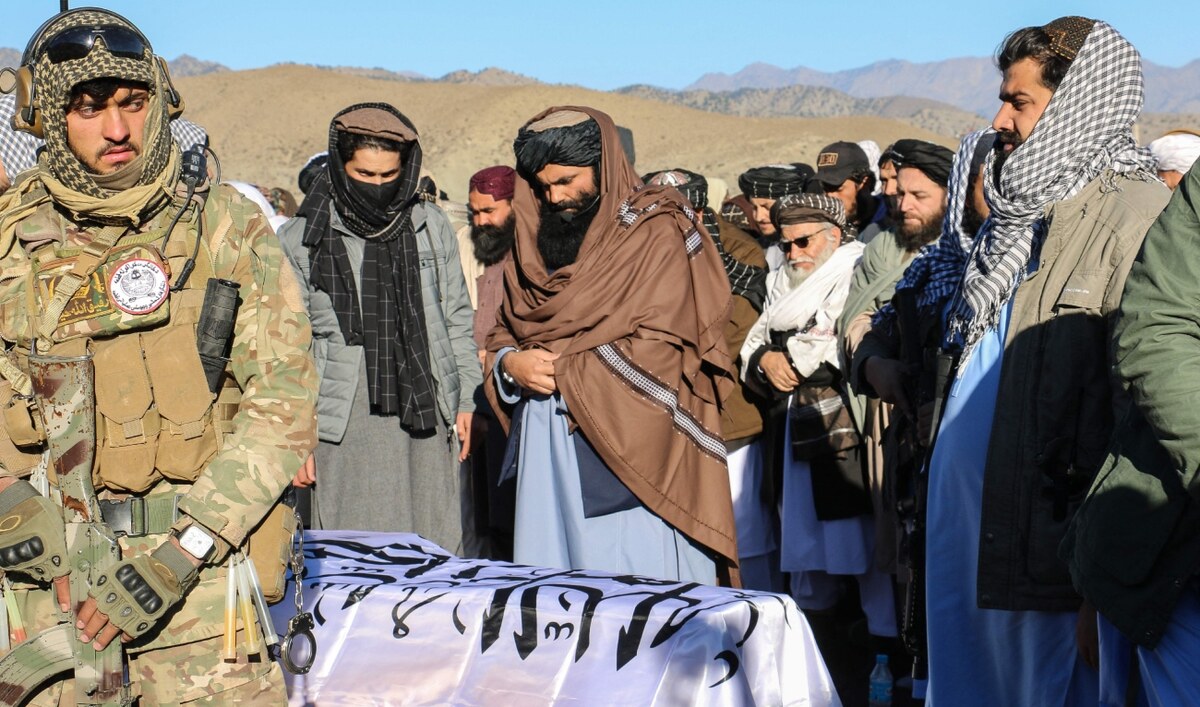


Sirajuddin Haqqani (C), the Taliban interior minister, attends the funeral ceremony of Khalil Ur-Rahman Haqqani, the Minister for Refugees and Repatriation, in Sarana of Paktia province, south of Kabul, on December 12, 2024. (AFP)

In September, the Taliban authorities said Daesh had training camps in Balochistan province of Pakistan, which also regularly faces attacks.

Haqqani, the highest ranked member of the Taliban government to be killed in an attack since their return to power, “was a big loss for us, the system and the nation,” said Paktia resident Hedayatullah, 22.

“May God protect our other leaders and keep them victorious.”

“Our leader... who had his life brutally taken away, achieved martyrdom,” said Bostan, 53, haranguing the “cowardly attack” that killed Haqqani.

The United Nations mission in Afghanistan condemned the attack on Thursday, offering condolences to the victims’ families.

“There can be no place for terrorism in the quest for stability,” the UN Assistance Mission in Afghanistan (UNAMA) said on X.

The European Union and the Organization of Islamic Cooperation also condemned the attack, along with Qatar, Saudi Arabia, Pakistan and Iran.

Haqqani — who is on US and UN sanctions lists and never appeared without an automatic weapon in his hand — was the brother of Jalaluddin Haqqani, founder of the feared Haqqani network responsible for some of the most violent attacks during the Taliban’s two-decade insurgency.

The Daesh group claimed responsibility for the attack, saying a bomber detonated an explosive vest inside the ministry, according to a statement on its Amaq news agency, as translated by the SITE Intelligence Group.

Taliban authorities had already blamed Daesh for the “cowardly attack” — the first targeting a minister since the Taliban returned to power in 2021.

Violence has waned in Afghanistan since the Taliban forces took over the country that year, ending their war against US-led NATO coalition forces.

However, the regional chapter of Daesh is active in Afghanistan and has regularly targeted civilians, foreigners and Taliban officials with gun and bomb attacks.


Thousands estimated to flee Cambodia scam centers after crackdown

Updated 6 sec ago
Follow

Thousands estimated to flee Cambodia scam centers after crackdown

  • Hundreds of thousands have been forced to work in online scam hubs across parts of Southeast Asia
  • New wave of releases come after Cambodian Prime Minister Hun Manet pledged fresh crackdown

JAKARTA: Thousands of people are estimated to have been released from scam compounds across Cambodia over recent days, including more than 1,400 Indonesian nationals, who according to Indonesia’s Embassy in Phnom Penh have sought consular support to return home.

The online scam industry has flourished across parts of Southeast Asia in recent years, with hundreds of thousands of people forced to work in illicit operations in countries like Cambodia, Myanmar and Laos, according to a 2023 report by the UN Office of the High Commissioner for Human Rights.

A wave of foreign nationals released from scam centers in Cambodia have been seeking assistance from their embassies since last week, after Prime Minister Hun Manet pledged a fresh crackdown on the multibillion-dollar industry.

Jakarta’s mission in Phnom Penh said it has received reports from 1,440 Indonesian nationals since Friday.

“The number is quite huge, considering the Indonesian Embassy handled a total of 5,008 cases throughout 2025. Looking at the ongoing trend of law enforcement by local authorities, we expect that the flow of Indonesian nationals (seeking our assistance) will continue for some time,” the Indonesian Embassy said in a statement issued on Wednesday.

In an earlier release, the embassy said that some Indonesians traveled from provinces like Banteay Meanchey and Mondulkiri to reach the Cambodian capital, which would take them at least five hours by car.

“Following the arrest of a number of main perpetrators in various cities, many syndicate networks then disbanded and let their workers leave,” it said, while urging Indonesians to be more cautious.

“Don’t be easily tempted by unrealistic job offers abroad, promising high salaries with minimal requirements. Don’t get involved in online fraud operations abroad.”

Many trafficked foreign nationals were employed to run “romance” and cryptocurrency scams, often recruited to deceive strangers online into transferring large amounts of money.

Large queues of Chinese nationals have also been spotted in front of the Chinese Embassy in Phnom Penh this week, while Amnesty International has pointed to recent footage showing “the mass release and escape attempts from scamming compounds” across Cambodia.

In a statement issued on Friday, Amnesty said it had geolocated 15 videos and images, and reviewed social media posts that show people leaving, or having already left, multiple locations that have been confirmed as scamming compounds or identified as suspected sites for fraud operations.

“There are no official figures on the total number of scamming compounds in Cambodia, but for an Amnesty International investigation, our team visited 52 of 53 identified scamming compounds in 16 cities … a single scamming compound can employ thousands of workers,” Amnesty International Indonesia spokesperson Haeril Halim told Arab News.

He added that “many human rights violations” were found in the scamming compounds Amnesty investigated, including human trafficking, torture and other ill-treatment, forced labor, child labor, deprivation of liberty and slavery.

The recent releases of foreign nationals came after Chen Zhi, a Chinese-born Cambodian tycoon, was arrested and extradited to China earlier this month.

Chen was sanctioned by the UK and the US in October last year, with the US Department of Treasury accusing him of running “a transnational criminal empire through online investment scams targeting Americans and others worldwide.”

Estimates from the UN Office on Drugs and Crime show that scam victims worldwide lost between $18 billion and $37 billion in 2023.