Panama asks Trump to maintain US aid for deporting migrants

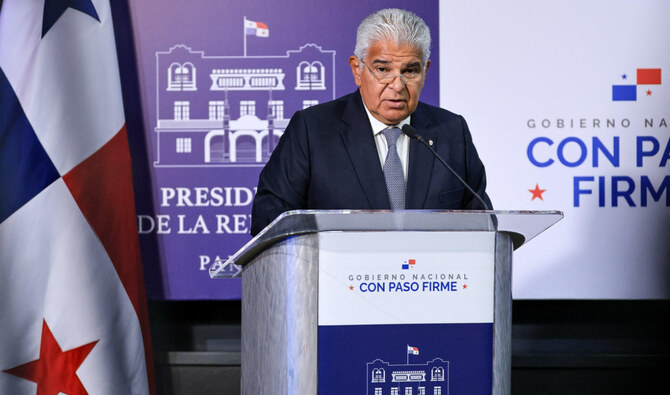
This handout picture released by the Panamanian Presidency shows President Jose Raul Mulino speaking during a press conference at the Las Garzas government palace in Panama City, on December 12, 2024. (AFP)
Short Url
Updated 13 December 2024
Follow

Panama asks Trump to maintain US aid for deporting migrants

PANAMA CITY: Panama’s president appealed to US President-elect Donald Trump on Thursday to maintain the aid Washington gives his central American country for deporting US-bound migrants.
The United States has contributed $1 million toward the cost of deporting over 1,000 migrants who tried to cross the Darien jungle from Colombia into Panama since July.
“I believe it must be maintained under the Trump administration,” said the right-wing Jose Raul Mulino, who was elected in May on a promise to end the migrant transit through Panama.
His government has organized some 30 deportation flights to Colombia, Ecuador and India.
Mulino has not however deported Venezuelans — who account for the bulk of the migrants crossing the jungle — because Panamanian planes have been barred from landing in Venezuela.
Caracas instituted the ban on Panama and several other Latin American countries after they criticized Venezuelan President Nicolas Maduro’s claim to have won re-election.
The Darien jungle is a key route for the smuggling of South American migrants trying to reach the United States through Central America.
In 2023, more than half a million migrants braved fast-flowing rivers, wild animals and criminal gangs as they crossed the jungle.
So far this year, nearly 300,000 people have crossed the Darien, 41 percent less than in the same period of 2023, a decrease which Mulino attributed partly to the deportation flights.
Trump has threatened to carry out the largest deportation of migrants in US history when he becomes president on January 20.
His transition team has reportedly drawn up a list of countries, including Panama, to which it wants to deport undocumented migrants when their home countries refuse to take them back.
But Panama has stressed it will only take back its own citizens.


Boys recount ‘torment’ at hands of armed rebels in DR Congo

Updated 2 sec ago
Follow

Boys recount ‘torment’ at hands of armed rebels in DR Congo

BUNIA: Forcibly recruited into a rebel militia affiliated with the Daesh group, two boys revealed the “torment” of living in its camps as members committed massacres in the Democratic Republic of Congo’s northeast.
The two minors freed from the Allied Democratic Forces (ADF) gave AFP an unprecedented account of the shadowy group, notorious for its extreme brutality.
Paluku, a frail 12-year-old, spent two months with the ADF after rebels killed his mother during an attack on his village in eastern North Kivu province. His brother and sister were also captured.
Edouard, 17, spent a gruelling four years with the ADF — formed by Ugandan rebels who took refuge in DRC — after he was kidnapped at age 12.
The two boys, using pseudonyms, spoke on condition of anonymity at a center specializing in the care of minors recruited by armed groups in the region, whose location AFP has chosen not to disclose to avoid potential reprisals.
Their accounts were confirmed by health and security sources.
Round-faced Edouard, a fast-talker, did not mince his words in describing his years of “torment” within the ADF.
“We suffered terribly,” he said.
After their capture, Edouard and Paluku were sent to ADF bases hidden in the dense forest of northeast DRC where the elusive rebels avoid patrols by the Congolese army and Ugandan forces deployed there since 2021.
The bases consist of simple tents and tarps, easy to move in the event of an attack.
Most occupants are women and children, according to security sources, contributing to the group’s operations — but also serving as human shields.
New recruits are swiftly forced to convert to Islam and learn Arabic, but also English and Swahili, Edouard said.
“I was also trained in medicine to treat the wounded, and we learned how to handle weapons and clean them,” he said.
Paluku said he underwent similar training, as well as learning how to “steal food, clothing and medicine to bring back to the ADF camp.”

- Floggings -

Children play a central role in supplying the group, security sources said. Those who fail to bring back loot face severe punishment.
The wives of the ADF commanders, some of whom are particularly influential, also exercise power over the young recruits.
When the fighters go out on “operations,” the youngest among them like Paluku, were “supposed to bring something back for the chief’s wife,” he said, like soap, cooking oil or fabric.
“To get it we have to loot people’s belongings, and if a chief’s wife accuses you to her husband of not bringing back what she asked for, she can demand that you be killed,” he said.
Edouard and Paluku said they were subjected to incessant corporal punishment.
Girls and boys were whipped or thrown into pits for several weeks over the slightest misbehavior.
“I was punished with lashes because I refused to go kill people,” Paluku said with a long stare.
Edouard took part in combat with the group at least three times against the Congolese army or local militias.
“They beat us mostly when we lost our weapons and ammunition, claiming we had wasted them for nothing or lost them on the front,” he explained.
Faced with such an accusation, Edouard said a chief ordered that he be whipped.
“I fell ill because of those lashes. I told the chief outright I was no longer able to go fight on the front, I begged him to send others who were capable, but that made him even more angry, and I was whipped once again,” he said.

- Trauma -

About 10 children freed from the ADF arrive on average each month at the reception center in the troubled northeast Ituri province.
“These children have suffered psychological trauma and torture, and when they arrive here, most are aggressive,” said Madeleine, a psychologist at the center.
After a few weeks spent around other children and staff, their aggression fades, she said.
But there are other scars to contend with.
Edouard became addicted to drugs administered by the rebels after he was wounded in combat.
Suffering from speech disorders, he talks constantly and sometimes incoherently, disturbing other residents, Madeleine said.
After a year at the center receiving ongoing treatment, Edouard recounted the horrors of his experience with a shy smile and a lively, excitable gaze.
Paluku meanwhile had a darker expression, recalling his sister who remains a hostage.
“She has become the wife of one of the ADF chiefs,” he said.