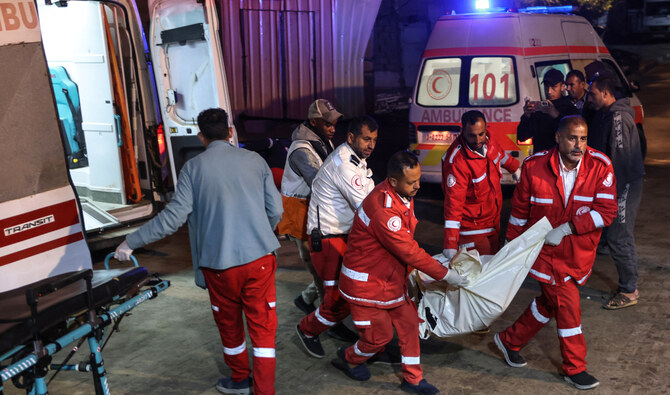
GAZA STRIP: Gaza’s civil defense agency said a series of Israeli air strikes on Thursday killed at least 58 people, including 12 guards securing aid trucks, while the military said it targeted militants planning to hijack the vehicles.
The latest bloodshed came despite growing optimism that negotiations for a ceasefire and hostage release deal might finally succeed, with US National Security Adviser Jake Sullivan saying on Thursday that the regional “context” had changed in favor of an agreement.
Seven guards were killed in a strike in Rafah, in southern Gaza, while another attack left five guards dead in nearby Khan Yunis, agency spokesman Mahmud Basal said.
“The (Israeli) occupation once again targeted those securing the aid trucks,” Basal told AFP, though the military said it “does not strike humanitarian aid trucks.”
Basal added that around 30 people, most of them children, were wounded in the two strikes.
“The trucks carrying flour were on their way to UNRWA warehouses,” Basal noted, referring to the United Nations agency for Palestinian refugees.
Witnesses later told AFP that residents looted flour from the trucks after the strikes.
The military said its forces “conducted precise strikes” overnight on armed Hamas militants present in an Israeli-designated humanitarian zone in southern Gaza.
“All of the terrorists that were eliminated were members of Hamas and planned to violently hijack humanitarian aid trucks and transfer them to Hamas in support of continuing terrorist activity,” a military statement said.
The United Nations and aid agencies have repeatedly warned about the acute humanitarian crisis in the besieged Gaza Strip, exacerbated by the war that has persisted for more than 14 months.
“Conditions for people across the Gaza Strip are appalling and apocalyptic,” UNRWA spokeswoman Louise Wateridge told journalists during a visit to Nuseirat in central Gaza.
She added that life-saving aid to “besieged areas in north Gaza governorate has been largely blocked” since the Israeli military launched a sweeping assault there in early October.
In southern Gaza, UNRWA said earlier this week it had successfully delivered enough food aid for 200,000 people.
But on Thursday it said “a serious incident” meant that only one truck out of a convoy of 70 traveling along Gaza’s southern border reached its destination.
The agency did not provide any details on the incident, but called on “all parties to ensure safe, unimpeded and uninterrupted” aid deliveries.
As diplomacy aimed at ending the war appeared to be gaining pace again, the violence continued.
The civil defense agency said Israeli air strikes on two homes, near Nuseirat refugee camp — which was again hit later in the evening — and Gaza City killed 21 people.
Fifteen people, at least six of them children, died “as a result of an Israeli bombing” of a building sheltering displaced people near Nuseirat, Bassal said.
Bassam Al-Habash, a relative of the dead in Nuseirat said: “These people are innocent, they are not wanted. They have nothing to do with the war.”
“They are civilians, and this is not a war between two armies, but a war armed with weapons, planes and Western support against a defenseless people who own nothing.”
Another strike late on Thursday killed at least 25 people and wounded 50 others in the Nuseirat refugee camp, the civil defense said.
In the latest diplomatic effort to secure an end to the violence, the UN General Assembly adopted a resolution on Wednesday calling for an immediate and unconditional ceasefire.
The non-binding resolution was rejected by the United States, Israel’s main military backer.
However, in recent days, there have been indications that previously stalled ceasefire negotiations could be revived.
Families of the 96 hostages still in Gaza since the Hamas attack that triggered the war, including 34 the Israeli military says are dead, are pressing for their release.
US National Security Adviser Jake Sullivan, who visited Israel on Thursday and met with Prime Minister Benjamin Netanyahu, said he “got the sense” that the Israeli leader was “ready to do a deal.”
He also said that the Hamas approach to negotiations had changed, attributing it to the overthrow of their ally Bashar Assad in Syria and the ceasefire that went into effect in the war between Israel and another ally, Lebanese group Hezbollah.
Militants abducted 251 hostages during the October 7, 2023 attack on Israel, which killed 1,208 people, mostly civilians, according to an AFP tally based on official figures.
This count includes hostages who died or were killed while held in Gaza.
Israel’s retaliatory offensive has killed at least 44,805 people in Gaza, a majority of them civilians, according to figures from the Hamas-run territory’s health ministry that the United Nations considers reliable.


![]()

Gaza rescuers say Israeli strikes kill 58, hit flour trucks
Short Url
https://arab.news/8zygx
Gaza rescuers say Israeli strikes kill 58, hit flour trucks
- Around 30 people, most of them children, were wounded in the two strikes


Latest updates


© 2026 SAUDI RESEARCH & PUBLISHING COMPANY, All Rights Reserved And subject to Terms of Use Agreement.