Pakistan welcomes UNGA resolution demanding Gaza ceasefire, unrestricted aid access

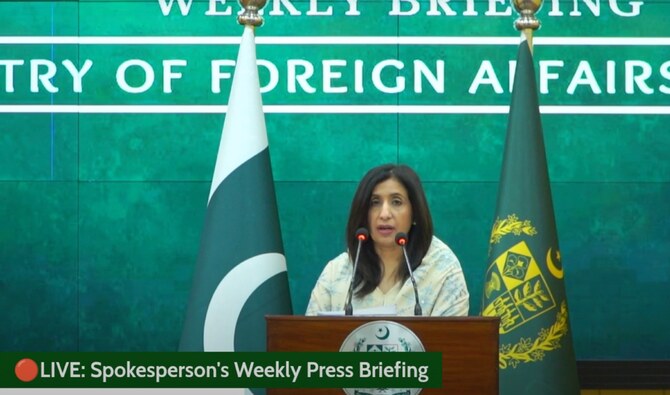
The screengrab taken from the video posted by Pakistan's foreign office on December 12, 2024, shows foreign office spokesperson Mumtaz Zahra Baloch addressing a weekly press briefing in Islamabad, Pakistan. (ForeignOfficePk/YouTube)
Short Url
Updated 12 December 2024
Follow

Pakistan welcomes UNGA resolution demanding Gaza ceasefire, unrestricted aid access

  • Ongoing Israeli military campaign in Gaza has killed over 44,000 people, injured thousands more since Oct 7, 2023 
  • UN-backed assessment last month warned famine was looming in northern Gaza due to a near-halt in food aid

ISLAMABAD: Pakistan on Thursday welcomed a United Nations General Assembly resolution demanding an immediate, unconditional and permanent ceasefire between Israel and Palestinian group Hamas in the Gaza Strip and unrestricted access for the UN Relief and Works Agency (UNRWA) to deliver aid.

The ongoing Israeli military campaign in Gaza has killed more than 44,000 people and injured thousands more since Oct 7, 2023 attacks by Hamas in which Israel says 1,200 people were killed and 250 taken hostage. 

Israel’s 13-month military campaign has displaced an estimated 1.9 million Palestinians, many of them multiple times. Bombings, movement restrictions and evacuations ordered by Israel’s military block access to health care and keep aid workers from reaching people in need, with aid organizations and charities repeatedly warning of crisis-level hunger affecting nearly two million people.

A UN-backed assessment last month warned famine was looming in northern Gaza due to a near-halt in food aid. Essential goods such as water, fresh produce, and medicines are also scarce.

“Pakistan welcomes the UNGA resolution of yesterday demanding an immediate and unconditional ceasefire in Gaza and removal of restrictions against UNRWA in its aid operations in the Gaza Strip and the West Bank,” Foreign Office Spokesperson Mumtaz Zahra Baloch said at a weekly briefing on Thursday.

She called for the immediate “cessation of hostilities” in Palestine, an end to Israel’s “genocide,” protection of civilians and infrastructure, humanitarian access for the needy, and full support for UNRWA’s health care activities.

“We also urge the international community to hold Israel accountable for its war crimes and crimes against humanity in occupied territories,” Baloch added.

Since the beginning of Israel’s war on Gaza, Pakistan has repeatedly raised the issue at the UN, the Organization of Islamic Cooperation and other multilateral platforms, demanding international powers and bodies stop Israeli military actions in Gaza.

Pakistan has dispatched a total of 1,273 tons of relief items to the war-affected people of Gaza until Nov. 27, according to the National Disaster Management Authority.

The South Asian nation does not recognize nor have diplomatic relations with Israel and calls for an independent Palestinian state based on “internationally agreed parameters” and the pre-1967 borders with Al-Quds Al-Sharif as its capital.


Rating firm S&P says it won’t rush Iran war downgrades, sees risks for countries like Pakistan

Updated 12 March 2026
Follow

Rating firm S&P says it won’t rush Iran war downgrades, sees risks for countries like Pakistan

  • Agency says it is monitoring indebted energy importers as higher oil prices strain finances
  • Gulf economies seen better placed to weather shock, though Bahrain flagged as vulnerable

LONDON: S&P Global ‌said it would not make any knee-jerk sovereign rating cuts following the outbreak of war in the ​Middle East, but warned on Thursday that soaring oil and gas prices were putting a number of already cash-strapped countries at risk.

The firm’s top analysts said in a webinar that the conflict, which has involved US and Israeli strikes ‌against Iran and Iranian ‌strikes against Israel, ​US ‌bases ⁠and Gulf ​states, ⁠was now moving from a low- to moderate-risk scenario.

Most Gulf countries had enough fiscal buffers, however, to weather the crisis for a while, with more lowly rated Bahrain the only clear exception.

Qatar’s banking sector could ⁠also struggle if there were significant ‌deposit outflows in ‌reaction to the conflict, although there ​was no evidence ‌of such strains at the moment, they ‌said.

“We don’t want to jump the gun and just say things are bad,” S&P’s head global sovereign analyst, Roberto Sifon-Arevalo, said.

The longer the crisis ‌was prolonged, though, “the more difficult it is going to be,” he ⁠added.

Sifon-Arevalo ⁠said Asia was the second-most exposed region, due to many of its countries being significant Gulf oil and gas importers.

India, Thailand and Indonesia have relatively lower reserves of oil, while the region also had already heavily indebted countries such as Pakistan, Bangladesh and Sri Lanka whose finances would be further hurt by rising energy prices.

“We ​are closely monitoring ​these (countries) to see how the credit stories evolve,” Sifon-Arevalo said.