UN General Assembly calls for ‘unconditional’ ceasefire in Gaza

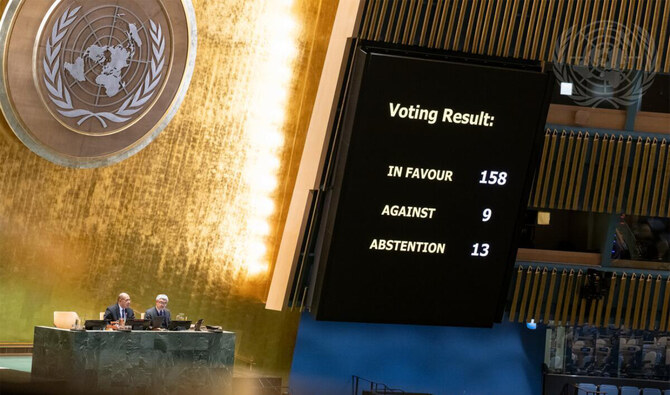
(UN Photo/Manuel Elías)
Short Url
Updated 12 December 2024
Follow

UN General Assembly calls for ‘unconditional’ ceasefire in Gaza

  • The resolution, a symbolic gesture, was rejected by the United States and Israel
  • Palestinian militant group Hamas said on Thursday it welcomed a UN General Assembly vote

UNITED NATIONS: The UN General Assembly on Wednesday overwhelmingly adopted a resolution calling for an immediate and unconditional ceasefire in Gaza, a symbolic gesture rejected by the United States and Israel.

The resolution — adopted by a vote of 158-9, with 13 abstentions — urges “an immediate, unconditional and permanent ceasefire,” and “the immediate and unconditional release of all hostages” — wording similar to a text vetoed by Washington in the Security Council last month.

At that time, Washington used its veto power on the Council — as it has before — to protect its ally Israel, which has been at war with Hamas in the Gaza Strip since the Palestinian militant group’s October 7, 2023 attack on Israel.

It has insisted on the idea of making a ceasefire conditional on the release of all hostages in Gaza, saying otherwise that Hamas has no incentive to free those in captivity.

Palestinian militant group Hamas said on Thursday it welcomed a UN General Assembly vote.

Hamas said in a statement it “welcomes the adoption (on Wednesday) of the UN General Assembly resolution, supported by 158 countries, demanding a ceasefire in Gaza, enabling civilians in the (Gaza) Strip to have immediate access to essential services and humanitarian aid.”

Deputy US Ambassador Robert Wood repeated that position Wednesday, saying it would be “shameful and wrong” to adopt the text.

Ahead of the vote, Israel’s UN envoy Danny Danon said: “The resolutions before the assembly today are beyond logic. (...) The vote today is not a vote for compassion. It is a vote for complicity.”

The General Assembly often finds itself taking up measures that cannot get through the Security Council, which has been largely paralyzed on hot-button issues such as Gaza and Ukraine due to internal politics, and this time is no different.

The resolution, which is non-binding, demands “immediate access” to widespread humanitarian aid for the citizens of Gaza, especially in the besieged north of the territory.

Dozens of representatives of UN member states addressed the Assembly before the vote to offer their support to the Palestinians.

“Gaza doesn’t exist anymore. It is destroyed,” said Slovenia’s UN envoy Samuel Zbogar. “History is the harshest critic of inaction.”

That criticism was echoed by Algeria’s deputy UN ambassador Nacim Gaouaoui, who said: “The price of silence and failure in the face of the Palestinian tragedy is a very heavy price, and it will be heavier tomorrow.”

Hamas’s October 2023 attack on southern Israel resulted in the deaths of 1,208 people, mostly civilians, according to an AFP tally based on official figures. That count includes hostages who died or were killed while being held in Gaza.

Militants abducted 251 hostages, 96 of whom remain in Gaza, including 34 the Israeli military says are dead.

Israel’s retaliatory offensive in Gaza has killed at least 44,805 people, a majority of them civilians, according to data from the Hamas-run health ministry that is considered reliable by the United Nations.

“Gaza today is the bleeding heart of Palestine,” Palestinian UN Ambassador Riyad Mansour said last week during the first day of debate in the Assembly’s special session on the issue.

“The images of our children burning in tents, with no food in their bellies and no hopes and no horizon for the future, and after having endured pain and loss for more than a year, should haunt the conscience of the world and prompt action to end this nightmare,” he said, calling for an end to the “impunity.”

The Gaza resolution calls on UN Secretary-General Antonio Guterres to present “proposals on how the United Nations could help to advance accountability” by using existing mechanisms or creating new ones based on past experience.

The Assembly, for example, created an international mechanism to gather evidence of crimes committed in Syria starting from the outbreak of civil war in 2011.

A second resolution calling on Israel to respect the mandate of the UN agency supporting Palestinian refugees (UNRWA) and allow it to continue its operations was passed Wednesday by a vote of 159-9 with 11 abstentions.

Israel has voted to ban the organization starting January 28, after accusing some UNRWA employees of taking part in Hamas’s devastating attack.


Washington presses Syria to shift from Chinese telecom systems

Updated 26 February 2026
Follow

Washington presses Syria to shift from Chinese telecom systems

  • Syria is exploring the possibility of procuring Chinese technology
  • It was unclear whether the United States ⁠pledged financial or logistical support to Syria to do so

DAMASCUS: The United States has warned Syria against relying on Chinese technology in its telecommunications sector, arguing it conflicts with US interests and threatens US national security, according to three sources familiar with the matter.
The message was conveyed during an unreported meeting between a US State Department team and Syrian Communications Minister Abdulsalam Haykal in San Francisco on Tuesday. Washington has been coordinating closely with Damascus since 2024, when Syria’s now President Ahmed Al-Sharaa ousted longtime leader Bashar Assad, who had a strategic partnership with China.
Syria is exploring the possibility of procuring Chinese technology to support its telecommunications towers and the infrastructure of local Internet service providers, according to a Syrian businessman involved in the procurement talks.
“The US side asked for clarity on the ministry’s plans regarding Chinese telecom equipment,” said ⁠another source briefed on ⁠the talks.
But Syrian officials said infrastructure development projects were time-critical and that Damascus was seeking greater vendor diversity, the source added.
SYRIAN OFFICIALS CITE US EXPORT CONTROLS AS TELECOMS BARRIER
Syria is open to partnering with US firms but the matter was urgent and export controls and “over-compliance” remained an issue, according to person familiar with the meeting in San Francisco.
A US diplomat familiar with the discussions told Reuters that the US State Department “clearly urged Syrians to use American technology or technology from allied countries in the telecoms sector.”
It was unclear whether the United States ⁠pledged financial or logistical support to Syria to do so.
Responding to Reuters questions, a US State Department spokesperson said: “We urge countries to prioritize national security and privacy over lower-priced equipment and services in all critical infrastructure procurement. If it seems too good to be true, it probably is.”
The spokesperson added that Chinese intelligence and security services “can legally compel Chinese citizens and companies to share sensitive data or grant unauthorized access to their customers’ systems” and promises by Chinese companies to protect customers’ privacy were “entirely inconsistent with China’s own laws and well-established practices.”
China has repeatedly rejected allegations of it using technology for spying purposes.
The Syrian Ministry of telecommunications told Reuters any decisions related to equipment and infrastructure are made “in accordance with national technical and security standards, ensuring data protection and service continuity.”
The ministry said it is also prioritizing the diversification of partnerships and technology sources to ⁠serve the national interest.
Syria’s telecom ⁠infrastructure has relied heavily on Chinese technology due to US sanctions imposed on successive Assad governments over the civil war that grew from a crackdown on anti-government protests in 2011.
Huawei technology accounts for more than 50 percent of the infrastructure of Syriatel and MTN, the country’s only telecom operators, according to a senior source at one of the companies and documents reviewed by Reuters. Huawei did not immediately respond to a request for comment.
Syria is seeking to develop its private telecommunications sector, devastated by 14 years of war, by attracting foreign investment.
In early February, Saudi Arabia’s largest telecom operator, STC, announced it would invest $800 million to “strengthen telecommunications infrastructure and connect Syria regionally and internationally through a fiber-optic network extending over 4,500 kilometers.”
The ministry of telecommunications says that US restrictions “hinder the availability of many American technologies and services in the Syrian market,” emphasizing that it welcomes expanding cooperation with US companies when these restrictions are lifted.
Syria has inadequate telecommunications infrastructure, with network coverage weak outside city centers and connection speeds in many areas barely exceeding a few kilobits per second.